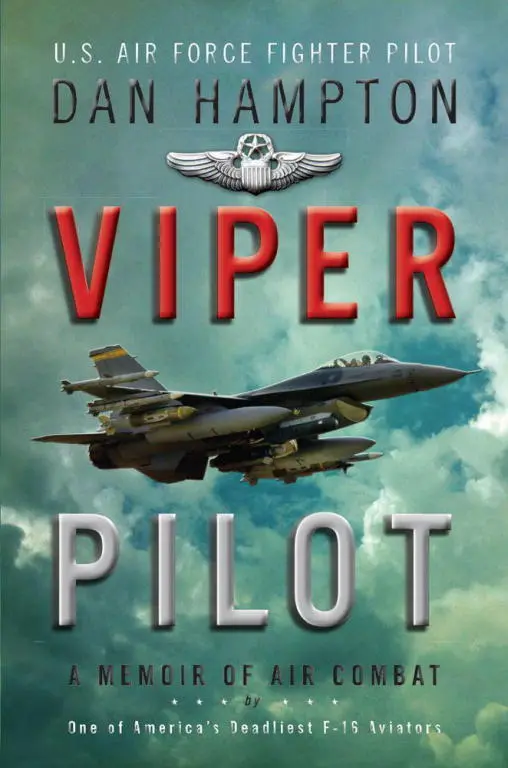
Dan Hampton - Viper Pilot
Здесь есть возможность читать онлайн «Dan Hampton - Viper Pilot» весь текст электронной книги совершенно бесплатно (целиком полную версию без сокращений). В некоторых случаях можно слушать аудио, скачать через торрент в формате fb2 и присутствует краткое содержание. Город: New York, Год выпуска: 2012, ISBN: 2012, Издательство: William Morrow, Жанр: Биографии и Мемуары, nonf_military, на английском языке. Описание произведения, (предисловие) а так же отзывы посетителей доступны на портале библиотеки ЛибКат.
- Название:Viper Pilot
- Автор:
- Издательство:William Morrow
- Жанр:
- Год:2012
- Город:New York
- ISBN:978-0-06-213035-8
- Рейтинг книги:4 / 5. Голосов: 1
-
Избранное:Добавить в избранное
- Отзывы:
-
Ваша оценка:
Viper Pilot: краткое содержание, описание и аннотация
Предлагаем к чтению аннотацию, описание, краткое содержание или предисловие (зависит от того, что написал сам автор книги «Viper Pilot»). Если вы не нашли необходимую информацию о книге — напишите в комментариях, мы постараемся отыскать её.
is the electrifying memoir of one of the most decorated F-16 pilots in American history: U.S. Air Force Lieutenant Colonel Dan Hampton, who served for twenty years, flying missions in the Iraq War, the Kosovo conflict, and the first Gulf War.
Both a rare look into the elite world of fighter pilots and a thrilling first-person account of contemporary air combat,
soars—a true story of courage, skill, and commitment that will thrill U.S. Special Forces buffs, aviation and military history aficionados, and fans of the novels of Tom Clancy and Dale Brown.
Viper Pilot — читать онлайн бесплатно полную книгу (весь текст) целиком
Ниже представлен текст книги, разбитый по страницам. Система сохранения места последней прочитанной страницы, позволяет с удобством читать онлайн бесплатно книгу «Viper Pilot», без необходимости каждый раз заново искать на чём Вы остановились. Поставьте закладку, и сможете в любой момент перейти на страницу, на которой закончили чтение.
Интервал:
Закладка:
Then it happened.
“WHUMP… WHUMP… WHUMP.”
Sonofabitch. As we rolled out again, I saw that he’d blown the gear down with the Alternate Gear Handle. This was an emergency system only to be used when the wheels wouldn’t lower any other way. Doing it now could cause all sorts of problems. In fact, as I took the jet to land, my main hydraulic system failed.
Language was always an issue. Another day, in another D-model two-seater, I was trying to teach a kid how to land. The Egyptians conducted all their RTU-type training in their line squadrons, something we would never do. This was another Russian idea that didn’t work but they insisted on it anyway.
This particular pilot, named Moshen, had also come from MiG-21s and was doing his best to kill us both every time we came around to land. There’s a position in the overhead pattern, called the “Perch.” This occurs when you’re abeam the end of the runway about a half-mile away, and you begin to turn to final. In a fighter, this means dropping the nose and flying the jet around in a descending arc, so you roll out on a one-mile final. Every time is different, and you simply play the stick, throttle, and your eyes to make it happen. It’s a Zen thing.
This kid didn’t have it. He’d dive for the end of the runway with no concept of speed, distance, or death. Our conversation went like this.
“Moshen… pull your nose up.”
“Sir?”
“Pull the nose up… see the men on the ground running away? That’s bad.”
“Sir?”
“I got the jet.”
And I’d recover control, go around, and we’d have our three-language discussion. He’d swear he understood and I’d give him control back.
“Pull the nose up.”
“Sir?”
“Pull your nose up… we’re too steep and we’re going to die.”
“Sir?”
“Look at the fucking ground, Moshen!” I exploded in Arabic.
“Can’t see the ground, sir!”
“What?”
“Can’t see ground. My nose is up!”
And my mouth dropped open. Looking around the ejection seat, I saw him sitting with his head all the way back, staring up through the top of the canopy. I saved us again and discovered that every time I’d told him to pull his nose up, he did exactly that. He just hadn’t understood I was talking about the aircraft nose… not his nose.
Some days it didn’t pay to get out of bed.
LIVING IN EGYPT AND TRAVELING THROUGH THE REGION GAVE me insights into how some Arabs think and act. The sweeping generalizations made against them were as inaccurate as those about Americans. Finding any member of the U.S. military who knew much about Arabs was a rarity in 1992. Sure, we’d won the Gulf War, but after careers spent training for World War III, most military folks, myself included, sat back afterward and said, “What the Hell was that all about?” Iraq hadn’t directly threatened the U.S., after all.
I’d fought some Arabs, trained a few, made personal friends and at least one personal enemy among them. There is much to admire about the Arabs and their culture. For instance, my Egyptian friends were always watching American television to improve their English (fat chance) and learn about us. One day, one of them asked me about a show he’d seen, regarding nursing homes. He remarked, “How sad that these old people have no family to care for them.” I told him that many did have families but that they lived in homes to receive proper care. This shocked him and he just couldn’t grasp the notion that families wouldn’t care for their own.
On the other hand, I watched a platoon of Egyptian tanks (American-made M-1 Abrams) level a village that had supposedly sheltered insurgents. They pulled up, gave the villagers thirty minutes to leave, and smoked a few cigarettes. At the end of the half-hour, they simply rolled over the mud-brick houses and flattened them.
Understanding them a little, living within their world, and flying with them was a tremendous advantage. However, this would cause me some problems later in my career. There were lots of guys, especially among the general officers and the up-and-coming batch of lieutenant colonels, who’d all missed the Gulf War. They’d been off on staffs or in one of the Professional Military Education (a true oxymoron) courses, and hadn’t fought anybody. These officers were still fighting the Soviet Union in their minds, and were slow to change with the times. But an officer who could quote Sun Tzu and knew about OODA loops was, well, vital. Right?
Right.
That’s how a guy who wrote speeches for a general ended up commanding a fighter squadron. It’s also how a C-130 transport pilot wound up in charge of the entire U.S. Air Force.
Another obstacle was simply entrenched military doctrine. Decades had been spent creating, packaging, and making careers out of fighting the Soviet Union and its puppets. No one had been thinking of Iraqis or Afghans as a threat, because no one cared. Fundamentalist extremists like al-Qaeda and the Taliban weren’t on anyone’s radar yet. They weren’t a threat to the big military and so they weren’t considered—though they should’ve been. As the Arab proverb says, “A fly in a man’s mouth won’t kill him but it will make him vomit.” I’d seen the entrenched hatred of America even in our Egyptian allies, and if some of them felt that way then trouble from Iraq, Iran, and others couldn’t be far behind.
Several months after the Great Hijacking, I was thrilled to get orders back to the United States. I’d been away for more than four years and was ready to come home. The exotic life of an expatriate is great, but I wanted a Sonic double hamburger. I wanted to listen to people talk and not translate it in my head. I wanted to see brainless American television and go to the Home Depot on Saturday morning to buy flowers I’d never plant. I wanted to walk into a Safeway at three A.M. because it was open and I could.
I wanted to come home.
5
Patchwearer
FIGHTER SQUADRONS, LIKE ALL ELITE GROUPS, EACH HAVE their own personality. Same profession, same jets, same types of people; and yet every one is unique. Some of our active units, like the 27th and 94th Fighter Squadrons, have lengthy pedigrees going back to the dawn of air combat during World War I. Many others were created amidst the huge expansion of military aviation during World War II. In 1941, there were barely a hundred up-to-date fighters in the U.S. inventory. By mid-1944, the Army Air Corps (the predecessor of the modern Air Force) owned eighty thousand combat aircraft.
The structure, from the top down, works like this. The modern Air Force contains nine Major Commands (MAJCOMs), grouped by location and mission. Three of these are fighter commands and the others are for bombers, transports, training, and logistics. I don’t count the Space Command—sorry. Incidentally, this ongoing money pit has a bigger slice of the 2012 Air Force budget than Air Superiority and Special Operations combined. Air Combat Command (ACC) is for fighter wings based in the continental United States; Pacific Air Forces (PACAF) for units in Asia or the Pacific; and U.S. Air Forces in Europe (USAFE) is for Africa and Europe. Pilots can and do rotate between all of these. It’s a great way to see the world, learn languages, and live life.
MAJCOMs are composed of Numbered Air Forces (NAF) responsible for a geographic region. Ninth Air Force, for example, is made up of five fighter wings based in Virginia, both Carolinas, Georgia, and Florida. A wing is commanded by a very senior full colonel or a brigadier general and functions like a small town. There are married and bachelor housing areas of different quality, depending upon one’s rank. Fire and police stations, a commissary for food, and a military-style Walmart called a base exchange. Fitness centers, pools, a church, and, of course, officer and enlisted clubs.
Читать дальшеИнтервал:
Закладка:
Похожие книги на «Viper Pilot»
Представляем Вашему вниманию похожие книги на «Viper Pilot» списком для выбора. Мы отобрали схожую по названию и смыслу литературу в надежде предоставить читателям больше вариантов отыскать новые, интересные, ещё непрочитанные произведения.










Обсуждение, отзывы о книге «Viper Pilot» и просто собственные мнения читателей. Оставьте ваши комментарии, напишите, что Вы думаете о произведении, его смысле или главных героях. Укажите что конкретно понравилось, а что нет, и почему Вы так считаете.