Hugh Mills - Low Level Hell
Здесь есть возможность читать онлайн «Hugh Mills - Low Level Hell» весь текст электронной книги совершенно бесплатно (целиком полную версию без сокращений). В некоторых случаях можно слушать аудио, скачать через торрент в формате fb2 и присутствует краткое содержание. Город: Novato, CA, Год выпуска: 2009, ISBN: 2009, Издательство: Presidio Press, Жанр: Биографии и Мемуары, military_history, на английском языке. Описание произведения, (предисловие) а так же отзывы посетителей доступны на портале библиотеки ЛибКат.
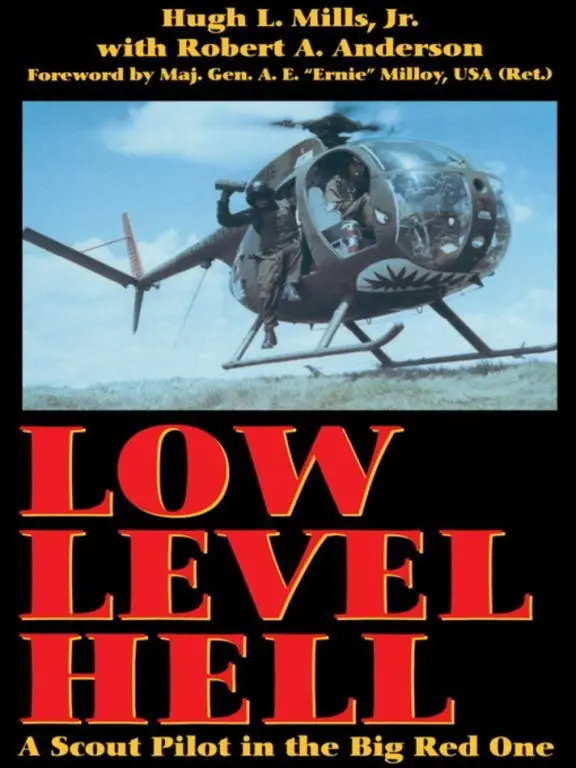
- Название:Low Level Hell
- Автор:
- Издательство:Presidio Press
- Жанр:
- Год:2009
- Город:Novato, CA
- ISBN:978-0-307-53792-8
- Рейтинг книги:4 / 5. Голосов: 1
-
Избранное:Добавить в избранное
- Отзывы:
-
Ваша оценка:
Low Level Hell: краткое содержание, описание и аннотация
Предлагаем к чтению аннотацию, описание, краткое содержание или предисловие (зависит от того, что написал сам автор книги «Low Level Hell»). Если вы не нашли необходимую информацию о книге — напишите в комментариях, мы постараемся отыскать её.
Low Level Hell — читать онлайн бесплатно полную книгу (весь текст) целиком
Ниже представлен текст книги, разбитый по страницам. Система сохранения места последней прочитанной страницы, позволяет с удобством читать онлайн бесплатно книгу «Low Level Hell», без необходимости каждый раз заново искать на чём Вы остановились. Поставьте закладку, и сможете в любой момент перейти на страницу, на которой закончили чтение.
Интервал:
Закладка:
Four Six radioed that information back to Phu Loi ops and was again told that he should move in and make contact with the enemy, to fix them in place. If necessary, additional forces would be brought in to support the twenty-eight ARPs already on the ground.
With that order understood, Harris pressed the platoon on into the woods, fully expecting to begin receiving fire at any moment. But, strangely enough, no enemy fire came.
Four Six radioed his point men again. “Why aren’t we getting shot at? What’s it look like up there?”
Of course, Harris knew that Gratton couldn’t see much through the dense vegetation. No one in the formation could see more than a few inches in any direction. There was no way to detect enemy positions or firing lanes. Daylight itself was almost shut off by the thick growth of the stifling jungle foliage.
Without realizing it, Harris’s ARPs had pressed about halfway into the enemy base camp. Charlie was sitting in his bunkers all the way around the ARP formation—waiting, watching, allowing the whole platoon to enter the lair before slamming shut the ambush door. Harris’s men, though properly deployed and proceeding with all the skill and jungle savvy at their command, didn’t have the slightest tip-off that they were already amidst the cunningly camouflaged enemy bunkers.
Suddenly, Harris’s riflemen were deep enough into the trap. With a sharp staccato, AK-47 rounds abruptly tore into the column. Enemy fire came from their front and both flanks. Everybody hit the ground, but nobody knew where to shoot back because of the density of the jungle and total inability to see an enemy target.
It took only a moment to discover that any movement among the ARPs drew fire. Obviously the enemy could see.
Realizing that there was no way to attack an enemy he couldn’t see, Harris concerned himself with finding cover and getting his men out of the killing zone. Most of the unit was right next to a bomb crater left by a 750- or 1,000-pound bomb from one of our B-52 raids. It looked like the only cover available. Rolling into the crater with his RTO, Harris contacted the other elements of his unit and told them to do the same.
It was then that he learned that both of his point men, Gratton and Mitchell, were down. They had been caught by the first eruption of enemy fire. It was impossible to tell if they were OK, wounded, or dead. Suddenly, in a lull in the withering fire, Harris could hear Mitchell cry out, then moan.
Harris immediately ordered his left flanking element to crawl forward and try to get to Gratton and Mitchell. But as soon as the effort began, enemy fire opened up on the men, pinning them to the jungle floor.
Lieutenant Harris then radioed his flanking element on the right side, “Left flank is pinned. We think Mitchell on the point is wounded. See if you can crawl up there slowly; try to either recover Mitchell or lay down a base of fire that will allow Gratton to recover him.”
With Pfc. August Hamilton on the point, the right flanking element started to advance. They had crawled forward only a couple of feet when VC fire opened up on them. One of the enemy rounds went cleanly through the front of Hamilton’s helmet and struck him squarely in the forehead.
Seeing Hamilton hit, the man crawling right behind him grabbed his legs and pulled him back out of the line of fire. Harris then learned that his right flank couldn’t move forward either. They couldn’t see who was shooting at them, so they couldn’t effectively return the fire.
Now knowing that Hamilton was badly hit, Four Six ordered his right flank element to get the wounded man back to the cover of the bomb crater, where the medic could take a look at him.
Private First Class Hamilton was pulled, pushed, lifted, and finally lowered into the cover of the crater. Doc told Four Six that the man was losing blood fast. The supply of blood expander wouldn’t last long, and more blood would be needed very soon or Hamilton would die.
During these initial tactical problems on the ground, Bob Calloway in the scout ship above was completely dumbfounded by the situation. There wasn’t a thing he could do to help.
He couldn’t call in his Cobra to shoot up the bunkers because the ARPs were caught right in the middle of the base camp complex. He couldn’t call in an artillery strike to blast the place with heavy high-explosive rounds for the same reason.
All Calloway could do was fly circles over the contact point and provide information to his Cobra, who, in turn, relayed it back to troop ops. It wasn’t long before Calloway had to give up even that because of intense fire from the bunkers below. He either had to vacate the area or risk getting himself shot out of the sky.
By this time, I was in my hootch talking aeroscout tactics with Jim Bruton. I had stopped monitoring the radios when I left the ship on the ramp, and I had no idea how the ARP mission was going in the western Trap.
As Bruton and I talked, the hootch door burst open and a runner from operations came in. “Lieutenant Mills, sir, it’s coming over the radio that Four Six is in heavy contact with the enemy south of the Michelin. You’d better get over to the operations bunker right away.”
Rushing into the bunker, I was just in time to hear Bob Calloway’s Cobra pilot come up on VHF to ops saying, “The ARPs are pinned down. They’re separated into at least two or three groups and the vegetation on the ground is so dense that Four Six is unable to tell where all his people are. They’re all trapped in a bomb crater and every time anybody sticks his head out, he gets shot at.”
The ops officer questioned back, “What about casualties?”
Cobra answered, “Four Six doesn’t know about his point men, since he can’t see them and he can’t get anybody up to them. They were caught in the first blast of gook fire. He does have one man, however, who has been hit in the head with an AK round. He’s in the crater and bleeding badly.”
Standing there listening to those radio reports, I thought immediately of the many times I had been on ground missions with Bob Harris and his ARPs. I had gone with them as often as I could to sharpen my scouting skills. Those experiences had helped tremendously my understanding of the ARP’s world. I had found out right away that an aeroscout on the ground is totally out of his element.
In the air, the wind roared through the cockpit, making lots of noise and blowing the heat away. Also, you could see what was happening for several hundred yards in every direction.
On the ground, there was silence. The ARPs gave and received their instructions by hand and arm signals. Nobody talked unless the situation demanded it, and then only in quick, terse, all-business words. The heat was searing. Bodies were soaked with sweat and the beads ran down in their eyes—burning, blurring, and drawing swirling insects. Everybody carried at least two canteens of water on a mission, and guarded every drop.
But the most frustrating disadvantage of being on the ground was that you couldn’t see anything and had no idea what was going on around you. The grass, the jungle closed in on you like opaque walls. The infantryman was lucky if he could see three feet in any direction. It was the unseen enemy that posed the greatest threat to the ground soldiers’ good health and peace of mind.
So, standing there listening in the ops room, I had more than a minimal understanding of the mess Harris’s platoon was in. I leaned in close to the radio speakers and hung on each word coming through.
The ops officer continued talking with the Cobra. “What help do you need up there? What help can we give you?”
The frustration in the Cobra pilot’s voice showed. “I can’t roll in with rocks because the ARPs are pinned right in the middle of the base camp. The scout door gunner has shot selectively but fears hitting friendlies. I got a Dustoff up here in the area to evac the head wound, but Four Six doesn’t want to risk the Huey hovering in, knowing that it would make an irresistible target for the unfriendlies. You better get another hunter-killer team up here though. One Zero needs gas. Better roll Scramble 1.”
Читать дальшеИнтервал:
Закладка:
Похожие книги на «Low Level Hell»
Представляем Вашему вниманию похожие книги на «Low Level Hell» списком для выбора. Мы отобрали схожую по названию и смыслу литературу в надежде предоставить читателям больше вариантов отыскать новые, интересные, ещё непрочитанные произведения.











Обсуждение, отзывы о книге «Low Level Hell» и просто собственные мнения читателей. Оставьте ваши комментарии, напишите, что Вы думаете о произведении, его смысле или главных героях. Укажите что конкретно понравилось, а что нет, и почему Вы так считаете.