Hugh Mills - Low Level Hell
Здесь есть возможность читать онлайн «Hugh Mills - Low Level Hell» весь текст электронной книги совершенно бесплатно (целиком полную версию без сокращений). В некоторых случаях можно слушать аудио, скачать через торрент в формате fb2 и присутствует краткое содержание. Город: Novato, CA, Год выпуска: 2009, ISBN: 2009, Издательство: Presidio Press, Жанр: Биографии и Мемуары, military_history, на английском языке. Описание произведения, (предисловие) а так же отзывы посетителей доступны на портале библиотеки ЛибКат.
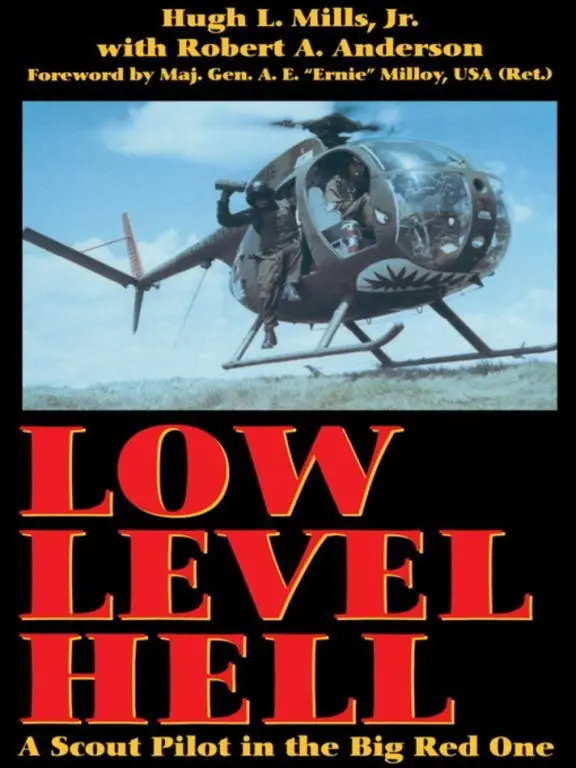
- Название:Low Level Hell
- Автор:
- Издательство:Presidio Press
- Жанр:
- Год:2009
- Город:Novato, CA
- ISBN:978-0-307-53792-8
- Рейтинг книги:4 / 5. Голосов: 1
-
Избранное:Добавить в избранное
- Отзывы:
-
Ваша оценка:
Low Level Hell: краткое содержание, описание и аннотация
Предлагаем к чтению аннотацию, описание, краткое содержание или предисловие (зависит от того, что написал сам автор книги «Low Level Hell»). Если вы не нашли необходимую информацию о книге — напишите в комментариях, мы постараемся отыскать её.
Low Level Hell — читать онлайн бесплатно полную книгу (весь текст) целиком
Ниже представлен текст книги, разбитый по страницам. Система сохранения места последней прочитанной страницы, позволяет с удобством читать онлайн бесплатно книгу «Low Level Hell», без необходимости каждый раз заново искать на чём Вы остановились. Поставьте закладку, и сможете в любой момент перейти на страницу, на которой закончили чтение.
Интервал:
Закладка:
Following this well-beaten trail off to the northwest, I soon spotted their hastily dug mass graves back in the jungle, and the location of the seventy-five recoilless and .50 caliber that covered their main attack. The guns weren’t there now, though; they had been dragged away, too.
The fresh, heavy foot trails through the jungle definitely headed back toward the Michelin. Charlie was probably holed up there by now, licking his wounds.
As I made my orbits, I kept up a constant stream of talk to Sinor on what I was seeing. His front-seater logged it on the map and radioed the information to the infantry ground commander and back to troop operations.
This was the first time I had seen the results of a large unit action, of the enemy coming in after us. The U.S. forces were hunkered down behind the fortifications of their fire support base, which was totally out in the open with no jungle overhead cover whatsoever. The enemy—possibly a unit of the 7th NVA Division’s 165th Infantry Regiment, known to be operating in the vicinity of the Michelin rubber plantation—was probably attempting to execute what we called a “hugging” tactic, that is, trying to overpower an installation by quickly charging their soldiers in so close under the artillery that our heavy fire-power was nullified by the extremely short range.
But to no avail at Gela. Caught in the cleared, open area between the fire base outer wire and the jungle tree line, the enemy was pounded by our mortar, artillery canister rounds, and aerial ordnance. The bare earth outside the wire had been pulverized by hundreds, if not thousands, of projectiles, then scorched by napalm from the tac air, and by Phougas drums of jellied gasoline half-buried in defensive positions around the perimeter and pointed to explode liquid fire onto incoming attackers. The enemy bodies beyond the wire looked like ripped and burned rag dolls. Many had made it as far as the wire before being caught in the deadly defensive small-arms fire generated from within the fire base.
God, what a battle! I thought over and over to myself.
Official afteraction reports listed three U.S. soldiers killed in the attack, twenty wounded, and forty-one enemy killed. But forty-one bodies were all the enemy left to be counted; as my observation had confirmed, scores of their dead and wounded had been dragged from the field and left hastily buried just a few yards into the jungle.
I have often heard it said that an aviator fights an impersonal war, that he never sees, hears, or smells the close-up reality of the battlefield. But on 13 May 1969, looking down into that pit of death and devastation at Gela, Crockett and I knew the reality of war.
CHAPTER 7
WHERE IS ONE FIVE?
By May 1969, division G-2 estimated enemy strength in the 1st Division area at ten thousand personnel, with another four thousand people providing logistical support for the field troops.
Our picture of the enemy was getting clearer. With more experience, the scouts could now tell who and what we had found on the ground. We could, for instance, identify the NVA troops, generally natives of North Vietnam, members of the legally constituted, trained, and equipped people’s army of the North Vietnamese government. Outfitted in his green and tan fatigue uniform, including thick-soled boots, Soviet web gear, and Russian-designed weapons, the NVA soldier was a professional—well-equipped, trained, and disciplined. His basic weapon was the Soviet Kalashnikov AK-47 assault rifle, though many were armed with either the RPG-7 or RPG-2 portable rocket launcher. He was a worthy foe on the battlefield.
The Viet Cong guerrillas, on the other hand, were generally natives of South Vietnam but not sympathetic to the government of the Republic of Vietnam. Their loyalty was to the national liberation movement of South Vietnam, and to the NVA who had come from the north to help them in their cause.
Though many times thought of as wandering guerrilla bands, the VC, in reality, were highly organized in their military resistance efforts. Main force VC units in the 1st Division area included combat outfits such as the Dong Nai Regiment, Song Be Battalion, and the SR-4 (strategic region) battalions of the Thu Due Regiment. In addition, they had their own artillery units, such as the 74th and 96th artillery regiments, along with K33, K34, and K35 arty battalions.
Instead of the highly militarized uniforms of the NVA, the VC normally wore dark blue or jet black pajama tops and bottoms. Sometimes the pants would be to the ankle, but black shorts were common. Unless he had come across a pair of U.S. jungle boots, VC always wore Ho Chi Minh sandals, cut out of vehicle tires.
Many wore scarfs fashioned from strips of camouflage parachute cloth. Larger pieces of this same cloth were tied around the neck and used as capes. The scarf served to hide the head and face and keep away insects; the cape provided excellent camouflage as the guerrilla moved through the terrain. When a VC ran, the cape flapped out behind him like a banner.
The things needed to sustain a VC in the field were mostly carried on his back: generally a lightweight sleeping bag around his shoulders, web pouch or bandolier of ammo across his chest, and a roll of rice around his neck. He carried an AK-47 assault rifle, sometimes a Russian 7.62mm SKS (Simonov) carbine. On occasion, it was an American M-16 scavenged from the field, as well as a supply of U.S. hand grenades.
The main force VC were nearly on a par with NVA regulars in their fighting capability. They were well-organized, employed good tactics, had excellent weapons, and were tenacious as hell.
As an aviator, I noticed one difference between the NVA and VC that held true in most instances. That was in fire control. In scouting over an enemy contact area, if I began to catch ground fire from a considerable distance, it was a probable assumption that I had jumped VC troops. If the fire opened up right under me, you could take odds that the shooters were NVA soldiers. The more battlewise NVA regulars didn’t expose their positions as readily, and realized that waiting to shoot meant a better chance at knocking the low, slow-flying scout ship out of the sky.
The lowest organized component of VC combat troops was the local force unit. The main forces were organized to regimental strength; the smaller VC local force units generally did not exceed platoon and company-sized elements. Though these small units were numbered (C-61 Company, D-368, K-10), many times they were identified by the name of the village or area from which the people manning the unit came, for example, the Ben Cat Company or the An Loc Platoon.
The men and women making up these local forces could be seen around their villages one day doing their jobs; the next day they would be gone, having disappeared to join their VC units for some guerrilla operation. When the mission was accomplished, they’d return as quietly and discreetly as they had left.
The local force VC most often carried older weapons. Being at the bottom of the supply distribution schedule, they had to use whatever weapons were available to them. This included old French MAT-49 submachine guns, U.S. BARs (Browning automatic rifles), Thompson submachine guns, and .30-caliber M-l carbines.
It was very difficult to tell any of the Vietnamese soldiers apart, and nearly impossible to determine individual political persuasions. Only our Kit Carson scouts could positively tell the good guys from the bad.
The NVA and the VC lived the same way in the field. They ate their rice and fish and built bunkers in their areas of operations. Bunkers were important for storing supplies, providing overhead cover, and establishing field bases from which to operate.
As aerial scouts, we were always on the lookout for cooking fires, especially early in the morning when Charlie might be boiling his rice and fish for breakfast. We also looked for their fish traps in the many rivers and tributaries. There was generally someone around to tend the traps, and you could be pretty sure that the “someone” was Charlie.
Читать дальшеИнтервал:
Закладка:
Похожие книги на «Low Level Hell»
Представляем Вашему вниманию похожие книги на «Low Level Hell» списком для выбора. Мы отобрали схожую по названию и смыслу литературу в надежде предоставить читателям больше вариантов отыскать новые, интересные, ещё непрочитанные произведения.












Обсуждение, отзывы о книге «Low Level Hell» и просто собственные мнения читателей. Оставьте ваши комментарии, напишите, что Вы думаете о произведении, его смысле или главных героях. Укажите что конкретно понравилось, а что нет, и почему Вы так считаете.