Jason Elliot - The Network
Здесь есть возможность читать онлайн «Jason Elliot - The Network» весь текст электронной книги совершенно бесплатно (целиком полную версию без сокращений). В некоторых случаях можно слушать аудио, скачать через торрент в формате fb2 и присутствует краткое содержание. Жанр: Триллер, на английском языке. Описание произведения, (предисловие) а так же отзывы посетителей доступны на портале библиотеки ЛибКат.
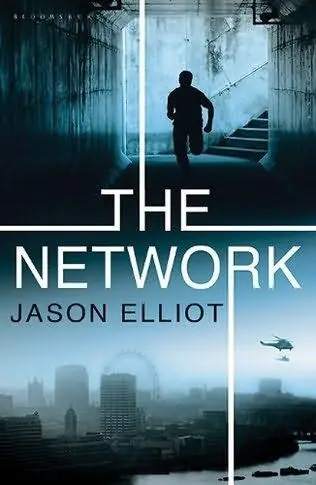
- Название:The Network
- Автор:
- Жанр:
- Год:неизвестен
- ISBN:нет данных
- Рейтинг книги:4 / 5. Голосов: 1
-
Избранное:Добавить в избранное
- Отзывы:
-
Ваша оценка:
The Network: краткое содержание, описание и аннотация
Предлагаем к чтению аннотацию, описание, краткое содержание или предисловие (зависит от того, что написал сам автор книги «The Network»). Если вы не нашли необходимую информацию о книге — напишите в комментариях, мы постараемся отыскать её.
The Network — читать онлайн бесплатно полную книгу (весь текст) целиком
Ниже представлен текст книги, разбитый по страницам. Система сохранения места последней прочитанной страницы, позволяет с удобством читать онлайн бесплатно книгу «The Network», без необходимости каждый раз заново искать на чём Вы остановились. Поставьте закладку, и сможете в любой момент перейти на страницу, на которой закончили чтение.
Интервал:
Закладка:
‘No end-user certificate required, I presume,’ he mutters charmingly as he hands it over, then asks if we’ll stay for lunch. Over the meal he briefs us informally on the situation in Afghanistan: the Taliban’s steady advance into Massoud’s shrinking stronghold in the north of the country and the stalemate in negotiations between the Americans and the Taliban on the ongoing issue of bin Laden.
‘Poor old Massoud,’ he murmurs, working his fork into a Yorkshire pudding. ‘Never met him, but one feels terribly for him all the same.’
On our way back I ask the driver on impulse to take us to the Qissa Khane bazaar, which I want H to see. For an hour we wander through the clamour and chaos of the narrowing streets of the Old City, where the memories of my first visit with Manny return to me in unexpected flashes. I seem to remember the very places where we drank glasses of greenish iced sugar crushed from the raw cane in front of us, and shared kebabs with wild-looking mujaheddin who told us our first real tales of war, and I remember too how we sensed the magnetic pull of the war just across the border, and both felt immortal.
Time still holds this place less tightly in its grasp than most. On the way back we see a little crowd that has gathered around an elderly Punjabi snake charmer. He wears an orange turban and plays a strange sonorous melody on a reed flute to a jaded cobra, which he taps on the back of its neck when it’s too tired to dance. It’s how the two of them make a living. The sight reminds me how quickly we’ve been transported into a different world with different rules and ways which most Westerners don’t even know exist, let alone really understand. I know, at least, that I don’t.
We call our contact the following day. He agrees to visit us for lunch. I’m not sure what kind of person I expect, but he isn’t it. At midday there’s a banging on the gate and the chowkidar admits a lightly built man pushing a bicycle with dusty woven saddlebags. He wears a flowing white shalwar kameez, waistcoat and a black karakul lambskin hat, beneath which his ears project prominently. It must be Hamid Karzai. I recognise him from the photograph that Grace has shown me in Washington.
‘Ah, Grace.’ He chuckles, propping his bike against the wall. He takes off his hat and sweeps a hand over the perspiring and almost smooth crown of his head. ‘She’s a real cowboy. When she came to Afghanistan they treated her like a man.’
He has a quick mind and a keen sense of humour, and H and I both like him from the start. He talks freely in almost perfect English, and our conversation moves rapidly over the burning issues. The situation, he says, has never been more dangerous. Massoud’s forces are hanging by a thread, and unless more help comes he’ll be unable to withstand the Taliban. With help, he’ll be able to survive until rebellions can be spread among Pashtun groups within the Taliban’s own heartland. It’s an ambitious plan, which prompts H to ask if the Taliban can really be defeated. The answer surprises us.
‘Nobody can defeat the Taliban militarily,’ says Karzai, shaking his head. ‘As long as Afghanistan exists, the Taliban will exist. They are the sons of Afghanistan and they will always have their place. But the Taliban are not one entity. They are like – what is the name of that Greek monster with all those heads? If you cut off one, another will take its place.’
‘A hydra.’
‘A hydra. But the Taliban can’t unify my country. They cannot repeat their earlier success.’
‘Success?’ asks H. ‘Do you call their kind of government a success?’
‘My friend,’ he says, ‘for a scorpion, even hot sand is a relief. We have to start where we are. The Taliban have their place in that. You cannot deny them their achievements. People who have not seen the conditions in the country cannot understand their popularity. But by bringing foreign fighters onto the Afghan earth they have done a thing which Afghans cannot forgive. People can see where they are taking our country. That is why we need friends, real friends, who can help to defeat them politically.’
‘Does that include America?’ I ask.
‘Of course,’ he says. ‘Why shouldn’t it? I don’t dislike America. But America is like the Taliban. It doesn’t have one head. Listen, my friends. I have talked to American diplomats here and in Islamabad. I have talked to the State Department in Washington. I have talked to the CIA and the military. Every one of them has a different idea about Afghanistan, but only America is powerful enough to help us.’ He sweeps his hand again over his head. ‘Their great weakness is to see the world in black and white. It’s always good guys and bad guys with them.’ He chuckles. ‘In meetings they always ask, “Is he a good guy or a bad guy?” They want it to be black and white. But nothing is black and white in Afghanistan. There are a thousand shades between black and white.’
I ask if he thinks that bin Laden will be handed over.
He sighs deeply. ‘Before, it was possible. Now, I doubt. After they tried to catch him, he is too cautious.’ I didn’t know anyone had tried to catch him, but thinking back to some of the things Grace alluded to back in Washington, it makes sense. Karzai raises an emphatic finger in the air. ‘Osama will bring big trouble to Afghanistan, I guarantee. Even though he himself is not the most powerful one. Make no mistake. This is an international war with international players.’
We move on from this dark thought to more immediate things. Karzai doesn’t know, or want to know, the operational details of our onward journey. But he sits with us over our maps and tells us in detail about the Taliban’s deployments and what we can expect in different places. He agrees that to drive to the south via Kandahar will invite too much attention and that our planned approach from the north will be safer.
‘Whatever you think of them,’ he says, ‘the Taliban are Afghans, and unless you do something very foolish they will treat you as their guests. But al-Qaeda is a different matter. They are trained to think that Westerners are the cause of all evil. If they suspect something, you will have difficulties.’
‘When you say difficulties,’ asks H, ‘what do you mean?’
‘I mean they will shoot you and your bodies will never be found. Fortunately for you the majority are in the south of the country and you are unlikely to meet them. God forbid it should be so.’
He agrees to send a message to our contact in Kabul to alert him to our arrival and advises caution in the matter of who we trust. When it’s time to give him the money that we have promised to deliver on Grace’s behalf, we hand over the shrink-wrapped bundles of cash, each one of which contains a hundred thousand dollars. He picks them up, stuffs them cheerfully into the saddlebags of his bicycle, wishes us good luck and pedals away.
‘He’s pretty switched on for a bike messenger,’ says H as we go back indoors.
Not many foreigners take the overland route into Afghanistan. We haven’t actually got permission to enter the tribal territories between Peshawar and the border, but it can take weeks to arrange and H wants to see the Khyber Pass, which is actually a dramatic series of switchbacks on the Pakistani side of the frontier. It’s an unforgettable way to get to Afghanistan and there isn’t anywhere quite like it. So at dawn two days later, after our visas come through with the help of the trust, we change into local clothes and head for the border with our driver.
From the tribal point of view, we’re already in Afghanistan. The British drew the frontier a hundred years ago, but it was never recognised by the Pashtuns who live along both sides of its thousand-mile length, and Afghans still like to joke that they in fact own much of Pakistan. It’s wild territory. There are Pakistani police checkpoints along the way, but you get the sense their power doesn’t reach much further than the distance they can swing their long bamboo truncheons. As we leave Peshawar behind, the mountains swell and the road begins to sway between their steepening flanks as we approach the pass that officially connects the two countries. Everything looks more dilapidated except the mountains, which rise steadily higher and magnify the feeling that you’re entering a different world, with different and harsher but simpler rules. Even the sky begins to clear as the dust of the plains falls away, and the air cools as it thins.
Читать дальшеИнтервал:
Закладка:
Похожие книги на «The Network»
Представляем Вашему вниманию похожие книги на «The Network» списком для выбора. Мы отобрали схожую по названию и смыслу литературу в надежде предоставить читателям больше вариантов отыскать новые, интересные, ещё непрочитанные произведения.




Обсуждение, отзывы о книге «The Network» и просто собственные мнения читателей. Оставьте ваши комментарии, напишите, что Вы думаете о произведении, его смысле или главных героях. Укажите что конкретно понравилось, а что нет, и почему Вы так считаете.