Jason Elliot - The Network
Здесь есть возможность читать онлайн «Jason Elliot - The Network» весь текст электронной книги совершенно бесплатно (целиком полную версию без сокращений). В некоторых случаях можно слушать аудио, скачать через торрент в формате fb2 и присутствует краткое содержание. Жанр: Триллер, на английском языке. Описание произведения, (предисловие) а так же отзывы посетителей доступны на портале библиотеки ЛибКат.
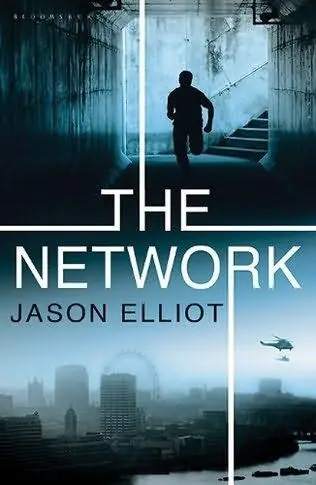
- Название:The Network
- Автор:
- Жанр:
- Год:неизвестен
- ISBN:нет данных
- Рейтинг книги:4 / 5. Голосов: 1
-
Избранное:Добавить в избранное
- Отзывы:
-
Ваша оценка:
The Network: краткое содержание, описание и аннотация
Предлагаем к чтению аннотацию, описание, краткое содержание или предисловие (зависит от того, что написал сам автор книги «The Network»). Если вы не нашли необходимую информацию о книге — напишите в комментариях, мы постараемся отыскать её.
The Network — читать онлайн бесплатно полную книгу (весь текст) целиком
Ниже представлен текст книги, разбитый по страницам. Система сохранения места последней прочитанной страницы, позволяет с удобством читать онлайн бесплатно книгу «The Network», без необходимости каждый раз заново искать на чём Вы остановились. Поставьте закладку, и сможете в любой момент перейти на страницу, на которой закончили чтение.
Интервал:
Закладка:
‘Shall we see how it goes?’ I ask H.
In Afghanistan cars sound as if they’re about to fall apart when you slam their doors. This one sounds as if we’ve just closed the hatch of a nuclear shelter. The engine starts first time and purrs. It’s done less than a thousand kilometres and is good for about another half-million. Mr Raouf drives ahead of us and heads back to the office, but I take the road to Kart-e Parwan and turn west around Aliabad hill. I have my reasons. As we reach the Deh Mazang crossroads by the zoo I turn onto the broad avenue that leads in a straight line to the presidential palace, nearly a mile away. The surface is scarred by shell and rocket blasts and the G weaves between the craters, handling magnificently.
It’s a surreal drive. We see the world through a greenish haze, silenced and deceptively harmless-looking, as if we’ve descended like aliens and are observing the life around us from a protective bubble. Some men on bicycles and the occasional taxi pass us in the opposite direction, but there’s no other traffic. Men haul at overloaded carts of timber and sacks, and ghost-like women in pale-blue burqas float past us as if carried on air.
I’ve never dared to visit this part of the city before because it was so vulnerable to attack and came under rocket fire almost daily when I was last in Kabul. The buildings on either side of the road are in a state of utter ruin. Floors, columns and lintels all sag and droop, held together only by the metal reinforcement inside them. Lesser structures are shattered and split and crumbling into the earth. There’s isn’t a square foot that hasn’t been riddled with gunfire. Sometimes we see the dark scar of a rocket blast that looks as if someone has thrown a bucket of paint against a wall, only it’s been caused by an explosion of white-hot metal.
We are in the centre of a capital city, but it looks more like one of the battlefields of the First World War. In the early 1990s the area was first devastated by Hekmatyar’s rockets, vast stockpiles of which were generously financed by American taxpayers and supplied by the CIA. Later it became the southern front of prolonged battles as the government’s rivals converged on the city from every direction except the north. They were fought off in a series of desperate counter-attacks organised by Massoud, whose exhausted forces were unable to counter the swift advance of the Taliban a year later.
Ahead, the palace looms. It’s a shell of a building now. The roof has been torn open in several places by rocket blasts, and resembles a botched attempt to open a tin can. The walls are saturated with bullet holes. I park nearby, and for a few minutes H and I wander around the deserted arcades of the lower floor, where kings and heads of state were once received and where our feet now crunch the fragments of its shattered walls.
Then we return to the G, circle the palace on a dusty track and drive north again along the equally devastated Jade-ye Maiwand, named after the battle in which the British 66th Foot were decisively defeated by Afghan forces in 1880. The Afghans were rallied, so the story goes, by a Pashtun woman called Malalai.
As we near the house, we round a final bend and nearly collide with an ageing Land Rover, whose occupants gawp at us with a look of horror. It’s the BBC’s official car, and I recognise the pale and scarved face of the Kabul correspondent. I’ve had a bit of a crush on her ever since she interviewed me years ago in Islamabad, when I was on my way home and Kabul was going to hell. I feel guilty at not stopping to say hello, but it’s better that H and I remain as invisible as possible. I don’t want a journalist to be able to position us in Kabul just before a rather large act of sabotage is committed.
Back at the guest house I park the G in the garage and put a new lock on the door.
‘Looks a bit like a hearse,’ says H, ‘but very impressive. Let’s look at the manual and check the consumption. We need to sort out how much fuel we need.’
You never quite know what a person has gone through in life to make him what he is. This is especially true in Afghanistan, where no one has escaped the effects of more than twenty years of war without some sort of scar. I don’t want to pry too much into this young man’s life, but he’s a sullen character and I wonder what’s made him that way.
He comes to the house after dusk but before curfew begins. I’d prefer him not to know where we’re staying, but H and I agree it’s a necessary risk, and it would somehow be a breach of Afghan protocol to show mistrust. He’s supposed to be our ally, after all. Sattar is a member of the tribal intelligence unit raised by the CIA. He’s the only one who can provide a link to Orpheus because he’s the one who made contact with him in Jalalabad and knows what he looks like, though he knows nothing of my connection with him.
‘You remember this man?’ I ask, showing him the photograph taken of Manny earlier in the year.
‘The foreigner,’ he says.
‘You can deliver him a message?’
‘Sure.’
‘How will you do it?’
‘I will just do it,’ he says. ‘It will take a few days.’
‘You speak good English, Sattar.’
‘I learned at University of Kabul.’
‘I thought the university was closed.’
‘It was open when I was there.’ He smiles but only with the lower part of his face.
I’m not entirely sure I believe him. I don’t know when the university was last teaching English, but I’ve never met an Afghan who made the same claim and was under fifty years old. I wonder whether his English wasn’t acquired from a spell with the Afghan secret police or the Pakistani ISI, the intelligence service on which the Americans rely too much. And I know it’s wrong to expect him to be cheerful so that he better fits my idea of how Afghans should be, but he noticeably lacks the friendliness and spontaneity of nearly every Afghan I’ve known, and the combination of these things amounts to a kind of private suspicion. It’s not such an odd feeling to have towards someone who you know is a spy.
We talk over the situation around the country and discuss the best route to take for the operation, though I don’t reveal the exact location of where we’re going. He suggests as a precaution that we travel via Bamiyan, where the Taliban have a regional headquarters and can give us a letter of safe passage through the area under their control. I can’t help suspecting that this might be the trap that is waiting to be set for us, but I thank him for the suggestion.
‘What is the message?’ he asks.
I take out a fifty-afghani banknote, almost worthless in itself.
‘Give him this note,’ I say, ‘and this one only. Tell him it comes from England.’
He looks at it with an expression of disappointment. He doesn’t know that I’ve made several tiny holes in the note with the point of a needle. There’s one in the centre of the note, over the engraving of the Darul Aman Palace, and several more over the serial numbers in the corners. It’s taken me a while to find a note which contains the right numbers, but I’ve got about a thousand of them.
If Manny gets the note and knows it’s from me, he’ll know that there’s a message contained in it somehow, and will examine it minutely for clues. He’ll find the pinprick that shows him I want to meet at the ruined Darul Aman Palace. Then he’ll look at the numbers and realise they represent the time, 1800, and the days of the week, indicated by the Persian initials for Monday and Tuesday. I space the holes so that even under inspection they’ll look as though they were made by a staple, and add Manny’s initials to garble the signal. Only he will recognise them and know to eliminate them from the message.
Читать дальшеИнтервал:
Закладка:
Похожие книги на «The Network»
Представляем Вашему вниманию похожие книги на «The Network» списком для выбора. Мы отобрали схожую по названию и смыслу литературу в надежде предоставить читателям больше вариантов отыскать новые, интересные, ещё непрочитанные произведения.






Обсуждение, отзывы о книге «The Network» и просто собственные мнения читателей. Оставьте ваши комментарии, напишите, что Вы думаете о произведении, его смысле или главных героях. Укажите что конкретно понравилось, а что нет, и почему Вы так считаете.