Jason Elliot - The Network
Здесь есть возможность читать онлайн «Jason Elliot - The Network» весь текст электронной книги совершенно бесплатно (целиком полную версию без сокращений). В некоторых случаях можно слушать аудио, скачать через торрент в формате fb2 и присутствует краткое содержание. Жанр: Триллер, на английском языке. Описание произведения, (предисловие) а так же отзывы посетителей доступны на портале библиотеки ЛибКат.
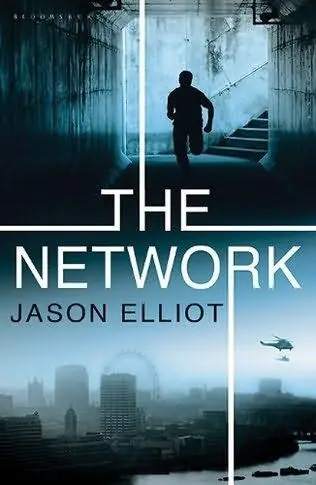
- Название:The Network
- Автор:
- Жанр:
- Год:неизвестен
- ISBN:нет данных
- Рейтинг книги:4 / 5. Голосов: 1
-
Избранное:Добавить в избранное
- Отзывы:
-
Ваша оценка:
The Network: краткое содержание, описание и аннотация
Предлагаем к чтению аннотацию, описание, краткое содержание или предисловие (зависит от того, что написал сам автор книги «The Network»). Если вы не нашли необходимую информацию о книге — напишите в комментариях, мы постараемся отыскать её.
The Network — читать онлайн бесплатно полную книгу (весь текст) целиком
Ниже представлен текст книги, разбитый по страницам. Система сохранения места последней прочитанной страницы, позволяет с удобством читать онлайн бесплатно книгу «The Network», без необходимости каждый раз заново искать на чём Вы остановились. Поставьте закладку, и сможете в любой момент перейти на страницу, на которой закончили чтение.
Интервал:
Закладка:
There’s a pause before he replies.
‘Yes.’ He purses his lips like someone who’s deciding from the look of the sky whether it’s going to rain. ‘Course we were.’
‘I need to know why.’
‘Perfectly normal precaution, and none of your business. How’d you find out anyway?’
‘I found out,’ I tell him, ‘because two armed Mokhabarat officers came to take my source away, and that wasn’t in the plan.’
‘Well.’ He muses again. ‘They are very much more efficient than they used to be. Get picked up at her place, did you?’
He’s already figured out the scenario.
‘It wasn’t very nice. One of them tried to stab me too.’
‘Is that why you’re limping? Have you had it looked at? Christ, we would have brought you home.’
‘You were running Hibiscus before I ever got to Khartoum. You set me up.’
‘Rubbish,’ he says dismissively. ‘Don’t be so melodramatic. Keeping an eye on her was just a safety net. Imagine it hadn’t been us. Imagine someone else had got her on their payroll. Ever occur to you? Rate you were going, you might have compromised the entire op. Anyway it’s not unusual. Makes the source feel special, like they’re doing something important. Secondly we get to compare what she says with what you tell us. Like matching up a couple of fingerprints. If there are any discrepancies we know something funny’s going on.’
‘Were there any discrepancies?’
‘As yet, no. I wasn’t expecting any, but that’s how we do things.’ His tone softens, and I recognise the gentle introduction of charm. ‘We also get to see how you handle your first cultivation. I, personally, was impressed with the way you handled Rome. Your meeting there is already bringing us some half-decent CX. I thought you should be given a chance with Hibiscus, but not everybody agreed with me. You haven’t exactly come through the right channels, but you could have a future with the Service, Ant.’
‘I don’t believe a word of what you’re saying.’
‘Excellent.’ He stops and turns to me. There’s a disarming grin on his face. ‘You’re showing the first signs of a competent Intelligence Branch officer. Wouldn’t it be better if I put that on your appraisal form rather than mention that you assaulted me with a weapon while I was on my way home?’
‘It’s not a weapon.’ I pull out the mobile from my pocket. ‘And I didn’t assault you.’
He sighs.
‘Come on,’ he says. ‘You’re upset. Let’s go to the Phat Phuk. Good Vietnamese scoff. It’s just up here.’ He searches my face for a signal of assent and, as he knows he eventually will, finds it.
True to his apparent concern, Seethrough does have my leg looked at. He arranges for a car to take me the next day to a surgeon in Wimpole Street, who’s unimpressed by my do-it-yourself repairs. A sour look comes over his face as he peers at my attempt at stitches through an illuminated magnifying glass. Then he deadens the leg with an injection and a stout serious-looking Polish girl fastens a surgical mask to his face. My ragged black stitches are pulled gently free from the enclosing skin and replaced with neat loops of biodegradable suture that doesn’t need removing. I lie on my stomach and feel nothing, thinking of the steady eyes of the guardian of the Mahdi’s shrine.
‘It feels much better when it’s done with anaesthetic,’ I tell the surgeon.
An hour later I’m limping to Regent’s Park and marvelling at its greenness. After the dust and desiccation of Khartoum, it’s so much easier to understand why the Islamic vision of paradise is a verdant place with running streams and fountains. I sit for a while on a bench beside the main avenue and watch people passing. They seem extraordinarily preoccupied and utterly unaware of the luxury of their surroundings.
Later I walk along the shady paths by the ponds and through the rose garden and back to the Outer Circle, where I’ve parked Gerhardt. I have not paid attention to the time and there’s a ticket on the windscreen. England is unreal to me again.
At home, nothing seems to have changed, although my private world has gone through indescribable tumult over the past few weeks. I mow the lawn and clear the pond of leaves, and count my fish to see if they’re all there. I write up a long report for Seethrough on everything that’s happened in Khartoum, and send it as an encrypted email via the Firm’s server.
I call Jameela at her home for three days in a row but there’s no answer. Then, on the fourth, she picks up. Her faint voice carries on it a flood of memories. She was released without harm after twelve hours. But I have a burning question.
‘Yes,’ she says, in answer to it, ‘it was real. All of it.’
‘What do we do now?’ I ask.
‘I don’t know.’ She weeps.
I don’t know either. I want to ask when we’ll see each other again, but the question sticks in my throat and the result is a long and agonising silence in which each impulse to speak is superseded by its opposite. Neither of us knows what to say. There is only a silent knowing which we both instinctively feel is undermined by words; it’s the very thing we detected in each other when we first met and which took us both by surprise with its intensity. Even at this distance from each other we are in its grasp again.
I call H too, and he invites me to his home to catch up. I drive there the following day. It’s sunny and H is in his garden on a ladder, picking caterpillars from the leaves on his rear porch.
‘They’re eating my wisteria,’ he says, ‘but I don’t like to kill the little buggers.’ I help him gather them up and put them in a box which he’s planning to empty in a neighbouring field.
He doesn’t like the look of my limp, so a long walk isn’t part of our plans.
‘Thought we could put in an hour’s target practice,’ he says. ‘Good for morale. We’ve got permission to use the drive-in range, so we don’t have to creep around any quarries.’
It’s not far. Eight miles from the bridge at Hereford we reach a village where there’s an ancient church with an illustrious history. I half expect to see a works access only sign of the kind that usually indicates a secret government facility, but there’s nothing of the kind. We turn off the main road opposite the church, and drive almost a mile along a country lane barely wide enough for two cars. At an unremarkable crossroads H turns along the way he knows. We pass a derelict-looking farm and suddenly there are high chain-link fences on both sides of the road, beyond which any view is obscured by thick twenty-foot-high deciduous hedges. Poking above them are some high-frequency antenna arrays resembling rotary washing lines, the kind used for long-range agent communication, but there’s not much else to betray a special forces training camp.
We turn in opposite a cluster of low buildings. H slows the car, puts his window down and waves to the man emerging from the security post, who smiles as he recognises him.
‘Alright, H-?’ calls a thick Scottish voice. ‘Nae seen you fra while.’
‘You know how it is,’ says H, and tells him we’ll be about an hour.
‘Nae grief, mate,’ comes the reply.
We pass a small car park with a fleet of scruffy identical vehicles which look as though they’re used for training. A helicopter with no registration markings sits in a neighbouring field. To our left, a quarter of a mile away, rises a wooded slope which H calls Gibbie’s Hill, where he fondly recalls catching wild eels to eat on an E amp; E exercise. We drive towards it across some innocent-looking open land, past some equally innocent-looking buildings, and then some slightly less innocent-looking ones. These, H says, are former ammunition storage facilities, protected by mounded blast-protecting revetment walls and once linked by rail when the site was used as a hideaway for government munitions. The Regiment calls them bunkers. H points out the bunker with the mocked-up interior of a house where he used to practise hostage rescue scenarios. One of the rooms contains a comfy sofa where, despite the bullet holes, H says he used to sleep when it got too late to go home.
Читать дальшеИнтервал:
Закладка:
Похожие книги на «The Network»
Представляем Вашему вниманию похожие книги на «The Network» списком для выбора. Мы отобрали схожую по названию и смыслу литературу в надежде предоставить читателям больше вариантов отыскать новые, интересные, ещё непрочитанные произведения.








Обсуждение, отзывы о книге «The Network» и просто собственные мнения читателей. Оставьте ваши комментарии, напишите, что Вы думаете о произведении, его смысле или главных героях. Укажите что конкретно понравилось, а что нет, и почему Вы так считаете.