Jason Elliot - The Network
Здесь есть возможность читать онлайн «Jason Elliot - The Network» весь текст электронной книги совершенно бесплатно (целиком полную версию без сокращений). В некоторых случаях можно слушать аудио, скачать через торрент в формате fb2 и присутствует краткое содержание. Жанр: Триллер, на английском языке. Описание произведения, (предисловие) а так же отзывы посетителей доступны на портале библиотеки ЛибКат.
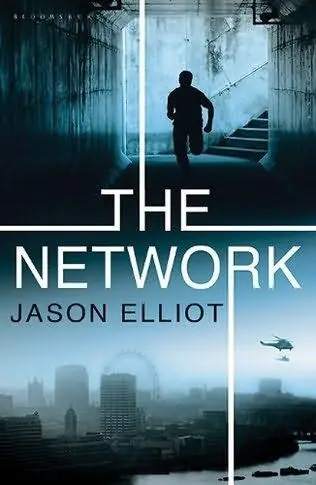
- Название:The Network
- Автор:
- Жанр:
- Год:неизвестен
- ISBN:нет данных
- Рейтинг книги:4 / 5. Голосов: 1
-
Избранное:Добавить в избранное
- Отзывы:
-
Ваша оценка:
The Network: краткое содержание, описание и аннотация
Предлагаем к чтению аннотацию, описание, краткое содержание или предисловие (зависит от того, что написал сам автор книги «The Network»). Если вы не нашли необходимую информацию о книге — напишите в комментариях, мы постараемся отыскать её.
The Network — читать онлайн бесплатно полную книгу (весь текст) целиком
Ниже представлен текст книги, разбитый по страницам. Система сохранения места последней прочитанной страницы, позволяет с удобством читать онлайн бесплатно книгу «The Network», без необходимости каждый раз заново искать на чём Вы остановились. Поставьте закладку, и сможете в любой момент перейти на страницу, на которой закончили чтение.
Интервал:
Закладка:
At the foot of the hill the road loops around and we pull up at the entrance to what at first looks like a small open-air stadium.
It’s a hundred and fifty feet square, with steep grassy banks on three sides, which rise to about thirty feet. The whole area is fenced off and guarded with a barrier on its open side, which faces south so that no one has to shoot into the sun. Vehicle drills of the kind we’ve earlier practised are carried out within the central enclosure, but H doesn’t want me to risk aggravating my leg, so we work on grouping and then snap shooting with the Brownings. Then, because H can’t resist the opportunity, we practise shooting from a moving vehicle, which is as noisy as it is exhilarating. And as he rightly suggests, good for morale.
We drive back in the afternoon. As we reach the village near his home I offer him a drink at his local. But he seldom goes there any more, he says. He used to when he first moved to the area years ago, he says, but that was before the SAS became such a big deal. He stopped going to the pub not long after the Prince’s Gate hostage rescue, when people who heard he was in the Regiment would treat him disturbingly, like a kind of god.
The thing I like about H is that he prefers to be invisible. I can’t really picture him, after all this is over, going public and giving lectures to the local British Legion in pubs around Hereford and Leominster. Nothing makes him stand out in either habit or appearance, unless you count the small knife that always hangs from the back of his belt or the length of opaque plastic that he carries in his wallet, which can be put to so many different uses.
The few Regiment men I’ve met all share this quality. They are the last ones you would identify as members of the most feared military unit in the world. They are all exceptionally fit, and exertion comes easily to them. They enjoy order and precision in physical tasks, and prefer action to theory, which makes them wary of pretence or self-importance and suspicious of men who wear moleskin trousers. They take solace in beauty of the kind not found in art galleries but in the mist that hovers over a bend in a river at dawn. They rarely smoke, but tend to drink more than most. Much more, in fact. They love the quiet life of the English country village until the next operation in a country that most of us have never heard of. It’s true they keep strange things in their garages, but they get points on their driving licences like anyone else.
So H cooks us an early dinner instead, and afterwards produces a bottle of whisky, which we broach in front of the fire that he lights in his living room. We get on to stories about people H has met who claim to be members of the Regiment. His favourite is the time he gets into conversation with a former soldier who’s just delivered a lecture to a gathering of security experts and claims to have been in the SAS for years. H invites him for a friendly drink, over which the man reveals, confidentially of course, that he’s a former member of the Regiment’s F Squadron. There’s no need, on this occasion, to make a call to the security cell at the Regimental HQ to check on him, because the SAS has never had an F Squadron.
Stories about the more stubborn Walter Mitty types sometimes reach Mars and Minerva, the Regiment’s newsletter. H finds me a copy. It’s mostly titbits of news and reunions. There’s a mention of the sophistication and expense of the security features incorporated in the double fence around the new camp at Credenhill. There are letters from former members and their wives, details of the Regimental Association’s benevolent fund, and obituaries. Members can even buy wine with the Regiment’s insignia on the label. It’s as interesting as a village parish magazine. Nothing could be further from the sensationalism of all the books with flaming daggers on their fronts, which now seem so absurd to me.
‘It’s weird,’ I say.
‘What’s weird?’
‘It’s just that in films when they have to train someone for a special op, they take him off to a huge underground secret base.’
‘You mean one with those doors that swish open like they do in Star Trek?’
‘Exactly. And a thing that X-rays you and scans your eyeball. You don’t see them saving caterpillars or sitting on the floor in somebody’s living room with a dog asleep on a chair.’
H looks affectionately at his terrier Jeffrey, who occupies the largest chair in the room, and tugs on his sleeping chin.
‘Welcome to the real world,’ he says.
On the way home, Gerhardt has difficulty pulling away from a crossroads, and I realise I’ve forgotten to top up the transmission fluid. I stop at a garage and it occurs to me, as I burn my hand on the cylinder head in the attempt to remove the transmission fluid dipstick, that it’s time to call in the favour from Gemayel before I leave.
It’s also time to see the Baroness. I arrange it in the usual way, but she’s not at the club and a note is waiting for me instead, indicating that I come to her home. I’m not expecting to be followed but take time for a careful dry-cleaning before reaching her front door. She buzzes me in. I feel my calf aching where the stitches have yet to heal as I walk up the stairs to the second floor.
The curtains are half-drawn as if she hasn’t had the strength to open them fully. She’s visibly more frail and I can’t help thinking that the end of an era is near. She uses a hand to steady herself against the furniture as she walks across the room, but stubbornly insists on preparing a pot of tea on her own and not letting me help.
I tell her about Khartoum, my illegal escape, and about my feelings for Jameela.
‘It does happen sometimes.’ She smiles. Her teacup tilts imperfectly on the saucer as she returns it. Then her expression grows more grave and I can tell she has something on her mind.
‘I have some news,’ she says. ‘It’s not what you would call good.’
I’m imagining it’s something personal, so it’s a shock when she refers to the operation we’re planning in Afghanistan.
‘It is only a whisper, but it’s been suggested that some parties would prefer the operation to fail.’
‘To fail? Who could want it to fail? Is this Macavity’s idea?’
She shakes her head and frowns.
‘Elsewhere. There’s no reason Macavity should know. The contrary.’ She lets out a wistful sigh. ‘Have you considered the possibility of the missiles being allowed to fall into the wrong hands in order to be turned against us? To permit such a catastrophe may even be desirable to some. Imagine,’ she smiles darkly, ‘a new crusade. It would reach across the world and drag on for a generation.’
‘That sounds dangerously like a conspiracy,’ I tell her.
‘What is coherent at a more organised level may be incomprehensible at a lesser one. If it is true, as I fear it may be, we must hope that the plan is uncovered along the way. The Network has always been a counterweight to the abuse of power, but it cannot change the weaknesses of human nature.’ She sighs again, then looks up at me. ‘You must be especially vigilant. When will you leave?’
‘Soon. In a week or so.’
‘Well,’ she sighs, ‘I have passed on what I could.’
I’m not certain what she’s referring to, but I sense that it’s more than simply the news she’s given me. It’s her habit to assign more than one meaning to the things she says, but now it’s as if a mask is dropping from her, and she’s preparing to relinquish the role she’s steadfastly played all these years. I have the feeling she knows that, before long, loneliness and infirmity will rob her of all the worldly authority and guile her character has accumulated over a lifetime, and that now she must relinquish it voluntarily, shedding herself of its burden to allow her life to at last become simple and unencumbered.
Читать дальшеИнтервал:
Закладка:
Похожие книги на «The Network»
Представляем Вашему вниманию похожие книги на «The Network» списком для выбора. Мы отобрали схожую по названию и смыслу литературу в надежде предоставить читателям больше вариантов отыскать новые, интересные, ещё непрочитанные произведения.












Обсуждение, отзывы о книге «The Network» и просто собственные мнения читателей. Оставьте ваши комментарии, напишите, что Вы думаете о произведении, его смысле или главных героях. Укажите что конкретно понравилось, а что нет, и почему Вы так считаете.