Jason Elliot - The Network
Здесь есть возможность читать онлайн «Jason Elliot - The Network» весь текст электронной книги совершенно бесплатно (целиком полную версию без сокращений). В некоторых случаях можно слушать аудио, скачать через торрент в формате fb2 и присутствует краткое содержание. Жанр: Триллер, на английском языке. Описание произведения, (предисловие) а так же отзывы посетителей доступны на портале библиотеки ЛибКат.
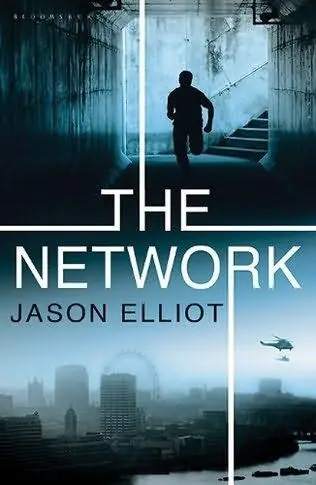
- Название:The Network
- Автор:
- Жанр:
- Год:неизвестен
- ISBN:нет данных
- Рейтинг книги:4 / 5. Голосов: 1
-
Избранное:Добавить в избранное
- Отзывы:
-
Ваша оценка:
The Network: краткое содержание, описание и аннотация
Предлагаем к чтению аннотацию, описание, краткое содержание или предисловие (зависит от того, что написал сам автор книги «The Network»). Если вы не нашли необходимую информацию о книге — напишите в комментариях, мы постараемся отыскать её.
The Network — читать онлайн бесплатно полную книгу (весь текст) целиком
Ниже представлен текст книги, разбитый по страницам. Система сохранения места последней прочитанной страницы, позволяет с удобством читать онлайн бесплатно книгу «The Network», без необходимости каждый раз заново искать на чём Вы остановились. Поставьте закладку, и сможете в любой момент перейти на страницу, на которой закончили чтение.
Интервал:
Закладка:
‘You will remember,’ she says quietly, ‘that the great art is always to find an activity which serves a practical visible purpose but which serves your hidden purpose as well.’
‘You have taught me that and much more,’ I say.
‘Context…’ she begins, but then coughs harshly. ‘Context is everything. I’m a little under par,’ she says. ‘Will you forgive me if I don’t see you out?’
‘I’ll see you as soon as I’m back from Afghanistan.’
‘When you’re both back.’ She means Manny, which I’m glad for.
‘Yes, both of us will come and see you.’
‘Of course.’
As I cross the road from her front door I look up to see her standing at a window. She’s waving. But it’s not a modern wave, where the hand flaps from side to side like a metronome. Her arm is upheld but remains still, and her hand rotates with only a slight and stately motion about her wrist. Then her gaze rises towards the sky, and it looks as though she’s holding up an antique ornament towards the light, tilting it back and forth experimentally, as if to glimpse across its surface some tarnished hieroglyph which she alone can decipher.
It’s a Sunday when the call comes.
‘Why not come round for tea?’ asks H in his characteristically gritty voice. It sounds an odd request until I remember it’s the expression we’ve agreed on for our order to move. I make sure the letters I’ve prepared are left neatly on my desk, together with instructions for my sister in case she’s the one who ends up having to deliver them.
Then I go for a short walk, because it’s the last I’ll see of this damp and peaceful world which my countrymen take so blissfully for granted. As I walk, I hear three sounds. One is the whispering of a light wind in the nearby trees, which at moments seems like a conversation between the leaves. The second is a succession of calls between a pair of wood pigeons. The last is a distant cyclical pealing from a church somewhere. The notes descend in an eight-bell octave, but grow confused as the notes begin to sound out of sequence. Soon they become a sonorous tangle, the last note sounding after the first and the others steadily more disordered, until gradually they begin to rearrange themselves. Then, in the manner of a knot that magically unravels itself, the octave regains its proper sequence and the scale is finally resolved and returns to its original harmony. After which there is only silence.
At dawn H and I fly to London in the Puma and are escorted to our final briefing at Vauxhall Cross. We surrender our mobile phones to security and are met once again by Stella, who leads us wordlessly to an upper floor.
Seethrough is waiting for us with what looks like a pair of shopping bags, which contain our personal hiking boots. We scrutinise them in turn but can’t see where the heels have been opened and resealed to accommodate the tiny satellite transmitters that will keep track of our precise locations. The transmitters are almost identical to the kind covertly installed on ships and aircraft sold to allied forces around the world. Seethrough reminds us that they can also be used to designate a target or any other site that requires attention.
Then we move line by line through our operational plans, basically an actions-on list, or what we’ll do in the event of various mishaps. Seethrough plays the role of ops officer, questioning us like a quizmaster and making sure in the process that we all agree, to the extent that things allow, on what happens and when.
He confirms that H’s kit list, which consists of things that we can’t easily explain to curious immigration officials, has been approved. Some items will be picked up at the British consulate in Peshawar, and the rest in Afghanistan through one of the few remaining foreign embassies that still function in Kabul, the identity of which we undertake never to reveal. The only exotic item we actually carry ourselves is our new codes, which are a more personal matter. They’re stored on stamp-sized memory cards and easily concealed.
Then there’s what Seethrough calls last orders, and we hand over the sealed copies of our wills. Nothing in his manner suggests to me he’s aware that the operation will be deliberately threatened. It’s obvious he doesn’t know of any means by which our plans might be compromised, but is conforming faithfully to a well-established chain of command, the tainted origins of which lie far beyond our mutual reach.
No other place I know smells like Peshawar. The city is wrapped in smells like an Oriental tramp in an old coat from which he can’t be parted. There are three main layers to these smells, and infinite lesser ones, the proportions of which depend on your luck, or lack of it.
The first is the smell of the land itself, an ancient alliance of fragrances that probably hasn’t altered since the Buddha, Alexander, Chengiz Khan, Mahmoud the Great and Marco Polo passed through the city in turn. It’s the one that reaches around you as you step from the featureless atmosphere of the plane. It’s a warm smell, humid, sensual and faintly exotic. It comes from the mixture of dust, eternally recycled by wind and rain, and tropical vegetation, the fragrance of which suggests deep green canopies of untamed foliage on an immense scale.
The second layer rises unstoppably from the narrow open channels that run alongside every city street, carrying the full spectrum of human waste like a peeled-open intestine of infinite length, which you spend a good portion of the day anxiously hopping over or crossing on imperfectly balanced paving stones. The opaque slime contained in these primitive sewers cooks slowly in the heat, generously giving up its perfume of decomposition to the surroundings in a constant reminder of earthly dissolution and decay. It is strangely muted and inoffensive, and after a few days ceases to register.
The third layer is the toxic twentieth-century addition of vehicle fumes, which billow into the air from what seems like every passing vehicle. The main culprits are overworked buses and trucks, all obscenely laden and straining under their loads like ageing weightlifters. Clouds of eye-watering black exhaust follow them. On lesser streets and side roads their junior partners in olfactory crime are everywhere: plagues of three-wheeled rickshaws, trailing spumes of unburned oil from their soot-caked two-stroke engines.
Then, depending on where you find yourself, this basic range of smells is refined by the presence of countless others: the bluish smoke of low-grade wood charcoal burning on a million improvised stoves, betel nut, turmeric, cardamom, mildew, wool, concrete dust, whitewash, freshly skinned animal hides, baking bread, dung and the acrid fumes of burning rubbish.
Mercifully, our accommodation lies in the least polluted part of the city called University Town where, since we’re officially working for them as consultants, we’ll be staying at the official guesthouse of the de-mining trust. It’s the western and most prosperous suburb, where the streets are overhung with dusty eucalyptus trees and sprawling vines, and where the UN and foreign NGOs have made their headquarters in spacious houses with gated compounds and gardens behind high walls. Beyond them, from the car that takes us to the trust’s Peshawar headquarters, we catch glimpses of the villas built for the city’s politicians, high-ranking military and all the dealers and players who’ve made their fortunes from the endless war in Afghanistan, and whose white marble towers and balconies gleam like poisonous wedding cakes.
Our first meeting in Peshawar is at the British consulate. It’s there we’ve arranged to collect a large quantity of cash, to be delivered on behalf of the Cousins. It arrived from Islamabad a few days earlier, the consul tells us. He’s a likeable, gangly and urbane figure in his sixties and probably on his last posting. He doesn’t ask what’s in the padlocked bag, though he probably knows.
Читать дальшеИнтервал:
Закладка:
Похожие книги на «The Network»
Представляем Вашему вниманию похожие книги на «The Network» списком для выбора. Мы отобрали схожую по названию и смыслу литературу в надежде предоставить читателям больше вариантов отыскать новые, интересные, ещё непрочитанные произведения.









Обсуждение, отзывы о книге «The Network» и просто собственные мнения читателей. Оставьте ваши комментарии, напишите, что Вы думаете о произведении, его смысле или главных героях. Укажите что конкретно понравилось, а что нет, и почему Вы так считаете.