Jason Elliot - The Network
Здесь есть возможность читать онлайн «Jason Elliot - The Network» весь текст электронной книги совершенно бесплатно (целиком полную версию без сокращений). В некоторых случаях можно слушать аудио, скачать через торрент в формате fb2 и присутствует краткое содержание. Жанр: Триллер, на английском языке. Описание произведения, (предисловие) а так же отзывы посетителей доступны на портале библиотеки ЛибКат.
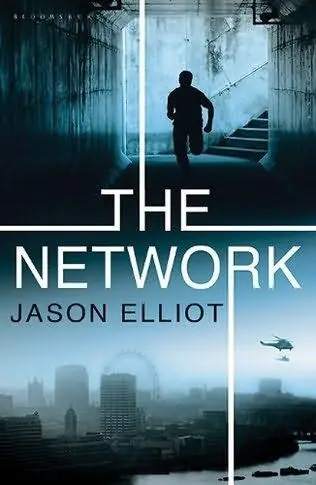
- Название:The Network
- Автор:
- Жанр:
- Год:неизвестен
- ISBN:нет данных
- Рейтинг книги:4 / 5. Голосов: 1
-
Избранное:Добавить в избранное
- Отзывы:
-
Ваша оценка:
The Network: краткое содержание, описание и аннотация
Предлагаем к чтению аннотацию, описание, краткое содержание или предисловие (зависит от того, что написал сам автор книги «The Network»). Если вы не нашли необходимую информацию о книге — напишите в комментариях, мы постараемся отыскать её.
The Network — читать онлайн бесплатно полную книгу (весь текст) целиком
Ниже представлен текст книги, разбитый по страницам. Система сохранения места последней прочитанной страницы, позволяет с удобством читать онлайн бесплатно книгу «The Network», без необходимости каждый раз заново искать на чём Вы остановились. Поставьте закладку, и сможете в любой момент перейти на страницу, на которой закончили чтение.
Интервал:
Закладка:
Cryptography is the science of hiding the true meaning of a message by disguising it; encrypting it by some means known to the recipient but not to others. As long as the sender and the recipient keep their means of encryption secret, the effort needed by the codebreaker is determined by the difficulty of the code. Some codes, like alphabetical substitutions, are easy to crack because the frequencies at which letters appear in words are well known. Others, like one-time pads based on random numbers, can only be cracked by computers, if at all. The most complex codes that use block ciphers and multiple algorithms need both computers and time, and modern computing power means that few codes are truly impossible to crack, given enough of the latter. But the science of hiding a message by disguising it as something which on the surface appears innocent is called steganography.
Strictly speaking, a message written in invisible ink across an ordinary letter is an example of steganography: the visible or cover message is innocuous. It’s an ancient idea. Herodotus describes a king who tattooed a secret message on the shaven head of his slave, whose hair was allowed to grow before he travelled through enemy territory to deliver it. More recent applications allow secret text to be hidden in the data of digitised photographs sent over the Internet. The advantage of a steganographic message is that, unlike a coded message, the secret part doesn’t attract attention to itself. It resembles something ordinary, and hides itself thereby.
My ex-wife, come to think of it, has a steganographic personality: an innocent-looking face concealing a cruel agenda.
I decide it has to be the numbers: thirteen and forty. ‘Degrees’ in the cover message also seems to be an overt clue. I find an atlas and look up the latitude and longitude. Problem. Thirteen degrees north and forty degrees east puts me in the mountains of northern Ethiopia. Forty degrees west is equally challenging – somewhere in the mid-Atlantic trench. Southern readings for the latitude land me in thick rainforest in Mozambique and Brazil. The numbers are not an obvious location.
They’re too short to be a phone number or a postcode. The only other reference I can imagine they might give is a book code, indicating a page and line number in a book known to both sender and recipient. But I haven’t agreed on a book with anyone called Mohammed.
Then it hits me like a delayed reaction, as I hear the echo of my very own words: I also read the Qur’an. The ‘old friend’, Mohammed, is the clue. It’s so obvious I can’t believe it’s taken me so long to realise. Now I regret my uncivil behaviour towards my visitor.
For centuries the mas-haf code, virtually unknown in the West, has been used in the Islamic world to encrypt messages using the numbers of the Qur’an’s sacred verses. Being identical in every version of the text, irrespective of country or date of publication, the verses retain the same numbers and provide thereby an unchanging key.
I go to my bookshelf, pull out an English translation and race to the thirteenth chapter, called Thunder. The fortieth verse, or aya, is a short one: ‘Whether We let you glimpse in some measure the scourge with which We threaten them, or cause you to die before we smite them, your mission is only to give warning: it is for Us to do the reckoning.’
There’s no need to look for any more clues. The reference to a warning is confirmation enough of the message. The question now is how to interpret it and, if necessary, respond. It’s strange news to get and I’m annoyed with myself for being hungover and slow. I regret my mind isn’t feeling sharper and that the whole significance of the message isn’t coming to me more quickly. The only thing I know for sure about the message is that it’s been sent by someone who knows enough of my background to be confident that I’ll figure out how to decipher it, and then how to interpret it. Whoever sent it also knows how to find me.
There’s a another sudden knock at the door, which has an effect similar to a powerful electric shock. I yank open the door with a scowl. There’s a different man standing on the doorstep, this time wearing a fake Barbour, jeans and trainers.
‘I’ve told your friend I’m a Muslim,’ I say gruffly.
The man’s eyebrows go up and down and he let outs a gravelly chuckle.
‘Well, in that case, As-salaamu aleikum.’ His voice is low, even and has a rasping quality as if something rough is being continually ground down in his throat. I frown at him. I’ve never met an Arabic-speaking Jehovah’s Witness and wonder if they’ve sent for a specialist to check my theology. He’s going to get a run for his money.
‘Wa aleikum as-salaam.’ I return the greeting out of reflex and look at him more closely. His frame is lighter than the other man’s, and the lines on his cheeks suggest leanness. He has short sandy-coloured hair, a neat moustache like an ex-soldier’s and looks a youthful fifty. His eyes have a watchful and mischievious sparkle. But he has no documents or bag. Before I can think of anything else to say, he speaks again.
‘Ana rafiq min landan.’ I am a friend from London. He speaks Ministry of Defence Arabic. ‘I parked down the road,’ he adds, gesturing with a thumb over his shoulder. Then it sinks in.
It’s Seethrough’s man from the Regiment. The SAS has arrived.
‘Oh, Christ. Sorry. Come in.’
He smiles and his eyes dart watchfully over the hallway as he steps inside. ‘It’s H- by the way. Friends call me H.’ The handshake is firm. ‘Late night?’ he asks with a knowing look.
‘Something like that.’
‘We’d better have some coffee.’
‘I’ve just made some.’
‘Good man.’
He sniffs the air as we go into the kitchen, puts his coat neatly over the back of a chair and sits at the table. The room’s a mess. I’m embarrassed and surreptitiously cover the ashtray in the sink with a plate as I rinse a pair of cups. I ask where he’s driven from this morning.
‘Hereford.’ That figures. Hereford is home to the Regimental HQ of 22 SAS.
I’m about to ask whether he lives there, but he answers first.
‘Settled down after I left the Regiment ten years ago, give or take.’
‘Marry a local girl?’
‘The whole nine yards. Wife, kids, cats, dogs.’
‘What have you been doing since?’
‘The security and protection circuit – rigs and pipelines, mostly. Some BGing once in a while. Sorry – bodyguarding. And the occasional special request.’
‘Isn’t it all a bit dull after the SAS?’
‘Better than sitting around in a damp hole all day.’
This is modest, coming from a member of the most elite special forces regiment in the world.
‘There’s a company that helps the blokes who want to stay active – the ones who don’t become postmen, mostly.’
‘Remind me not to tangle with the postman.’ I sit down opposite him and pour the coffee. His eyes fall on the dark red and blue bands of my watchstrap.
‘Regimental flash?’
‘Scots Guards.’
‘Alright for some.’ He grins. ‘When did you pack it in?
‘After the Gulf. Granby, wasn’t it? Stupid name for a war,’ I say. I know that military code names are chosen by computer and run alphabetically, but still.
‘Stupid war, if you think about it.’ He blows thoughtfully on his coffee. I like his irreverence.
‘Regiment did well out of it,’ I say.
‘The usual balls-up,’ he says, dismissing this. ‘Typical Regiment story. A lot of guys spread out all over the world in different theatres, and then up comes a deployment like the Gulf.’ His fingers trace a phantom squadron gathering across the tabletop. ‘All of a sudden every one of them wants a piece of the action, and a lot of jostling goes on. You get guys who’ve been training for something else doing the wrong job, and the right guys getting bumped down the line.’
Читать дальшеИнтервал:
Закладка:
Похожие книги на «The Network»
Представляем Вашему вниманию похожие книги на «The Network» списком для выбора. Мы отобрали схожую по названию и смыслу литературу в надежде предоставить читателям больше вариантов отыскать новые, интересные, ещё непрочитанные произведения.





Обсуждение, отзывы о книге «The Network» и просто собственные мнения читателей. Оставьте ваши комментарии, напишите, что Вы думаете о произведении, его смысле или главных героях. Укажите что конкретно понравилось, а что нет, и почему Вы так считаете.