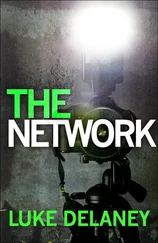
Jason Elliot - The Network
Здесь есть возможность читать онлайн «Jason Elliot - The Network» весь текст электронной книги совершенно бесплатно (целиком полную версию без сокращений). В некоторых случаях можно слушать аудио, скачать через торрент в формате fb2 и присутствует краткое содержание. Жанр: Триллер, на английском языке. Описание произведения, (предисловие) а так же отзывы посетителей доступны на портале библиотеки ЛибКат.
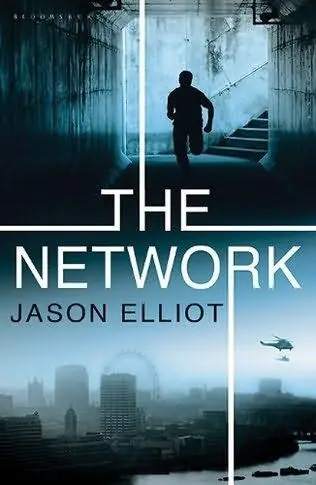
- Название:The Network
- Автор:
- Жанр:
- Год:неизвестен
- ISBN:нет данных
- Рейтинг книги:4 / 5. Голосов: 1
-
Избранное:Добавить в избранное
- Отзывы:
-
Ваша оценка:
The Network: краткое содержание, описание и аннотация
Предлагаем к чтению аннотацию, описание, краткое содержание или предисловие (зависит от того, что написал сам автор книги «The Network»). Если вы не нашли необходимую информацию о книге — напишите в комментариях, мы постараемся отыскать её.
The Network — читать онлайн бесплатно полную книгу (весь текст) целиком
Ниже представлен текст книги, разбитый по страницам. Система сохранения места последней прочитанной страницы, позволяет с удобством читать онлайн бесплатно книгу «The Network», без необходимости каждый раз заново искать на чём Вы остановились. Поставьте закладку, и сможете в любой момент перейти на страницу, на которой закончили чтение.
Интервал:
Закладка:
‘This is Macavity,’ says a watery-sounding voice, as the data packets are digitised and encrypted, then reassembled again in the handset. At some point the Firm’s special microchip begins sending out its impenetrable white noise. ‘Confirm please.’
‘This is Plato,’ I say, feeling silly.
‘All well?’
‘Can I change the ring tone on this thing?’ I ask.
‘No, you can’t. Now just listen. I’m going to send you someone.’
‘That’s nice,’ I say. ‘Will she jump out of a cake?’
‘It’s a he. He’s going to help you to get up to speed on a few things. If you get along, I’ll send him with you. He’s ex-Regiment and I want you to do whatever he asks.’
‘Whose regiment?’
‘The Regiment.’
That’s different. The Regiment is what the SAS calls the SAS. I picture a black-booted figure in body armour and respirator, Heckler amp; Koch MP5 at the ready, swinging through the window of the house as I lie in bed reading the Sunday papers.
‘I hope it’s not Andy McNab,’ I say. ‘He’s far too intellectual for me.’
‘Don’t be facetious. It’s not Andy McNab; it’s the fellow who trained him.’
That shuts me up.
‘Roger that. When?’
‘That’s his business. Just be nice to him. He’ll introduce himself as a friend from London. By the way, he’s a Mirbat vet, so I advise you not to mess him around.’
‘A what?’
‘Mirbat. Look it up. I have to go. Good luck.’
There’s a bleep, and a recording of a severe-sounding woman’s voice repeats, ‘Please hang up, please hang up.’
I’m impressed. Both by the mobile, which seems to do its job, and by a man who seems to do his. A man so busy he has no time for small talk. I’m about to reattach the handset to its cable when looking at it gives me an idea. Hearing Seethrough’s voice has reminded me of the mobile’s other functions, and I wonder now if they really work.
There’s a way, I realise, to test the infrared. I can switch my video camera to ‘nightshot’ mode, when the camera uses its own infrared source to film in total darkness, and then see what the mobile looks like. And it’s easy to test the ultraviolet function. There are dyes that show up under ultraviolet light in all sorts of things.
As soon as it’s dark, I’m thus able to waste several hours. In pitch blackness, viewed through the camera in infrared mode, the little screen on the mobile is, as promised, as bright as a searchlight. It lights up the entire room and is even visible from under a blanket. Handy, as Seethrough has suggested, for landing a helicopter in the garden.
The ultraviolet is equally distracting. It makes my fingernails seem luminous. I wave it over objects that take my fancy, and discover the hidden watermarks and security devices in my chequebook and passport. There are hidden phosphor bands on stamps, and images and tiny flecks of specially dyed paper in banknotes, invisible to the eye in ordinary light. Shining as if white-hot in the darkened room, they seem strangely beautiful. I also look at the postcard with it, and am disappointed to find there’s no hidden message.
It’s Saturday evening. I’m alone, and feel alone. As night falls, the familiar beast of despair begins to creep up on me. I have no tobacco and am too lazy to go and buy any. Worse, there’s virtually nothing to drink but a final bottle of Chateau Batailley, which I’ve promised myself I’ll save for a special occasion. This calls for a difficult decision. It’s either the Batailley or the sole other source of alcohol in the house: roughly half a bottle of Armenian cognac, which a so-called friend has palmed off on me as a gift. It’s so bad I haven’t touched it for six months, having discovered what damage it can do to the untrained nervous system. I retrieve it from the back of a kitchen cupboard, mix a slug with some mineral water and discover to my surprise that it’s quite drinkable. I also find a cigar, which I’ve similarly promised myself to save for a special occasion. I light the cigar, dig out my topographic maps of Afghanistan, and return to the cognac.
At ten o’clock I lurch into the grey morning with a sharp pain in my head where the cognac has etched Category 2 damage in the region of my cerebellum. The house reeks of cigar smoke, so I throw open the windows and put the coffee percolator to work in the kitchen. Taking the first sip, I hear myself whisper, ‘I must not do this again,’ and wonder how often I’ve uttered the same words. My Afghan maps are scattered on the floor by the sofa where I’ve fallen asleep. As I’m gathering them up there’s a triple knock at the door. I flee upstairs, throw on some clothes and return to the door.
The daylight is painfully bright. In front of me stands a clean-shaven middle-aged man with a sheaf of paperwork in his hand, and for a terrible moment I think of all the letters from the Television Licensing Authority which I’ve thrown away unopened.
‘Good morning, sir. I hope I’m not disturbing you.’
I don’t like the ‘sir’ part. It makes him sound like a policeman. But he doesn’t look like one. He’s wearing a black suit like an undertaker’s, for which he’s grown slightly too big, and a tie with green and red diagonals that hurts to look at.
‘Of course not,’ I reply with an unconvincing smile.
‘I wonder if I can ask whether you read the Bible?’ he asks. Resting in the crook of his arm like Moses in a basket is a sheaf of denominational literature.
‘I do, as a matter of fact.’
A smile of pleasant surprise spreads across his face, but it’s not a morning to give the enemy too much room for manoeuvre, because I don’t do religion on a hangover.
‘I also read the Qur’an. I have a soft spot for Marcus Aurelius too, and he was a pagan.’
The smile fades. He’s not really expecting this and a slight stutter comes into his voice. ‘But… but do you believe your actions in this life make a difference in the world to come?’
‘If we’re going to be judged on something in an afterlife, I think it’ll probably be our inactions. It’s not difficult to live a pious life, if you think about it, imagining you’ll be saved if you stick to a few rules. But think of all the good things you could have done but didn’t because you were too lazy or complacent. I think we’ll be judged on our potential.’
He’s frowning now.
‘I forget where I first heard the idea, but it does stay with you. I think it’s somewhere in the Qur’an.’
I pluck a copy of the Watchtower from his grasp and thank him warmly, saying I hope I’ll see him again soon. The speed at which he walks away up the drive suggests I won’t.
With a feeling of guilty victory I return to my coffee. Then I close the windows in the sitting room because the light is hurting my eyes, and sit down at the table, taking the postcard from the mantelpiece where I left it. I read it again several times. There’s nothing out of the ordinary about the text. I wonder if the picture, depicting a nomad leading a line of camels, is intended to convey a meaning. It’s the identity of ‘Mohammed’ that bothers me. I wonder if it might be worth looking through my diaries from the period I was last in Kabul, but if the card was sent months earlier, whoever Mohammed is will have given up hearing from me.
I take the card to the kitchen and boil the kettle, hold the card in the steam and gently work a corner of the stamp with the tip of a knife. I’m not sure what to expect – anything strange or out of the ordinary.
As the stamp begins to curl back in the steam, what I see is even stranger. Under the stamp, in the same ink as the writing on the card, is a tiny drawing of a dinosaur with a smiling face.
It’s a stegosaurus.
Читать дальшеИнтервал:
Закладка:
Похожие книги на «The Network»
Представляем Вашему вниманию похожие книги на «The Network» списком для выбора. Мы отобрали схожую по названию и смыслу литературу в надежде предоставить читателям больше вариантов отыскать новые, интересные, ещё непрочитанные произведения.


Обсуждение, отзывы о книге «The Network» и просто собственные мнения читателей. Оставьте ваши комментарии, напишите, что Вы думаете о произведении, его смысле или главных героях. Укажите что конкретно понравилось, а что нет, и почему Вы так считаете.