Jason Elliot - The Network
Здесь есть возможность читать онлайн «Jason Elliot - The Network» весь текст электронной книги совершенно бесплатно (целиком полную версию без сокращений). В некоторых случаях можно слушать аудио, скачать через торрент в формате fb2 и присутствует краткое содержание. Жанр: Триллер, на английском языке. Описание произведения, (предисловие) а так же отзывы посетителей доступны на портале библиотеки ЛибКат.
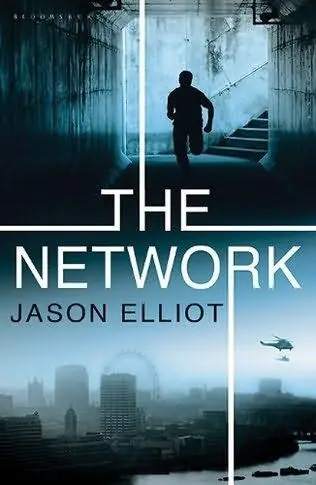
- Название:The Network
- Автор:
- Жанр:
- Год:неизвестен
- ISBN:нет данных
- Рейтинг книги:4 / 5. Голосов: 1
-
Избранное:Добавить в избранное
- Отзывы:
-
Ваша оценка:
The Network: краткое содержание, описание и аннотация
Предлагаем к чтению аннотацию, описание, краткое содержание или предисловие (зависит от того, что написал сам автор книги «The Network»). Если вы не нашли необходимую информацию о книге — напишите в комментариях, мы постараемся отыскать её.
The Network — читать онлайн бесплатно полную книгу (весь текст) целиком
Ниже представлен текст книги, разбитый по страницам. Система сохранения места последней прочитанной страницы, позволяет с удобством читать онлайн бесплатно книгу «The Network», без необходимости каждый раз заново искать на чём Вы остановились. Поставьте закладку, и сможете в любой момент перейти на страницу, на которой закончили чтение.
Интервал:
Закладка:
‘Haven’t I already signed this?’ I ask.
‘Yes, but it’s got a bit more draconian since then, I’m afraid,’ he says. ‘Now it authorises us to kill you and sell your children.’
I let him know with a look that this isn’t a good joke.
‘I’m sorry, I forgot. In Washington, aren’t they? Mother was American, wasn’t she?’
‘Yes.’ As if he didn’t know.
‘Rotten luck. Well, just sign the bloody thing so we can get on. I can’t brief you until you sign.’
As soon as I’ve signed, Seethrough begins a short lecture about the Service, sparing me what he calls the grisly details but wanting, he says, to give me an outline of where the operation he’s planning fits within the intelligence jigsaw. Seethrough’s fellow Intelligence Branch staff, of whom there are fewer than I imagined, divide their efforts between a number of regional controllerates and another called Global Issues. The combined work of the controllerates is carried out by P and R officers, standing for production and requirements, a division of labour, roughly speaking, between the first half and second half of what is called the intelligence cycle. I’ve already been introduced to the idea in the army during my stint with the Green Slime, as members of the Intelligence Corps are affectionately known on account of their spinach-coloured berets.
Intelligence is broadly described as having four main phases: raw intelligence is first gathered or collected by a variety of means and technologies, then converted or collated into a form useable by analysts. It is then disseminated to the right people at the right time, and finally put to use – or, as we used to joke, misuse – by decision makers. In the army intelligence is used to enhance what military analysts, with their characteristic love of terminology incomprehensible to ordinary people, call battlespace visualisation.
The vocabulary of the Firm is different. I never once hear the words secret or agent. Raw intelligence is used to produce varying grades of CX – finely sifted intelligence reports – for the top feeders in the intelligence food chain. I never find out why it’s called CX, or why intelligence from the Security Service, better known as MI5 and whose members Seethrough calls the River Rats, is called FX. They sound like types of nerve gas to me.
Since its area of specialisation is the use of human assets, the Firm’s officers engage in four parallel tasks: targeting, cultivating, recruiting and then running their assets. Those in the know are said to be indoctrinated; Seethrough’s philosophy is to keep the number of people indoctrinated into an operation to a minimum, and is emphatic that I discuss the material he’s about to show me with no one but himself unless specifically instructed otherwise. My questions, he said, will go to him. My ideas will go to him, and my contact reports will go to him. I’m to write nothing down.
‘This one’s at the request of the Americans,’ he says, opening the uppermost file. ‘Provisional code name is Elixir.’ He pushes the opened file towards me with a laminated companion list of commonly used acronyms and code words with their explanations – from Actor, meaning the Service’s headquarters at Vauxhall Cross, to Zulu, meaning Greenwich Mean Time. The contents of the file are divided into several sections, which we examine in turn.
The first is a description of three civilian airline crashes. Each plane has dropped out of the sky shortly after take-off, killing all on board. The three incidents have been briefly reported in the press, but none of the photographs I’m looking at has ever made it into the papers. They’re too gruesome. The debris from the first aircraft is strewn over a mile, along with the bodies of 200 passengers, many of whose charred and mutilated remains are still strapped into their seats. The second and third aircraft have crashed into water, and their wreckage has been gathered and secretly reassembled in long and dangerous recovery operations. Here too the passengers have been photographed as they were found, their bloated and limbless corpses still attached to their seats. In each case the accidents have been publicly blamed on engine failure, which official investigations have later confirmed. The most recent of them occurred only a few months ago.
‘Even the airlines don’t know this,’ says Seethrough, ‘but the culprit in all three is the same.’ He turns to another section in the file, and shows me a US Defense Department image of an FIM-92.
Better known by its common name: the Stinger missile.
‘Not a shred of doubt,’ he went on. ‘The Americans have verified it and we’ve double-checked at Fort Halstead. There’s a machine there that can identify the exact stock of explosive from a tiny fragment of wreckage. Stingers in every case.’
At the mention of Fort Halstead I think involuntarily of my strolls with the Baroness through the gardens of Chevening House, and I picture the incongruous-looking palm trees swaying above the rear porch. Fort Halstead, the secret research establishment labelled only as ‘works’ on ordinary maps, is over a mile away at the top of the hill that overlooks the village, but on a still day we could often hear the faint cry of the warning alarm, at the sound of which the Baroness’s finger would rise like a conductor’s in anticipation of the muffled thump of a subterranean explosion. Somewhere in the complex, more recently, white-coated technicians had identified residues of TNT from Stinger warheads, matching its chemical profile against a database of known explosive stocks.
‘Probably by spectrometric analysis of the isotopic ratios,’ I say because I know a thing or two about explosives.
‘Yes, quite,’ agrees Seethrough, looking up for a moment. ‘PTCP reckons they came through Iran but we don’t know for sure. And if you can’t stop the flow, you go back to the source.’
‘Afghanistan. Where we handed them out in the first place.’
‘To your old friends,’ he adds with a dark look.
‘Only some of them.’
‘Now they’re easy pickings for al-Qaeda, and you know what that means.’
‘Yes, I do. In Arabic it means base or capital or seat of operations. But the way you pronounce it, it sounds like al-qa’da, which means buttocks.’
‘I refer,’ says Seethrough, clearing his throat and choosing to overlook this impudence, ‘to the threat, not the etymology.’
The threat is an obvious one. If sufficient of the missiles are acquired by terrorists from Afghans willing to sell them, the potential for chaos and slaughter is impossible to contemplate. Governments will be held to ransom, says Seethrough. Anti-missile technologies are too costly to install on civilian airliners. The only solution is to recover the missiles themselves from the same people they were delivered to fifteen years earlier, when the Afghans were fighting the Soviets.
‘This is the update on the American buyback programmes,’ he says, turning the pages of the final section of the file. ‘There’ve been several initiatives, mostly relying on middlemen in Pakistan, and too many of the deals have come to nothing. Over the past couple of years they’ve had a final push and thrown a lot of cash around inside the country. Going rate is $100,000 apiece, sometimes more. In the north it’s been working quite well, where Massoud’s chaps have proved very willing. They get them across the border here.’ He points on a map of Afghanistan to the northern border with Uzbekistan. ‘But now that the Taliban control the rest of the country the Yanks haven’t got anyone they really trust who can move them. There’s a bloody great stash of Stingers but they can’t get them out. Somewhere down here.’ He points again to the map, north of Kandahar this time. ‘Too complicated. They need to be destroyed.’
Читать дальшеИнтервал:
Закладка:
Похожие книги на «The Network»
Представляем Вашему вниманию похожие книги на «The Network» списком для выбора. Мы отобрали схожую по названию и смыслу литературу в надежде предоставить читателям больше вариантов отыскать новые, интересные, ещё непрочитанные произведения.







Обсуждение, отзывы о книге «The Network» и просто собственные мнения читателей. Оставьте ваши комментарии, напишите, что Вы думаете о произведении, его смысле или главных героях. Укажите что конкретно понравилось, а что нет, и почему Вы так считаете.