Jason Elliot - The Network
Здесь есть возможность читать онлайн «Jason Elliot - The Network» весь текст электронной книги совершенно бесплатно (целиком полную версию без сокращений). В некоторых случаях можно слушать аудио, скачать через торрент в формате fb2 и присутствует краткое содержание. Жанр: Триллер, на английском языке. Описание произведения, (предисловие) а так же отзывы посетителей доступны на портале библиотеки ЛибКат.
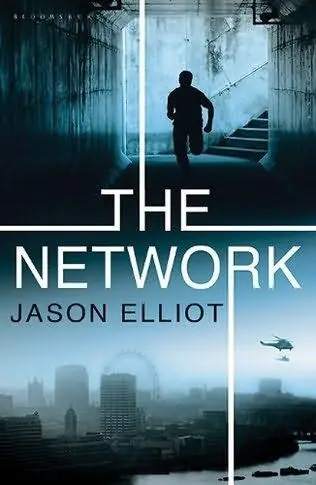
- Название:The Network
- Автор:
- Жанр:
- Год:неизвестен
- ISBN:нет данных
- Рейтинг книги:4 / 5. Голосов: 1
-
Избранное:Добавить в избранное
- Отзывы:
-
Ваша оценка:
The Network: краткое содержание, описание и аннотация
Предлагаем к чтению аннотацию, описание, краткое содержание или предисловие (зависит от того, что написал сам автор книги «The Network»). Если вы не нашли необходимую информацию о книге — напишите в комментариях, мы постараемся отыскать её.
The Network — читать онлайн бесплатно полную книгу (весь текст) целиком
Ниже представлен текст книги, разбитый по страницам. Система сохранения места последней прочитанной страницы, позволяет с удобством читать онлайн бесплатно книгу «The Network», без необходимости каждый раз заново искать на чём Вы остановились. Поставьте закладку, и сможете в любой момент перейти на страницу, на которой закончили чтение.
Интервал:
Закладка:
‘Why can’t the Americans drop a bomb on them from a great height? They’re good at that,’ I say.
‘Too sensitive. The Paks won’t let them use their airspace for an offensive operation and the politics are too difficult. Imagine they hit the wrong target or the missiles are moved at the last minute. We need trusted eyes on the ground. There’s also a time factor. You’ve heard of bin Laden?’
‘Isn’t he wanted by the Americans for his role in financing the bombing of their embassies in Kenya and Tanzania?’
‘Yes. But now we’re hearing he’s looking for surface-to-air missiles. If he or his people get hold of the Stingers, God knows what he’ll try next. We’re asking you to go to Afghanistan and do the job yourself. Find a reason to be there, get a team together, verify the Stingers are where they say they are and blow the bloody things up so we can all go home.’
I don’t have to think too long. I feel a great sense of relief, in fact. The mission is a straightforward one. I have both the contacts and the know-how. I know how to move in and out of the country, and I know how to blow things up.
‘I think I can do that,’ I say.
‘Good,’ says Seethrough.
He leans back in his chair and runs his hands through his hair.
‘There’s a bit more,’ he says, then reaches for a different file, labelled TRODPINT. ‘Last month one of the Americans’ tribal int teams was approached by one of bin Laden’s chaps. Says he’s got top-grade time-sensitive CX on bin Laden’s plans and needs to get it to us. But he doesn’t identify himself and doesn’t show up for their next meet.’ He hands me a surveillance photograph taken in Afghanistan. It shows two dark-skinned heavily bearded men in conversation beside the roof of a car with a yellow plastic housing marked taxi in Persian letters. One wears a loose-fitting Afghan shalwar kameez, and the other an old army jacket.
‘Taken in Jalalabad last month. Chap on the left is one of bin Laden’s best mates. The other one’s our potential source, but we can’t identify him. We’ve run his face through every database we’ve got, but there’s no match.’
That’s because he’s supposed to have died nearly ten years ago, I’m thinking as I look at the photograph. He’s almost unrecognisable. His face is half hidden by his beard, his skin is dark, his face is older and leaner. But it’s Orpheus, I’m certain of it. He’s finally surfaced and needs to come in. I pull my eyes away from the photograph. Seethrough is still talking.
‘We’ve asked around. The Europeans don’t have anyone of their own in bin Laden’s circuit. Mossad swear they don’t have an illegal out there, but you never know with Mossad. This one’s too good to get away. We need to make an approach, God knows how.’
He doesn’t need to explain where the plan’s leading.
‘We can put you onto the source while you’re out there and you can do some fishing to see who bites. Could be a bit risky, but if you run a tight ship we should be alright. You feeling OK? It’s a lot for one session, I know. I thought I’d give you a little tour to cheer you up. There’s just one more thing. It’s alright, this is the fun part. Gadgets. Back in a minute.’
He gathers up the files and leaves the room while the image of Orpheus floats stubbornly in my vision. Then he returns with two small white cardboard boxes, which he opens on the table.
‘Let’s have a look at what the tossers have got for you. Sorry – another in-joke, I’m afraid. Technical and Operations Support. They decide on the kit for an op.’
From the first box he takes out a Motorola mobile telephone with a stubby antenna. ‘Identical to the real thing but there’s a chip inside that screens the call with white noise,’ he says. ‘Even the NSA can’t get their grubby hands on the signal. It’s GPS-enabled so we can keep track of it even if it’s switched off. It’ll also record a conversation up to sixteen hours.’ He shows me the keypad configurations for each instruction. ‘Now this is good. Have you ever used a firefly?’
I’ve heard of the small infrared strobes called fireflies being used by special forces, but never actually seen one.
‘It’s the next best thing to the military version. There’s no visible output, but to anyone with night vision gear it’ll look like a searchlight. Land a heli with it if you need to.’ I don’t know if he’s serious. ‘There’s an ultraviolet function too. Use it with this.’ Opening the second box, he takes out an ordinary-looking gel-ink pen with a retractable tip. A single click causes it to produce visible black ink. A second activates a flow of ink that’s only visible under a narrow frequency of ultraviolet light. To demonstrate, he draws an invisible line from the back of his hand to the surface of the table, then keys a sequence on the keypad of the phone. As he holds the phone over the table, a bright white streak appears on the table, merging with the streak on his hand as he draws it closer. The slightest movement of an object marked with the ink, when viewed under the light from the phone, will be immediately obvious.
‘Use it for security when you’re out and about, and you’ll always know if anyone’s been in your stuff,’ he says. ‘You need to sign for these, by the way.’ He leaves the room again and returns with a final folder containing the release forms, carrying a long dark-blue overcoat and elegantly battered leather briefcase. He drapes the coat over the back of a chair, then notices a bulge in the fabric and removes from the inner pocket some envelopes and a chequebook. I just make out the Coutts emblem embossed on the black outer cover before it disappears into his briefcase.
Our briefing is over. I stand up and wander over to the windows. The river looks grey and sullen. Closer to, I can see the chequerboard pattern in dark and light tiles of the veranda below us.
‘Don’t do that, please,’ says Seethrough.
‘Don’t do what?’
‘Stand by the windows. We don’t do that.’
I return to the table and ask him why the windows are so thick. They’re not as green as they look from the outside, but they’re visibly thicker than normal windows.
‘Something called TEMPEST. Can’t remember what it stands for. It’s to stop people listening to our computers. If you’re very clever you can actually detect the little bits of radiation coming out of the screens and piece them all together somehow. That’s it,’ he remembers. ‘Tiny Electro-Magnetic Particles Emitting Secret Things.’
I’m never entirely sure when he’s joking. He gathers up his coat and case and we walk back along the corridor to the lifts. As we’re waiting he turns to me with a smile and says: ‘Welcome to the wonderful world of deniable operations.’
‘I’ve always wondered what exactly that means.’
‘It means,’ he explains thoughtfully, ‘that if the whole thing goes pear-shaped and you get yourself killed in Afghanistan, then the nice people in I/OPS upstairs will make sure there’s a story in the papers about a careless British tourist beheaded by a loony Afghan mullah.’
‘They don’t actually behead people in Afghanistan,’ I correct him. ‘But I agree it’s certainly evocative.’
‘Yes,’ he muses, ‘I/OPS are very good at that.’
The lift falls gently but swiftly; I imagine it will stop at the ground floor, but there are several subterranean levels and we descend to the final one. Leaving the lift, we pass through another set of double glass doors like the airlock of a high-security laboratory. On the far side we emerge in a stony-grey corridor resembling one of the passageways of the Heathrow Express. Everything is grey; it’s an appropriate colour for all the grey people who move along its secret grey spaces.
Читать дальшеИнтервал:
Закладка:
Похожие книги на «The Network»
Представляем Вашему вниманию похожие книги на «The Network» списком для выбора. Мы отобрали схожую по названию и смыслу литературу в надежде предоставить читателям больше вариантов отыскать новые, интересные, ещё непрочитанные произведения.







Обсуждение, отзывы о книге «The Network» и просто собственные мнения читателей. Оставьте ваши комментарии, напишите, что Вы думаете о произведении, его смысле или главных героях. Укажите что конкретно понравилось, а что нет, и почему Вы так считаете.