Jason Elliot - The Network
Здесь есть возможность читать онлайн «Jason Elliot - The Network» весь текст электронной книги совершенно бесплатно (целиком полную версию без сокращений). В некоторых случаях можно слушать аудио, скачать через торрент в формате fb2 и присутствует краткое содержание. Жанр: Триллер, на английском языке. Описание произведения, (предисловие) а так же отзывы посетителей доступны на портале библиотеки ЛибКат.
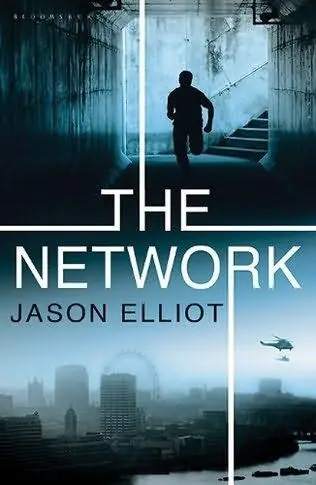
- Название:The Network
- Автор:
- Жанр:
- Год:неизвестен
- ISBN:нет данных
- Рейтинг книги:4 / 5. Голосов: 1
-
Избранное:Добавить в избранное
- Отзывы:
-
Ваша оценка:
The Network: краткое содержание, описание и аннотация
Предлагаем к чтению аннотацию, описание, краткое содержание или предисловие (зависит от того, что написал сам автор книги «The Network»). Если вы не нашли необходимую информацию о книге — напишите в комментариях, мы постараемся отыскать её.
The Network — читать онлайн бесплатно полную книгу (весь текст) целиком
Ниже представлен текст книги, разбитый по страницам. Система сохранения места последней прочитанной страницы, позволяет с удобством читать онлайн бесплатно книгу «The Network», без необходимости каждый раз заново искать на чём Вы остановились. Поставьте закладку, и сможете в любой момент перейти на страницу, на которой закончили чтение.
Интервал:
Закладка:
‘You said you’d arrange a context for me. I won’t ask how you managed it.’
She doesn’t rise to this but smiles benignly. This frail old woman has succeeded in having me recruited to the Secret Intelligence Service for a purpose unknown even to the Service itself.
‘You will jump aboard and must be prepared for the journey. When you know more, contact me in the usual way. In the meantime I shall watch, and pray.’
She says nothing more, but with a simple gesture indicates it’s time to move to the coffee room, as the dining room is misleadingly called. We walk down the carpeted stairs in silence, and a jacketed member of staff greets us with a deferential bow and shows us to a table. Two menus are produced, though no prices appear on the one I’m given.
I look out of the window. From it I can just see the Duke of York’s Monument and coated figures scurrying past the shrapnel-scarred statues in Waterloo Place. I wonder how many of them have undertaken work about which they can speak to no one, how they have managed the burden of secrecy, and how they have mastered the division in one’s life that comes with a double task.
As if from afar I hear the voice of my hostess. I’m reminded that her presence is a comfort, even though we hardly talk. A wine list is in her hand and she’s peering at me over her glasses.
‘Can we manage a bottle? There’s a Montrachet that’ll go very well with the sole.’
I nod enthusiastically, but my thoughts are somewhere else. I’m remembering how the plastic sheeting on the windows of the house in Kabul used to balloon inwards whenever there was a detonation in the city, and how the whole house used to shake when a Taliban rocket landed nearby, and how rich I felt just to be alive afterwards.
I’m haunted by the prospect of returning to Afghanistan, a country that has left its mark on me like no other. There’s a discovery waiting for me there, and the answer to a secret that I can mention to no one except the Baroness. I’m not sure I’m ready for it. The Baroness long ago taught us the power of a single thought: that in the Network we are never alone. There are always others among its members in similar or more difficult situations, suffering or struggling with the same situations, unable to reveal their true purpose to the world, and this know-ledge has often come to my aid, as it does now.
‘My dear boy,’ I hear her say, ‘you’re miles away.’
I make the second journey after the agreed interval of a week, the following Sunday. Two hours after leaving home with Gerhardt I’m crossing the Thames at Vauxhall Bridge, trying to decide whether the building looming ahead of me on the left is ugly or not. It still looks brand new, though I wonder how its clean and angular lines will eventually age.
I park in Kennington Lane. Now that Gerhardt is at rest, I can smell the transmission fluid burning off the hot manifold. With a few minutes to spare, I take the opportunity to check the fluid level, to see how much poor Gerhardt has leaked on the way. It isn’t good. It’s dropped considerably, and the dark liquid streaks all the way from the torque converter to the rear silencer. I feel a pang of regret that I can’t afford a new transmission, then remember how old Gerhardt is. Replacing his transmission is akin to giving a heart transplant to an elderly man. Much in life, I reflect gloomily, simply isn’t solvable.
At midday I walk through the doors of Number 85 Albert Embankment, and enter the lobby. The place has a stripped-down and anonymous look with the smooth flat colours of a modern hotel, and there is everywhere a slightly greenish hue, cast by the triple-glazed glass of the windows. I announce myself at the reception area, which is overseen by an unexpectedly cheerful pair of young women.
‘Plato to see Macavity,’ I say.
One of the women picks up a handset, passes on the names and motions me, as might a hotel receptionist, to a black sofa opposite, where I wait next to an imitation Monstera deliciosa. Seethrough appears a few minutes later from behind the futuristic door system that stretches across the far side of the entrance lobby, and comes up to me. He’s dressed in a charcoal mohair suit, one of his Savile Row shirts with a swept-back collar and antique garnet cufflinks, and a grey silk tie. An identity card hangs from his neck, bearing his photograph but no name. Beside his image is what looks like a globe surrounded by yellow lightning bolts. He sees me looking at it.
‘Now, now,’ he says, tucking the card into his breast pocket. We shake hands and he looks me up and down approvingly.
‘You clean up quite well,’ he says.
‘Thank you. New shirt?’
‘Yes. Had it made in Italy. Little place off Piazza Navona,’ he replies with a knowing grin, correctly locating my tailor in Rome. I’m not sure if I’m reassured by this detail. He must have had someone search my credit card records since our meeting a week earlier. At least it means he listens to everything I say.
‘Shall we? I need your phone first.’ No one, he explains, is allowed a mobile phone inside the main building.
He hands it to the security guard, who gives me a receipt like a raffle ticket.
‘Right. Follow me and don’t even think of wandering off,’ he says. ‘And by the way, you never run in this place. Whatever happens, you never run.’ We walk to the doors, where he passes his card through a reader and enters a number on a keypad. A door slides open, he goes through, it closes again, and he repeats the process from behind a second door on the far side, allowing me to enter. I’m reminded of French high street banks where the customer is isolated for a few moments in a glassy pod before being able to escape. Then the door in front of me slides aside and I join Seethrough in a tall and spacious inner courtyard with tropical-looking plants overhanging a cream-coloured marble floor. There are broad corridors radiating from a pair of central lift shafts. Kew Gardens, I’m thinking, meets Terence Conran. The plants are plastic.
Seethrough watches my reaction. ‘Welcome to Babylon-on-Thames.’ He grins. He’s visibly proud of his workplace. We take the lift to an upper floor, where the pale marble turns to grey floor tiles. Halfway along an anonymous-looking corridor we come to an empty briefing room identified by a letter and a number. Seethrough offers me a chair at a large oval table with expensive veneer, from which the cables of two slim computer monitors and a pair of complicated-looking telephones run into plugs recessed into the floor. He picks up a handset and says, ‘Ready now,’ and a few minutes later we’re joined by a woman carrying a handful of variously coloured files.
We sit down and Seethrough ignores me for a few minutes as he types at a keyboard.
‘What’s the reg on your car?’ he asks and types it in. ‘Look at that.’ He grins again. ‘We’ve got you on camera 150 times since you left home.’ His eyes are glued to the screen. ‘You’re actually speeding in this one. Eighty-two miles an hour. I didn’t know your Unimog could go that fast. What were you doing in Amesbury?’
‘Petrol,’ I say. ‘And it’s not a Unimog.’
He peers more closely at the screen, and his fingers tap and scroll at the keyboard.
‘You bought thirty-five pounds of four-star. And a Mars bar. Bloody clever, this point of sale stuff,’ he mutters, then looks up. His assistant is standing beside him.
‘Sorry. This is Stella,’ he says. ‘Inside joke.’ She’s about fifty, slim and slightly built, and has a gaunt sad-looking face with large dark eyes. She puts the files on the table, glances at me and utters a timid hello. Then she leaves the room.
‘Right, let’s take care of the paperwork,’ he says, opening a Manilla file and pushing it towards me. A document marked top secret in big red letters glares back. It’s a copy of the best bits of the Official Secrets Act.
Читать дальшеИнтервал:
Закладка:
Похожие книги на «The Network»
Представляем Вашему вниманию похожие книги на «The Network» списком для выбора. Мы отобрали схожую по названию и смыслу литературу в надежде предоставить читателям больше вариантов отыскать новые, интересные, ещё непрочитанные произведения.











Обсуждение, отзывы о книге «The Network» и просто собственные мнения читателей. Оставьте ваши комментарии, напишите, что Вы думаете о произведении, его смысле или главных героях. Укажите что конкретно понравилось, а что нет, и почему Вы так считаете.