Jason Elliot - The Network
Здесь есть возможность читать онлайн «Jason Elliot - The Network» весь текст электронной книги совершенно бесплатно (целиком полную версию без сокращений). В некоторых случаях можно слушать аудио, скачать через торрент в формате fb2 и присутствует краткое содержание. Жанр: Триллер, на английском языке. Описание произведения, (предисловие) а так же отзывы посетителей доступны на портале библиотеки ЛибКат.
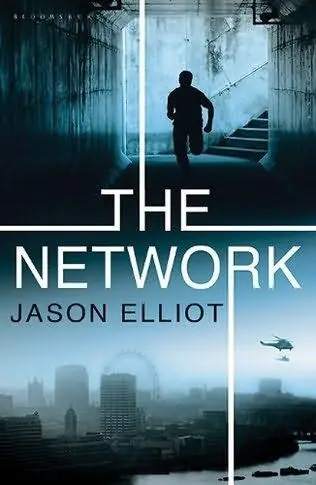
- Название:The Network
- Автор:
- Жанр:
- Год:неизвестен
- ISBN:нет данных
- Рейтинг книги:4 / 5. Голосов: 1
-
Избранное:Добавить в избранное
- Отзывы:
-
Ваша оценка:
The Network: краткое содержание, описание и аннотация
Предлагаем к чтению аннотацию, описание, краткое содержание или предисловие (зависит от того, что написал сам автор книги «The Network»). Если вы не нашли необходимую информацию о книге — напишите в комментариях, мы постараемся отыскать её.
The Network — читать онлайн бесплатно полную книгу (весь текст) целиком
Ниже представлен текст книги, разбитый по страницам. Система сохранения места последней прочитанной страницы, позволяет с удобством читать онлайн бесплатно книгу «The Network», без необходимости каждый раз заново искать на чём Вы остановились. Поставьте закладку, и сможете в любой момент перейти на страницу, на которой закончили чтение.
Интервал:
Закладка:
‘Nobody uses the main entrance,’ says Seethrough. ‘If we did, we’d all be famous within twenty-four hours.’
From this side tunnel we come into a broader older-looking tunnel equipped at intervals with red fire hoses and alarms. High-pressure sprinkler pipes run overhead, and the walls are criss-crossed with metal cable conduits, junction boxes and switches. Nearby is a line of half a dozen small open carriages resembling golf caddies. They must be electrically powered. At the front sits a driver wearing the same dark uniform as the security guards above us. Behind him, each doorless carriage has a single seat, large enough for two passengers.
‘All aboard,’ says Seethrough, indicating one of them. After a minute’s wait we begin to move forward at a speed slightly faster than walking pace. ‘There’s another London under here,’ he says, looking lazily at the gently passing walls. Tributary tunnels and doorways, marked with acronyms above their entrances, lead away at right angles. Occasionally we pass giant blast- and flood-proof doors hanging from hinges the height of a man. At each of the main intersections the train comes to a gentle halt, and passengers get on and off; twice an identical train passes us in the opposite direction. We must be heading north because a few minutes later he points out a sign indicating the Security Services building, which lies across the river on Millbank. There are many other tributary tunnels, and I realise the hidden network beneath London is far more extensive than anything I’ve imagined.
‘God, this is nothing,’ he says. ‘Half of Wiltshire’s a bloody great Emmental.’ He points out a cryptic sign on the wall. ‘There’s a C4 facility through there where we can run a whole war from. Can’t take you there, I’m afraid. Or there.’ He points to another sign bearing the acronym of the subterranean Cabinet Office Briefing Rooms. We’re somewhere under Whitehall now. The train draws once more to a halt and Seethrough adjusts his coat. ‘Come on,’ he says. ‘I’ve got an appointment topside.’
We leave the carriage, turn into a tributary tunnel and come to a lift entrance, where he swipes his card and enters a number on the keypad by the doors. The lift glides up and we emerge in the lobby of an older but grand official building with an alert-status board by the entrance. It reads yellow. A grey-haired guard at the security desk looks up from his newspaper, then down again. Beyond him, I can make out traffic in the street, but I’m not sure where we are.
‘I won’t see you out,’ says Seethrough. ‘Cross the river and head down Albert Embankment. The walk’ll do you good.’ I’m still trying to take in the substance of our meeting, and perhaps it shows. He detects my feelings and, in an unexpectedly avuncular gesture, switches his long overcoat into his left arm and puts the other over my shoulders. ‘Let it settle,’ he says in a near whisper. ‘Get your stuff tied up so that you can do some travelling, and I’ll have some briefings organised. I’ll contact you in a week on the mobile. Look after the things I gave you.’
I walk outside. It’s overcast and has begun to drizzle. I’m at the south-east corner of St James’s Park, looking along Horseguards Road and a stone’s throw from Downing Street. I don’t mind the walk. I can’t help thinking how confident and grown-up Seethrough seems. I picture him retiring at fifty-five to sell his expertise to big businesses from his Home Counties mansion, dividing his time between Glyndebourne, charity balls and unofficial meetings with heads of UK industry.
I reach Gerhardt half an hour later, remove the parking ticket from the windscreen and, resisting a momentary urge to weep, start up and head for home.
Jason Elliot
The Network
5
For days I’m hoping to continue with life as if nothing’s really happened, feeling all the while like a man condemned. My meeting with Seethrough has stirred up memories I’ve preferred to forget, and now they return to me like ghosts, visiting at unexpected moments. From time to time I wonder whether Seethrough’s proposal is no more than an elaborate hoax, and imagine him jumping out at me one day in his long coat, waving his chequebook from Coutts and declaring the whole thing a joke.
My sleep grows disturbed, and I have strange dreams in which I’m wandering along the secret corridors of Vauxhall Cross. In one I’m walking under a giant portrait of the Duke of Edinburgh that hangs in the main atrium, but the face is Seethrough’s, grinning cynically at me. Recalling our meeting gives me a jittery feeling akin to panic. It’s as if the visible events of ordinary life are now no more than a stage set that ordinary people believe is real, but behind which I alone know what’s going on. I tell myself I’ll get used to keeping things secret, and push thoughts of the future aside. But I know too that a secret can enliven one’s life or poison it, and I’m wondering which way things will eventually turn out.
Seethrough has said he’ll contact me again in a week’s time. But the lack of news makes me anxious, and the evenings fall heavily. My working routine has gone haywire. I drink a bottle and a half of wine every night, and I’m smoking again, a vice I’ve managed to evade for over a year. For most of the week I avoid contact with people, stop shopping and, worst of all, run out of decent red wine. I take to going for long walks alone and driving Gerhardt cross-country on the muddy tank routes over Salisbury Plain, thinking to test my nerve in the event of getting caught and arrested by the Military Police. I shouldn’t, because it would be a bad moment to be arrested. But you do odd things when the craving for adrenalin begins to set in.
Then two things happen. The following Saturday morning, along with a reminder that I haven’t paid my television licence, a postcard arrives from Afghanistan. It’s strangely timely. On the front is a poorly reproduced colour photograph, probably taken in the 1970s, of a turbanned Kuchi tribesman leading a caravan of camels, silhouetted against a background of barren mountains. It’s postmarked Kabul, but I can’t make out the date. Nor do I recognise the hand. It reads,
Be doubly warned that the journey here takes at least thirteen hours, in temperatures of up to forty degrees. We all look forward to seeing you here. Please do keep in touch. Your old friend, Mohammed.
I’ve had the occasional letter and postcard from Afghanistan, but I’m embarrassed not to remember a Mohammed who considers himself to be my old friend. Certainly not one who speaks English well enough to know his prepositions and such an expression as ‘be doubly warned’. I think of the English-speaking people I’ve met in Kabul and on de-mining missions over the years. Most of them are foreigners. I wonder if Mohammed might be a Western-educated Iranian. But my mind’s a blank. I’ve simply forgotten. Odder still, it’s winter now and nowhere in Afghanistan does the temperature reach forty degrees. Perhaps the card was posted months before, and has only just been flown out. The Taliban postal service is hardly famous for its swiftness. I walk into the living room, put the postcard on the mantelpiece and stare at it. It bothers me that I can’t identify the sender. I decide I’ll leave it there until I can.
The second event is a phone call from Seethrough. I’ve yet to get into the habit of calling him Macavity. When the mobile he’s given me begins to ring, I have no idea at first what it is. The tone resembles a two-tone police siren, and makes me think some kind of alarm has gone off in the house, only there aren’t any alarms in the house. After a few moments of bafflement, I find the handset with its blinking green light, disconnect it from the charger lead and press the answer button.
Читать дальшеИнтервал:
Закладка:
Похожие книги на «The Network»
Представляем Вашему вниманию похожие книги на «The Network» списком для выбора. Мы отобрали схожую по названию и смыслу литературу в надежде предоставить читателям больше вариантов отыскать новые, интересные, ещё непрочитанные произведения.








Обсуждение, отзывы о книге «The Network» и просто собственные мнения читателей. Оставьте ваши комментарии, напишите, что Вы думаете о произведении, его смысле или главных героях. Укажите что конкретно понравилось, а что нет, и почему Вы так считаете.