Jason Elliot - The Network
Здесь есть возможность читать онлайн «Jason Elliot - The Network» весь текст электронной книги совершенно бесплатно (целиком полную версию без сокращений). В некоторых случаях можно слушать аудио, скачать через торрент в формате fb2 и присутствует краткое содержание. Жанр: Триллер, на английском языке. Описание произведения, (предисловие) а так же отзывы посетителей доступны на портале библиотеки ЛибКат.
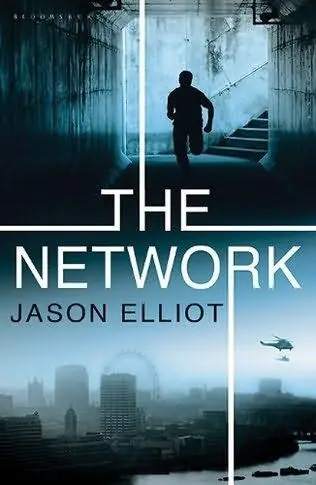
- Название:The Network
- Автор:
- Жанр:
- Год:неизвестен
- ISBN:нет данных
- Рейтинг книги:4 / 5. Голосов: 1
-
Избранное:Добавить в избранное
- Отзывы:
-
Ваша оценка:
The Network: краткое содержание, описание и аннотация
Предлагаем к чтению аннотацию, описание, краткое содержание или предисловие (зависит от того, что написал сам автор книги «The Network»). Если вы не нашли необходимую информацию о книге — напишите в комментариях, мы постараемся отыскать её.
The Network — читать онлайн бесплатно полную книгу (весь текст) целиком
Ниже представлен текст книги, разбитый по страницам. Система сохранения места последней прочитанной страницы, позволяет с удобством читать онлайн бесплатно книгу «The Network», без необходимости каждый раз заново искать на чём Вы остановились. Поставьте закладку, и сможете в любой момент перейти на страницу, на которой закончили чтение.
Интервал:
Закладка:
‘The SOPs are common sense mostly, but we’ll need to get them in our system,’ says H. ‘What sort of weapons do they use out there?’
‘Anyone who’s anyone has an AK-47,’ I say, half surprised he doesn’t already know. ‘Russian, Egyptian and Chinese versions mostly. There’s a few AK-74s around, but you don’t see many.’ The AK-74 is the smaller-calibre short-barrelled version of the AK-47, a prestige weapon carried by a number of distinguished commanders. There is no point in mentioning the endless variety of heavier weapons in use in the country.
‘Surprise, surprise. What about shorts?’
‘Makarov, I suppose.’ This is the Soviet-designed 9-millimetre pistol most often seen in Afghanistan. I’d nearly bought one for myself when I’d been there, but was dissuaded by my Afghan friend and driver, who said a pistol was ineffective. He carried a grenade with an extra-short fuse in his pocket instead.
‘Alright. We’ll brush up on weapons,’ says H, ‘and you can teach me about mines. I’ll see what other kit I can get out of the Kremlin. Are you fit?’
‘Been fitter.’
‘Try five K a day in under half an hour and we’ll take it from there.’ That sounds ominous. I can’t remember the last time I ran five kilometres, but all of a sudden I’m looking forward to the discipline.
‘Right,’ says H, glancing at his watch. ‘Got to get back to the memsahib.’
We walk back to the house. It starts to rain. H won’t come in again, he says. He puts up his collar, wishes me luck and walks to the end of the driveway and out towards his car. I head back inside and change into my running gear.
Then I stretch out on the sofa and fall asleep.
6
I no longer recall the exact sequence of the training that begins that week. It’s dark and drizzling when I leave for Hereford on the Tuesday morning. The sky begins to lighten only as I turn west on the M50, and soon the Malverns loom up on my right. An hour later, on the outskirts of a small village to the north-west of Hereford, I turn off a narrow lane and pull up facing a wooden front gate. Across a tended gravel driveway stands a small black and white timbered house typical of the county. An ageing dark blue Range Rover is parked in front of a detached garage.
A barking terrier runs up, and H appears moments later with an eager wave, opens the gate and invites me inside for coffee, defying once again my naive impression of the SAS soldier as a hard-hearted killer. In the front hallway of his home is a large framed photograph of H, looking youthful and wearing the unmistakable sand-coloured beret with the flaming-dagger badge. I imagine it lit up in the beam of a burglar’s torch, the muttered curses and the swift retreat.
‘Good man,’ says H, noticing that I’m already wearing my boots. ‘How’s the running coming along?’
‘Fine,’ I lie. I’ve started a five-K routine, but not without a few pauses on the way. Five kilometres seems like a long distance until you’re used to it. Boredom and the body’s resistance make it seem like about a hundred. My legs aren’t the problem. The protest comes from my lungs. No matter how fit I’ve been in the past, I’ve always hated long-distance running. ‘I’m a bit slow,’ I concede, feeling uncomfortable with the deceit, ‘but fine.’
‘Well, alright. You work on it. Come and have a look at the route, then we’ll walk and talk.’ He’s put a large-scale Ordnance Survey map of the Brecon Beacons, laminated in soft plastic film, on the kitchen sideboard. ‘We’ll start here,’ he says, pointing to a small building at the edge of a patch of forest just off the A470 in the heart of the Beacons, ‘at the Storey Arms.’ To the north of the road the light-brown contour lines thicken like a fingerprint.
I know what that means: up Pen-y-Fan in the rain.
‘We’ll leave the car in the car park and RV there if we get separated on the south side.’ He traces the route with the tip of a pencil. The plan is to head for the summit, walk down Cwm Llwch on the far side, follow a small road for a couple of miles around the base of the slope, then ascend again via a point called the Obelisk before heading down to the car. He points out an alternative rendezvous point for the north leg of the journey. RVs, backup RVs and emergency RVs are an obsession with the SAS, I’m learning.
Half an hour later we’re at our starting point. The weather’s not ideal. I last climbed Pen-y-Fan in shorts and a T-shirt several years ago, on a brilliant summer’s day. Now it’s cold and raining. Not heavily, but gusting in sheets, and there’s a distinct lack of ramblers. The slope above us disappears into a barricade of cloud. H offers to carry the Bergen, which holds our water, dry clothes and a heavy-duty orange plastic sheet for use as shelter in an emergency. I’m too proud to allow him to take it. We put on our waterproofs and H sees me grimace at the cold.
‘Better than being too hot,’ he says.
We trudge up and establish our pace. At least we’re walking. For selection to the SAS, we’d be running, says H when I ask him about his time in the Regiment. Despite being known for the gruelling tabs in the Beacons that every would-be trooper had to undergo, the Regiment’s selection process was designed to uncover mental resilience as much as physical grit. ‘You’d see a lot of muscle-bound guys packing it in,’ says H, recalling time spent as directing staff on selection. ‘Not because they weren’t fit enough, but because they got fed up the quickest. Too used to being tough, I suppose. It was the squinty-eyed little fellows who’d get through.’
Those who survived the gruelling Fan dance – up Pen-y-Fan and back three times – the night-time navigation to control points at memorised grid references, the heavily laden cross-country marches and mock interrogations, would end up on a month’s continuation training in the jungle. Brunei was the chosen location. H calls it ‘good jungle’. I don’t know what bad jungle is. He says it’s the jungle that really sorts people out, and where the real selection takes place.
‘Everything’s wet the whole time and there’s beasties all over the place. A lot of guys who did well on selection couldn’t handle the jungle,’ he says. I ask him how he’d fared on his own jungle training.
‘Me? Loved it,’ he says, beaming as the rain cascades over his eyebrows. ‘Happy as a pig in shit.’
We enter the cloud and feel its coldness. A purplish scar of track leads upwards. Beyond a dozen yards, every feature of the landscape is absorbed into the whiteness. H walks behind me and gives directions where the route looks uncertain. Higher up, a slippery outcrop of stone resembling a ruined wall marks the steepest portion of the ascent. The summit of Pen-y-Fan lies several hundred yards to the north-east. We reach it at the end of a narrow ridge where the flanks descend with spectacular steepness into deep glacial valleys on either side. But we can see nothing of the views.
It’s too cold to stop for more than a few moments. Using the corner of his compass, H points out our position on the map as the raindrops roll across its laminated surface, and we check our bearing for the long descent into Cwm Llwch. Beyond the valley at its base, we reach Cwm Gwdi, the remnants of the Parachute Regiment battle camp and the deserted road beyond. It loops west towards the shorter steeper ridge leading back up to the Obelisk.
Now I understand why H has chosen the route. It embraces a series of rewards and punishments – upward and downward gradients of varying degrees, from the painfully acute to the luxuriously gentle. You reap the pleasure of the gentle slopes to fight the steep ones. On a long tab there are strong arguments for stopping and others for going forward, and both spin out silently in your head. Bad weather magnifies the pleasures and the pains. The longer the route, the less seriously you take the clamour of these voices, which settle down into a kind of background grumble, while you drag your mind repeatedly back to something more concrete: the rhythm of your pace or breath.
Читать дальшеИнтервал:
Закладка:
Похожие книги на «The Network»
Представляем Вашему вниманию похожие книги на «The Network» списком для выбора. Мы отобрали схожую по названию и смыслу литературу в надежде предоставить читателям больше вариантов отыскать новые, интересные, ещё непрочитанные произведения.









Обсуждение, отзывы о книге «The Network» и просто собственные мнения читателей. Оставьте ваши комментарии, напишите, что Вы думаете о произведении, его смысле или главных героях. Укажите что конкретно понравилось, а что нет, и почему Вы так считаете.