Jason Elliot - The Network
Здесь есть возможность читать онлайн «Jason Elliot - The Network» весь текст электронной книги совершенно бесплатно (целиком полную версию без сокращений). В некоторых случаях можно слушать аудио, скачать через торрент в формате fb2 и присутствует краткое содержание. Жанр: Триллер, на английском языке. Описание произведения, (предисловие) а так же отзывы посетителей доступны на портале библиотеки ЛибКат.
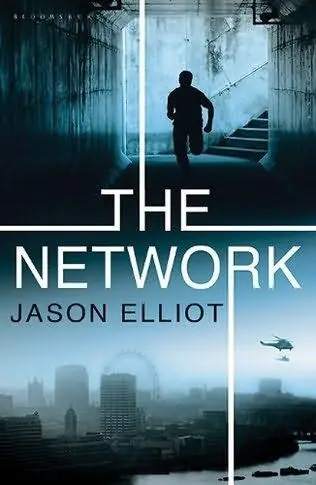
- Название:The Network
- Автор:
- Жанр:
- Год:неизвестен
- ISBN:нет данных
- Рейтинг книги:4 / 5. Голосов: 1
-
Избранное:Добавить в избранное
- Отзывы:
-
Ваша оценка:
The Network: краткое содержание, описание и аннотация
Предлагаем к чтению аннотацию, описание, краткое содержание или предисловие (зависит от того, что написал сам автор книги «The Network»). Если вы не нашли необходимую информацию о книге — напишите в комментариях, мы постараемся отыскать её.
The Network — читать онлайн бесплатно полную книгу (весь текст) целиком
Ниже представлен текст книги, разбитый по страницам. Система сохранения места последней прочитанной страницы, позволяет с удобством читать онлайн бесплатно книгу «The Network», без необходимости каждый раз заново искать на чём Вы остановились. Поставьте закладку, и сможете в любой момент перейти на страницу, на которой закончили чтение.
Интервал:
Закладка:
We start with the pistol, using the Browning in the manner of a hold-up. I push the muzzle into the small of H’s back. His hands go up; he shuffles forward and begins to babble as if terrified, then looks at me over his left shoulder. I’ve agreed to pull the trigger at the first moment I sense alarm. I feel his body turn and am about to respond, but within the space of a second I find myself on the ground, looking up at him. His left hand is clenched around the shirt on my chest, which he’s pulled up at the last moment to prevent my head from hitting the ground too hard. His right hand is poised above me, ready to strike. The pistol lies on the grass. I’m shaken, and very impressed.
‘Easy,’ he says, pulling me gently to my feet. ‘Let’s break it down into stages.’
Everything depends on confidence in the key idea that the weapon can be deflected before it can be fired. The rest is more or less common sense, says H. It’s an expression he’s fond of, I notice. There’s an element of stealth – glimpsing but not fixing on the threatening weapon – and distraction – dropping one’s keys or wallet onto the ground at the moment before counter-attacking. The counter-attack comes in the form of a swift turn and, at the same moment, a downward blow to deflect the weapon and open the attacker’s body to further disabling strikes.
‘Better not to launch into it at the first instant,’ says H. ‘That’s when a gunman’s most tense because he’s expecting you to try it on. Choose your moment. Get him talking and his mind off the weapon. Then check the hand it’s in by glancing over your shoulder. Pushing against the weapon is useful too, because when you start to turn it’ll slide off-target. The downward strike is hard and fast. Follow up with an open hand to the chin and a knee in the groin.’
There are more precise methods for seizing a pistol without harming an attacker, he tells me, but they take too long to learn.
‘Forget about Jackie Chan. The aim here is to disarm and disable, not circus tricks. Besides,’ he adds with a solemn look, ‘anyone who puts a weapon on you deserves whatever they get.’
This is the first glimpse I have of the steel beneath the velvet.
We practise being held up from front and back, applying the same principles with slight variations. A pistol to the head, pointed in the manner of an over-zealous gangster, is in fact the easiest of all threats to counter. But no two attacks are exactly the same, says H, and we practise until the moves come without thought. After this, he demonstrates optional refinements such as breaking the attacker’s trigger finger or nose.
Then he goes into the house and returns with the AK. We run through a similar routine, as he explains that a rifle is in fact less risky to deal with than a pistol. The defender can move past the point of danger – the muzzle – and prevent the rifle returning to its target by moving in close and blocking it. The bulky foresight on the muzzle of an AK also makes it ideal to grab, and allows the defender to control the weapon. As the attacker goes down, a few jerks on the barrel is usually enough to break his grip.
‘Once it’s yours, you can decide what you want to do,’ he says.
We try this out from the front a few times, at increasing speeds. H recommends a succession of kicks to the attacker’s knee and sharp pulls on the barrel of the rifle. We move on to the variation from behind. He jabs the muzzle into my back and shouts, ‘Move it!’ and I turn and strike the barrel, feeling the outer side of my palm connect with the foresight. But I hit it too hard, and the skin on the edge of my hand splits open like a banana peel. I finish the move, but there’s blood streaming over our clothes. H shoulders the AK with one hand and squeezes the sides of the cut together.
‘Bad luck,’ he says, ‘but I think you’ve got the hang of it.’ He leads me indoors, still holding the bloody hand, which drips over the kitchen floor. He stretches a few surgical strips across the wound, then binds it up in a bandage.
‘Lucky the memsahib’s away for a few days. She can’t stand the sight of blood.’
Life at home after our sessions together seems quiet. I study the weapons manual, practise stripping the AK, the Makarov and the Browning, and wonder how the Jehovah’s Witnesses might react if I came to the door with an AK at the ready. I perfect the skill of trapping small rodents, because the organisation of night-time ambushes in secondary jungle is not really practical in my garden, with the help of another manual H has lent me called Operational Techniques Under Special Conditions. I also force myself to run, and begin to shave seconds off my circuit times, though the margin is proving disappointingly difficult to improve on. My thighs are in fierce protest after the slopes of the Beacons, and running makes my calf muscles hurt all day long. I’m in constant discomfort.
The following week, my training with H follows the same pattern. His wife Sally is away again, visiting family over the weekend, and we have the house to ourselves. We walk and run long circuits in the mornings and go over practical skills in the afternoons. In the evenings we add more detail to the overall plan.
H says we’ll need to practise car drills too.
‘If our opsec is up to scratch, no one who doesn’t need to will ever know what we’re doing. But we have to plan for worst-case scenarios.’ He’s right. It’s not impossible that someone might try to rob us. In Afghanistan there are unofficial checkpoints where we might be held up, or worse. ‘Best way to deal with a bogus VCP is to never get into one,’ says H. ‘Next best is to turn around fast. Last resort is to drive through.’ We agree that driving through vehicle checkpoints isn’t such a great idea because trigger-happy Afghans are inclined to shoot at the occupants, rather than the tyres, of disobedient vehicles, and Afghans tend to be good shots. The problem of banditry has been much reduced by the Taliban, but their Arab allies affiliated with al-Qaeda are known to be cruel and frequently ruthless, and make Afghan bandits seem kindly.
One morning, another week later, he reverses his Range Rover into the centre of the driveway, and we stand by it as he speaks, imagining the scenario of coming under attack on some lonely stretch of Afghan road.
The interior of a vehicle, unless it’s armoured, offers no protection at all, which makes getting out fast a priority. H explains that a high-velocity round has no difficulty going through the body of a car and that the only part of a normal vehicle which can provide cover is either the engine block or the wheels. Since you can’t manoeuvre from behind an engine block, that leaves the wheels.
‘There’s just one problem,’ he says, asking me to lie down behind one of the wheels and imagine that I’m trying to return fire. Between the ground and the underside of the car is a thin strip of space, beyond which the ground obscures everything. The only thing I’ll be able to shoot from this position is our attacker’s toes.
‘You can’t see a bloody thing,’ I say.
‘Exactly.’
At that moment I hear a rapid panting in my ear as H’s terrier runs up and begins feverishly licking my face.
‘Jeffrey!’ hisses H. ‘Get out of it! Fuck off!’ The dog persists, so he leads it back into the house and, apologising, settles down beside me again.
‘If you stick your head up over the wheel, you’ll have a better view.’
That makes sense. Steadying my imaginary weapon over the bonnet of the car, I line up on an enemy sheep in the field beyond.
‘Get the idea?’ H retrieves the AK, puts it on the rear seat, and we get into the car. ‘Most important is to agree who goes where, so we don’t end up on top of each other. Let’s say we’re coming under fire from my side. You go back, I’ll go front. Shall we try it?’
Читать дальшеИнтервал:
Закладка:
Похожие книги на «The Network»
Представляем Вашему вниманию похожие книги на «The Network» списком для выбора. Мы отобрали схожую по названию и смыслу литературу в надежде предоставить читателям больше вариантов отыскать новые, интересные, ещё непрочитанные произведения.





Обсуждение, отзывы о книге «The Network» и просто собственные мнения читателей. Оставьте ваши комментарии, напишите, что Вы думаете о произведении, его смысле или главных героях. Укажите что конкретно понравилось, а что нет, и почему Вы так считаете.