Jason Elliot - The Network
Здесь есть возможность читать онлайн «Jason Elliot - The Network» весь текст электронной книги совершенно бесплатно (целиком полную версию без сокращений). В некоторых случаях можно слушать аудио, скачать через торрент в формате fb2 и присутствует краткое содержание. Жанр: Триллер, на английском языке. Описание произведения, (предисловие) а так же отзывы посетителей доступны на портале библиотеки ЛибКат.
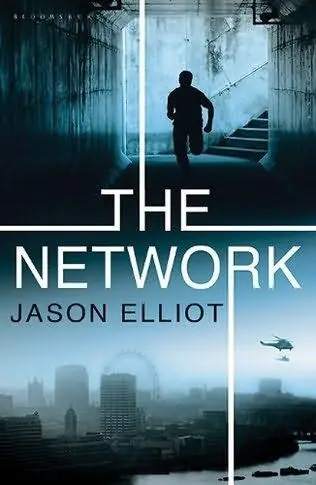
- Название:The Network
- Автор:
- Жанр:
- Год:неизвестен
- ISBN:нет данных
- Рейтинг книги:4 / 5. Голосов: 1
-
Избранное:Добавить в избранное
- Отзывы:
-
Ваша оценка:
The Network: краткое содержание, описание и аннотация
Предлагаем к чтению аннотацию, описание, краткое содержание или предисловие (зависит от того, что написал сам автор книги «The Network»). Если вы не нашли необходимую информацию о книге — напишите в комментариях, мы постараемся отыскать её.
The Network — читать онлайн бесплатно полную книгу (весь текст) целиком
Ниже представлен текст книги, разбитый по страницам. Система сохранения места последней прочитанной страницы, позволяет с удобством читать онлайн бесплатно книгу «The Network», без необходимости каждый раз заново искать на чём Вы остановились. Поставьте закладку, и сможете в любой момент перейти на страницу, на которой закончили чтение.
Интервал:
Закладка:
I throw open the door and tumble out, slamming it behind me instinctively just as H is trying to dive out. He blocks it with his hand and peers at me over the edge of the seat with a tolerant look I haven’t seen before.
‘Best not to slam the door in my face. Let’s try again.’
We return to the seats.
‘Last one out gets the AK. Enemy left – go!’
H rolls out of the passenger side and crouches behind the front wheel as I follow, grab the AK out of the back and position myself behind the rear wheel, firing imaginary rounds at our attackers.
‘Better,’ he says.
‘You must feel pretty vulnerable with your head sticking out like that,’ I say.
‘You do,’ he replies. ‘That’s why you don’t want to be there too long.’
We install ourselves back in the car.
‘Now we’ll withdraw under fire.’ He points around the garden. ‘I’ll move to that tree while you give covering fire. When I say, you move along the same path until we’re both behind the rhododendrons. When one of us is moving, the other is firing.’
‘Got it.’
We tumble out again at his signal. Bang bang bang bang bang! H runs to the tree. Then I follow as he covers me from the bushes beyond. Bang bang bang bang bang! We end up lying beside each other thirty yards from the car.
‘Fine,’ he says. ‘But I probably would have shot you. You ran through my line of fire. Try to keep a sense of where I am.’
Leaving me feeling like a small child, H disappears inside his garage and emerges with two black nylon waist packs.
‘Here,’ he says, handing me one of them, ‘your go bag.’ From the weight of it I know the Browning is inside. We check the weapons, which are unloaded, and put the packs on the bonnet.
‘You’ll usually have something like this on an op,’ he says, unzipping the main pouch of his bag. ‘Medical kit, E amp; E stuff, money, maps, heli marker for your exfil, and some other bits and pieces – it depends on what you need at the time. We’ll pretend these are ours and keep them under the seats.’
We stash the bags behind our heels and pretend once again to be heading into an ambush. If we’re expecting trouble, the best place for the Browning is on the seat under one’s leg, which saves having to scramble about for it. I copy him as he slides the weapon under his thigh with the butt facing out.
The Brownings are in our hands as we dive out again, then bound in turn across the drive into the garden.
‘Good, but you forgot the bag.’
But I’m learning. We repeat the drill several more times, upping the tempo each time until we’ve covered all the combinations. Speed, aggression and determination are the keys to success, he says. If there are only a few attackers, a concerted counter-attack with a high rate of fire from the AK can turn the tables, but it has to happen quickly.
We break for tea and H starts his ritual note-taking at the kitchen table. We draw up some general notes on security, with a plan to refine them as we go along. He draws a map of the ideas we need to understand. He lists the possible threats we’ll face, and how to defeat or minimise our vulnerability to them. He’s concerned with communications and transport, and getting safely from A to B, and not letting our plans be known to others. The level of detail borders on obsessive, but being methodical is what gives the SAS its reputation.
H talks at length about vehicle security: not choosing taxis which offer themselves, avoiding fixed routes, not getting boxed in when in heavy traffic, how to carry out a quick inspection of a vehicle to see if it’s been tampered with, code words for agreed sites, identifying safe havens to divert to in an emergency, and the need for back-up plans.
I realise he’s working his way through his own version of a military orders plan at combat-team level. This is generally written up under several headings. The first is ‘Ground’, which identifies the physical terrain, both generally and in detail. ‘Situation’ details friendly and enemy forces in the area of the operation, as well as the political layout. ‘Mission’ defines the scope of the operation, summed up in snappy language: kill X or destroy Y. ‘Execution’ goes into the details of routes, movement, RVs, action on target and exfil procedures – how to get home again. ‘Service Support’ deals with weapons, rations and equipment and how to get them to and from where they need to be. There’s another standard heading, which I can’t remember.
‘ “Command and Signals”,’ says H. ‘Radios, mostly. Who talks to who, when and how. We won’t be calling in much air support. Just checking in with London from time to time.’ He waves a pen over the notes. ‘And we need to think of a cover story for our time in-country. Something short term.’ This is my task. He then explains how I should apply for a second passport, which can be left hidden in a safe place in case we’re parted unexpectedly from our things.
His wife has prepared a dinner for us in advance. We eat and then devote the evening to familiarising ourselves with the weapon that lies behind the whole operation.
‘Might want to study this,’ says H, putting a bulky manual in front of me. It’s the American DoD training documentation for the FIM-92. The pages are marked secret, and there are several hundred of them.
‘The Sovs would’ve killed to get their hands on this a few years back,’ he says, tapping the cover.
‘They were the first to find out the hard way what the Stinger could do,’ I say, thinking of the missile’s deadly effect on Soviet airpower in Afghanistan.
‘Not quite,’ he corrects me. ‘The Yanks gave us some of these when we were down south in the Falklands. There was only one bloke from the Regiment who knew how to use the Stinger, and he was on that Sea King that crashed in the South Atlantic. A trooper in D Squadron managed to shoot down an Argentine fighter, though he was bloody lucky. That was the first combat kill with the Stinger.’
Its portability and reliability make it one of the most desirable weapons in the world. It is strange to think of the most advanced anti-aircraft technology of the time being hauled around Afghanistan on the backs of donkeys and camels. The Stinger’s role in the final humiliation of the Soviet army was never really acknowledged.
The earliest Stinger models didn’t distinguish between enemy or friendly targets: anything in the Afghan skies was fair game. The long thin missile is fitted into a fibreglass launch tube, and then attached to an assembly made up of the trigger and the infrared antennae, which looks vaguely like a toaster. A small battery unit is clipped in place, and when the missile has locked onto its target, a small speaker gives out the signal to fire. In case there is too much noise for it to be heard, a vibrator buzzes in the cheekbone of the firer. There are a number of checks and sensors that indicate whether the weapon is serviceable.
We need to know these things, and we go over them in detail.
Several hours later H gathers up our paperwork and locks it in a small safe. Then, when it’s time to turn in, he waves a hand over his bookshelves and invites me to have a browse.
‘You might like this one.’ He pulls down a book about the Regiment and fans the pages until he reaches the chapter devoted to the campaign in Oman. There’s a selection of photographs taken at the height of the conflict, but the images of the soldiers don’t look like conventional portraits. The men wear beards, ragged-looking uniforms and frayed caps or Arab shemaghs; cigarettes dangle from their lips, and many of them look too old to be soldiers in any case.
H points to a photograph of a fearsome-looking bearded man with a sunburned face under a combat cap. A bulky general purpose machine gun and dangling belt of gleaming ammunition hang from his shoulder.
Читать дальшеИнтервал:
Закладка:
Похожие книги на «The Network»
Представляем Вашему вниманию похожие книги на «The Network» списком для выбора. Мы отобрали схожую по названию и смыслу литературу в надежде предоставить читателям больше вариантов отыскать новые, интересные, ещё непрочитанные произведения.








Обсуждение, отзывы о книге «The Network» и просто собственные мнения читателей. Оставьте ваши комментарии, напишите, что Вы думаете о произведении, его смысле или главных героях. Укажите что конкретно понравилось, а что нет, и почему Вы так считаете.