Jason Elliot - The Network
Здесь есть возможность читать онлайн «Jason Elliot - The Network» весь текст электронной книги совершенно бесплатно (целиком полную версию без сокращений). В некоторых случаях можно слушать аудио, скачать через торрент в формате fb2 и присутствует краткое содержание. Жанр: Триллер, на английском языке. Описание произведения, (предисловие) а так же отзывы посетителей доступны на портале библиотеки ЛибКат.
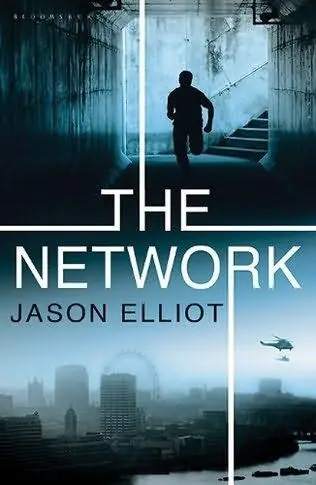
- Название:The Network
- Автор:
- Жанр:
- Год:неизвестен
- ISBN:нет данных
- Рейтинг книги:4 / 5. Голосов: 1
-
Избранное:Добавить в избранное
- Отзывы:
-
Ваша оценка:
The Network: краткое содержание, описание и аннотация
Предлагаем к чтению аннотацию, описание, краткое содержание или предисловие (зависит от того, что написал сам автор книги «The Network»). Если вы не нашли необходимую информацию о книге — напишите в комментариях, мы постараемся отыскать её.
The Network — читать онлайн бесплатно полную книгу (весь текст) целиком
Ниже представлен текст книги, разбитый по страницам. Система сохранения места последней прочитанной страницы, позволяет с удобством читать онлайн бесплатно книгу «The Network», без необходимости каждый раз заново искать на чём Вы остановились. Поставьте закладку, и сможете в любой момент перейти на страницу, на которой закончили чтение.
Интервал:
Закладка:
‘That’s another thing,’ says H, reaching out for it. ‘Don’t ever prop the weapon anywhere where it can fall over. Always lie it down within reach of you, breech side up, so you don’t get dirt in it.’
Suddenly I remember a question I’ve been wanting to ask him.
‘You know those documentaries where you see American servicemen tapping the magazines of their weapons on their helmets before locking them onto their M16s? Why do they always do that?’
‘I don’t know,’ he says thoughtfully. ‘I’ve never worn a helmet.’
We move on. He unwraps the remaining bundle on the table to reveal a 9-millimetre Makarov pistol with five-pointed Soviet star on the grip panels. He releases the magazine, which slips into his palm.
‘You’ve seen one of these. It’s like the AK. A bit primitive, but effective and reliable. They say it’s based on the Walther PPK. Double action, so you can cock it either with the hammer or by pulling back the slide. The trigger pull’s a bit heavy in double-action mode. Good stopping power though.’
We go over the details of the mechanism, how to check the chamber and make safe. The pistol can be stripped by pulling down on the trigger guard, allowing the slide to be eased off from the rear. The barrel is fixed. I practise loading and unloading, thinking all the while about the expression ‘stopping power’. It’s a term as removed from the reality it describes as collateral damage or intelligence interrogation – death and torture respectively. Herein, I reflect, lies the terrible contradiction between two of the most momentous experiences in the life of a man: the near-irresistible thrill of conflict and the horror it produces.
Our session has a final stage. H leaves the room again and returns with what looks like a book and yet another weapon. On the dark blue cover of the book defense intelligence agency is printed in silver letters. Several yellow Post-its protrude from between the pages. The weapon in his hand is an FN HP, better known as the Browning High Power. It was originally manufactured in Belgium by the famous Fabrique Nationale, but has been copied all over the world. I’d learned how to use it in the army, where it was also known as the L9A1. I’d also killed a man with the same weapon.
‘Personal favourite,’ says H, as he clears it, then clicks the magazine gently back into place. The Browning has been the army’s sidearm of choice for decades, and compared to the latest automatics using plastic and ceramic parts, it’s starting to look old-fashioned. The Swiss-made SIG is the most recent sidearm of choice for the Regiment, he says, but the Browning’s reliability and high-capacity magazine make it popular with armed forces in so many countries, it’s going to be around for a while longer.
‘It’d be nice to have a couple to take with us,’ says H with a grin as he weighs the pistol in his hand. This one’s a recent DA model, he says, a double-action version of the original that incorporates a few modifications. The magazine can hold fourteen rounds, making fifteen with one in the chamber; the shape of the trigger guard has been changed to improve the grip when firing with two hands; and instead of a manual safety catch, there’s now an ambidextrous de-cocking lever mounted on the frame. There’s an internal firing pin safety mechanism and another safety to prevent firing if the slide isn’t all the way back.
As he points out the weapon’s features, his fingers move lightly over its surfaces with the swift dexterity of a conjuror, and the dark metal seems suddenly alive to his touch, ready to spring into action. He draws back the slide, presses the de-cocking lever, takes the magazine out and replaces it, and flips the pistol between his hands.
‘I used to sit for hours playing with one of these,’ he says as he slides it behind his back in a single fluid motion and presents to me his open palms. Then with the same effortless gesture the pistol reappears in his hand, supported by the other in a firing grip.
‘Get the feel of it,’ he says, and passes it to me.
I like the feel of the ambidextrous design, which means I can reach the de-cocking lever by lifting my thumb over the hammer without having to loosen my grip.
‘Do what comes naturally,’ says H. ‘Remember the mechanism stays open after the final round’s been fired. When you put in a fresh mag, push down the slide stop to send a new round forward, and you can keep firing without having to re-cock. You can also change the mag release button so that it goes on the other side, if you want.’
He puts his hands over mine to demonstrate the correct grip when firing over the sights, and the en garde position for what he calls instinctive shooting with the arms straight and both eyes open, when the target is up to fifteen feet away. It’s a style of shooting that the regular army doesn’t teach: two rounds in rapid succession to the head of the target. The Regiment has an expression for it: double tap.
‘Take them all with you,’ says H, waving a hand over the AK and the pistols, ‘and practise with all three. If you can strip them in the dark, so much the better. We’ll test-fire them next week after you’ve had a chance to play with them.’ Between the running, I’m thinking. I ask where we’ll do the test-firing. ‘We could go down to the Fort, I suppose. Good range, but it’s a bit of a hike.’ He’s talking about Fort Monckton in Portsmouth, where young spooks go for their early training in firearms. ‘But it’ll be easier to get up early and have a go in the hills somewhere. By the time anyone’s got out of their pyjamas to investigate, we’ll be long gone.’ He picks up the sinister-looking book from the table and fans its pages. ‘I’ve marked a few other weapons you might want to look at. You can compare with the Beretta and the SIG and the HK. Let’s hope we don’t have to use any of them, but you never know.’
I can’t help asking if he’s comfortable with me taking a bag full of weapons to my home.
‘Just try not to get nicked on your way. I can’t keep them here anyway. Sally would kill me if she knew I had weapons in the house.’ His wife’s aversion to guns seems an incongruous thing in the life of a professional soldier. Perhaps it’s the secret of their apparent happiness.
By degrees my training is moving from the abstract to the very concrete. H is a gentle but thorough taskmaster, who never hurries or raises his voice, nor pushes me too fast with anything I feel unsure about. He shares his knowledge freely and without any trace of pretension. I much prefer his manner and method to the arrogant mystification of Seethrough, who seems to delight in making me feel ignorant.
We walk again the following day, pushing the pace a little harder. It’s overcast but mercifully dry, saving us the discomfort of getting soaked by sweat under our waterproofs. We take the same route to Pen-y-Fan, then leave the summit on the steep eastern side in the direction of the pyramidal face of Cribyn, crossing the valley by the reservoir and climbing onto the broad plateau above. After a further two hours’ walking, a long downward traverse puts us on the road a mile and a half from the car. I run this stretch in considerable pain while H mutters encouragement at my side.
In the afternoon we begin drafting notes for the tasks and routines we need to cover. Then, breaking for tea, H wanders outside and feels the grass on his lawn. It’s dry enough and he has an idea. It’s one thing to be on the right side of a weapon, he says, but finding oneself unexpectedly at the business end is another matter. It’s time to practise disarming techniques.
At the heart of the theory of disarming – jap-slapping, as it’s unofficially called by Regiment men – lies the notion that, if a weapon is pointed close enough to one’s body, it’s possible to knock it aside before the attacker can pull the trigger. It’s difficult to believe at first, so the point of disarming routines is to demonstrate the truth of it. Unless the belief is there, says H, you’re liable to hesitate.
Читать дальшеИнтервал:
Закладка:
Похожие книги на «The Network»
Представляем Вашему вниманию похожие книги на «The Network» списком для выбора. Мы отобрали схожую по названию и смыслу литературу в надежде предоставить читателям больше вариантов отыскать новые, интересные, ещё непрочитанные произведения.









Обсуждение, отзывы о книге «The Network» и просто собственные мнения читателей. Оставьте ваши комментарии, напишите, что Вы думаете о произведении, его смысле или главных героях. Укажите что конкретно понравилось, а что нет, и почему Вы так считаете.