Elizabeth George - Just One Evil Act
Здесь есть возможность читать онлайн «Elizabeth George - Just One Evil Act» весь текст электронной книги совершенно бесплатно (целиком полную версию без сокращений). В некоторых случаях можно слушать аудио, скачать через торрент в формате fb2 и присутствует краткое содержание. Год выпуска: 2013, ISBN: 2013, Издательство: Dutton, Жанр: Детектив, на английском языке. Описание произведения, (предисловие) а так же отзывы посетителей доступны на портале библиотеки ЛибКат.
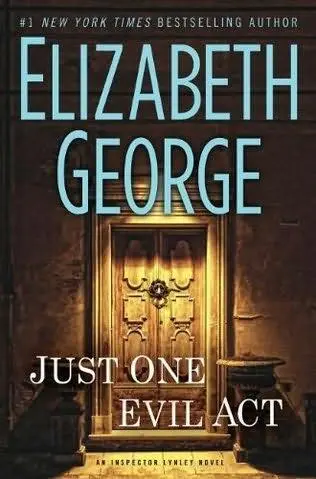
- Название:Just One Evil Act
- Автор:
- Издательство:Dutton
- Жанр:
- Год:2013
- ISBN:978-0-698-13828-5
- Рейтинг книги:5 / 5. Голосов: 1
-
Избранное:Добавить в избранное
- Отзывы:
-
Ваша оценка:
Just One Evil Act: краткое содержание, описание и аннотация
Предлагаем к чтению аннотацию, описание, краткое содержание или предисловие (зависит от того, что написал сам автор книги «Just One Evil Act»). Если вы не нашли необходимую информацию о книге — напишите в комментариях, мы постараемся отыскать её.
bestselling author Elizabeth George offers the latest in her Inspector Lynley series: a gripping child-in-danger story featuring fan favorite Barbara Havers. Detective Sergeant Barbara Havers is at a loss: The daughter of her friend Taymullah Azhar has been taken by her mother, and Barbara can't really help—Azhar had never married Angelina, and his name isn't on Hadiyyah's, their daughter's, birth certificate. He has no legal claim. Azhar and Barbara hire a private detective, but the trail goes cold.
Azhar is just beginning to accept his soul-crushing loss when Angelina reappears with shocking news: Hadiyyah is missing, kidnapped from an Italian marketplace. The Italian police are investigating, and the Yard won't get involved, until Barbara takes matters into her own hands. As she attempts to navigate the complicated waters of doing anything for the case against her superior's orders, her partner, Inspector Thomas Lynley, is dispatched to Italy as the liaison between the Italian police and Hadiyyah's distraught parents.
In time, both Barbara and Lynley discover that the case is far more complex than just a kidnapping, revealing secrets about Angelina; her new lover, Lorenzo; and even Azhar—secrets Barbara may not be willing to accept. With both her job and the life of a little girl on the line, Barbara must decide what matters most and how far she's willing to go to protect it.
Just One Evil Act — читать онлайн бесплатно полную книгу (весь текст) целиком
Ниже представлен текст книги, разбитый по страницам. Система сохранения места последней прочитанной страницы, позволяет с удобством читать онлайн бесплатно книгу «Just One Evil Act», без необходимости каждый раз заново искать на чём Вы остановились. Поставьте закладку, и сможете в любой момент перейти на страницу, на которой закончили чтение.
Интервал:
Закладка:
He’d been to Italy innumerable times—in childhood, adolescence, and as an adult—but somehow he’d never been to Lucca. So he was unprepared for the sight of the perfectly kept wall that had long protected the town’s medieval interior, both from marauders and from the occasional floods that its position on the alluvial plain of the River Serchio exposed it to. In many ways Lucca resembled numerous towns and villages he’d seen in Tuscany from his childhood on: with their narrow cobbled streets, their piazzas dominated by churches, and their fountains bubbling with fresh spring water. But in three ways it was different: in its number of churches, its remaining towers, and most of all its distinguishing wall.
He had to drive around this wall twice before he found the car park Denton had identified as being closest to the amphitheatre, so he was able to take in the towering trees upon it, as well as the statues, the military bulwarks, the parks, and the people on bikes, on rollerblades, in running clothes, and guiding pushchairs. A police car drove at a snail’s pace through them. Another stood parked above one of the many gates that gave access into the oldest part of the town.
He himself gained entrance through Porta Santa Maria. There he parked, and from there it was a short walk only to reach Piazza dell’ Anfiteatro, an ovoid marking upon the campestral landscape of the town. Lynley had to walk half the circumference of the repurposed amphitheatre to find one of the tunnel-like gallerie that allowed him access to the interior of the place, and once within its precinct, he paused and blinked in the bright sunlight that fell upon the yellow and white buildings inside and upon the stones that constituted the foundation of the piazza . Here there were tourist shops, cafés, apartments, and pensioni . His own was called Pensione Giardino although he suspected the garden of its name comprised only the impressive display of cacti, succulents, and shrubbery arranged in terracotta pots on various surfaces in front of the establishment.
It took a brief few minutes for Lynley to acquaint himself with the proprietor of the place. She was a young, heavily pregnant woman who introduced herself breathlessly as Cristina Grazia Vallera before she handed him his key, pointed out a claustrophobic breakfast room, and gave him the hours of colazione. That taken care of, she disappeared towards the back of the building, from which the crying of a small child emanated along with the welcome scent of baking bread, leaving him to find his room on his own.
He had no difficulty with this. He climbed the stairs, saw there were four rooms only, and located his at the front of the building, number three. It was warm within, so he opened the metal shutters over the window, then the window itself. He looked out at the piazza below him, where, at its centre, a group of students had positioned themselves in a large circle, facing outward. They were each sketching their own views of the piazza as their teacher moved among them. Thus, he saw Taymullah Azhar the moment the London man came through the galleria and headed for the pensione .
Lynley watched his progress. He had nothing with him but his devastation, and Lynley knew this feeling, its every nuance. He watched—one step back from the window—until Azhar disappeared beneath him into their shared accommodation.
Lynley removed his jacket and placed his suitcase upon the bed. In a moment, he heard footsteps on the tiles in the corridor, so he went to the door. When he opened it, Azhar was at the door to his own room, which was next to Lynley’s. He glanced over—as one would do—and Lynley was struck, even in the dim light of the corridor, by how contained the man was, even in his wretchedness.
“The chief inspector told us you were coming,” Taymullah Azhar said to Lynley, walking over to shake his hand. “I am, Inspector Lynley, so very grateful that you are here. I know how busy a man you are.”
“Barbara wanted to be sent,” Lynley told him. “Our guv wouldn’t allow it.”
“I know she must walk a very fine line in all of this.” Azhar used a thin hand to indicate the pensione , but Lynley knew he meant the situation of Hadiyyah’s disappearance. He also knew that the “she” in Azhar’s remarks did not refer to Isabelle Ardery.
“She does,” he told the London professor.
“I wish she would not. To have her on my conscience . . . what might happen to her . . . to her employment with the police . . . I do not wish this,” Azhar said frankly.
“Let go of that burden,” Lynley said. “Over a long acquaintance, I’ve found that Barbara goes her own way in matters that are important to her. Frankly? I wish she wouldn’t. Her heart’s always in the right place, but her wisdom—especially her political wisdom—often takes an ill-advised back seat to her heart.”
“This I have come to understand.”
Lynley explained to Azhar what his own position in the investigation would be as long as he remained in Lucca. He was in all respects an outsider, and how much he would be able to assist the Italian police was going to depend entirely upon them and upon the public minister. This man—a magistrate—directed the investigation, Lynley told Azhar. That was how Italian policing was structured.
“My job is to be a conduit for information.” Lynley went on to tell Azhar how it had come about that the Metropolitan police had decided to send a liaison officer to Lucca at all: because of The Source and what appeared to be Barbara Havers’s leaking information to that rag. “This has made her less than popular with Superintendent Ardery, as you can imagine. Nothing can be proved, of course, as to whether she actually gave them the story. But I have to say that I’m hoping my presence here will also keep Barbara out of any further trouble in London.”
Azhar took this in, quiet for a moment. “I will hope . . .” But he did not conclude the thought. Instead, he said, “The tabloids here are following the story, as well. I myself do what I can to keep it alive. Because with the tabloids involved . . .” He shrugged sadly.
“I understand,” Lynley told him. Pressure upon the police was pressure upon the police. No matter where it came from, it produced results.
Azhar went on to tell him that he was also carrying handbills to the nearby towns and villages. Rather than endure the agony of waiting for word of anything, he instead had been going out each day and posting these handbills in an ever-widening circumference around Lucca. He brought them from his room and handed one to Lynley. Mostly it comprised a large and very good picture of the little girl, with her name and the word MISSING written in Italian, German, English, and French beneath the photo along with a phone number that Lynley took to be that of the police.
Lynley was struck by the innocence of Hadiyyah’s expression in the handbill’s photograph and by how much of a child she still was. In the way of the modern world, children were growing up at a younger and younger age, so Hadiyyah could have looked like a miniature Bollywood film star despite her age. Instead, though, the photo showed a little girl with plaited hair tied off in small bows. She wore a crisp school uniform, and she had lively brown eyes and an impish grin. She looked quite small for a nine-year-old, which Azhar confirmed that indeed she was. This meant, of course, that she could have been mistaken for a younger child. Excellent pickings for a paedophile, Lynley thought grimly.
“This immediate area is not so difficult to canvass with the pictures,” Azhar said as Lynley gave the handbill back to him. “But as I move farther away from Lucca and as the towns rise up into the hills . . . Things are more difficult then.”
Читать дальшеИнтервал:
Закладка:
Похожие книги на «Just One Evil Act»
Представляем Вашему вниманию похожие книги на «Just One Evil Act» списком для выбора. Мы отобрали схожую по названию и смыслу литературу в надежде предоставить читателям больше вариантов отыскать новые, интересные, ещё непрочитанные произведения.










Обсуждение, отзывы о книге «Just One Evil Act» и просто собственные мнения читателей. Оставьте ваши комментарии, напишите, что Вы думаете о произведении, его смысле или главных героях. Укажите что конкретно понравилось, а что нет, и почему Вы так считаете.