Elizabeth George - Just One Evil Act
Здесь есть возможность читать онлайн «Elizabeth George - Just One Evil Act» весь текст электронной книги совершенно бесплатно (целиком полную версию без сокращений). В некоторых случаях можно слушать аудио, скачать через торрент в формате fb2 и присутствует краткое содержание. Год выпуска: 2013, ISBN: 2013, Издательство: Dutton, Жанр: Детектив, на английском языке. Описание произведения, (предисловие) а так же отзывы посетителей доступны на портале библиотеки ЛибКат.
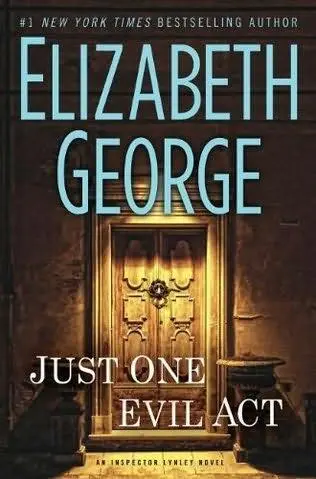
- Название:Just One Evil Act
- Автор:
- Издательство:Dutton
- Жанр:
- Год:2013
- ISBN:978-0-698-13828-5
- Рейтинг книги:5 / 5. Голосов: 1
-
Избранное:Добавить в избранное
- Отзывы:
-
Ваша оценка:
Just One Evil Act: краткое содержание, описание и аннотация
Предлагаем к чтению аннотацию, описание, краткое содержание или предисловие (зависит от того, что написал сам автор книги «Just One Evil Act»). Если вы не нашли необходимую информацию о книге — напишите в комментариях, мы постараемся отыскать её.
bestselling author Elizabeth George offers the latest in her Inspector Lynley series: a gripping child-in-danger story featuring fan favorite Barbara Havers. Detective Sergeant Barbara Havers is at a loss: The daughter of her friend Taymullah Azhar has been taken by her mother, and Barbara can't really help—Azhar had never married Angelina, and his name isn't on Hadiyyah's, their daughter's, birth certificate. He has no legal claim. Azhar and Barbara hire a private detective, but the trail goes cold.
Azhar is just beginning to accept his soul-crushing loss when Angelina reappears with shocking news: Hadiyyah is missing, kidnapped from an Italian marketplace. The Italian police are investigating, and the Yard won't get involved, until Barbara takes matters into her own hands. As she attempts to navigate the complicated waters of doing anything for the case against her superior's orders, her partner, Inspector Thomas Lynley, is dispatched to Italy as the liaison between the Italian police and Hadiyyah's distraught parents.
In time, both Barbara and Lynley discover that the case is far more complex than just a kidnapping, revealing secrets about Angelina; her new lover, Lorenzo; and even Azhar—secrets Barbara may not be willing to accept. With both her job and the life of a little girl on the line, Barbara must decide what matters most and how far she's willing to go to protect it.
Just One Evil Act — читать онлайн бесплатно полную книгу (весь текст) целиком
Ниже представлен текст книги, разбитый по страницам. Система сохранения места последней прочитанной страницы, позволяет с удобством читать онлайн бесплатно книгу «Just One Evil Act», без необходимости каждый раз заново искать на чём Вы остановились. Поставьте закладку, и сможете в любой момент перейти на страницу, на которой закончили чтение.
Интервал:
Закладка:
Once inside the office suite, Salvatore learned that a wait for the magistrate would be necessary. For a junior prosecutor had been taken into the presence in advance of Salvatore’s appearance, he was told. That meant someone was being dressed down. Salvatore sighed and took up a magazine. He flipped through it, noted which closeted homosexual American celebrity was currently attaching himself to a conveniently stupid supermodel twenty years his junior, and tossed this rivista idiota to one side. After five minutes he requested that Fanucci’s secretary let the magistrate know that he was waiting.
She looked shocked. Did he truly want to chance an eruption of il vulcano ? she asked. He did, he assured her.
But it turned out that interrupting Fanucci was not necessary. A pale-to-the-gills young man emerged from the magistrate’s office and scuttled on his way. Salvatore strode in, unannounced and not wishing it otherwise.
Piero eyed him. His facial warts were pale excrescences against skin inflamed by whatever had gone on between him and his underling. Apparently deciding to say nothing about Salvatore’s unheralded entrance into his office, he gave a sharp and wordless nod to a television on one of his office bookshelves, and he clicked it on without preliminaries.
It was a recording of a broadcast, made that morning by England’s BBC. Salvatore spoke very little English and was thus unable to follow the rapid-fire conversation between the two presenters. They were engaged in a strange discussion about UK newspapers, it seemed, and one at a time they held them up to the camera.
Salvatore saw quickly that no translation of this broadcast was actually going to be necessary. Piero stopped the recording when the presenters reached the front page of a particular tabloid. The Source , it was called. It had the story.
This, he knew, was not a good development. One tabloid meant many. Many meant the possible incursion of British reporters into Lucca.
Fanucci clicked the recording off. He indicated that Salvatore was to take a seat. Piero himself remained standing because standing was power, and power, Salvatore thought, could be demonstrated in so many ways.
“What more have you learned from this street beggar of yours?” Fanucci asked. He meant the poor drug addict, him of the Ho fame sign. Salvatore had brought the youth once into the questura for a formal interrogation, but Fanucci was pressing for another. This would be, he’d instructed Salvatore, a more serious one, a lengthier one, one designed to “encourage” the unfortunate’s memory . . . such as it was.
Salvatore had been avoiding this. While Fanucci believed drug addicts capable of anything to support their habit, Salvatore did not. In the case of this particular drug addict, Carlo Casparia had been occupying that same spot at the entrance to Porta San Jacopo for the past six years without incident, a disgrace to his family but a menace to no one but himself.
He said, “Piero, there is nothing more to be learned from this man Carlo. Believe me, his brain is too addled to have planned a kidnapping.”
“Planned?” Fanucci repeated. “Topo, why do you say this was planned? He saw her, and he took her.”
And then? Salvatore thought. He produced an expression on his face that he hoped projected that question without having to ask it directly.
“It could be,” Fanucci said, “that we have a crime of opportunity, my friend. Can you not see that? He has told you that he saw the child, no? He was not so brain-addled that he forgot that. So why this one child in his memory, Topo? Why not another? Why did Carlo remember a child at all?”
“She gave him food, Magistrato . A banana.”
“Bah! What she gave him was a promise.”
“ Come? ”
“The promise of money. Must I spell it out for you what happens once he takes the child?”
“There has been no demand for ransom.”
“Why should there be ransom when so many other opportunities exist to make money off an innocent girl?” Fanucci counted them off on the fingers of his six-fingered hand. “She is bundled into the back of a car and bundled out of the country, Topo. She is sold into the sex trade somewhere. She is made into a household slave. She is handed over to a paedophile with a clever basement into which she is stuffed. She is given to a satanic worship group for sacrifice. She is made a rich Arab’s plaything.”
“All of which, Piero, would beg for planning, no?”
“None of which, Topo, we will ever learn until you question Carlo again. You must see to this without delay. I wish to read it in your next report to me. Tell me how else you intend to spend your time, little man, if not with this and in this direction?”
In answer to the insulting question, Salvatore first asked his blood to cool. Then he chose a significant detail that had arisen from the posters and handbills round the central part of town. He’d received two phone calls from two hotels in Lucca, one within the city’s wall and one from Arancio, not far from the road to Montecatini. A man had come by, in possession of a picture of the missing child in the company of a nice-looking woman, presumably her mother. The man had been looking for them, and he’d left a card with the hotel receptionists. Unfortunately, the card in both cases had been tossed away.
Fanucci swore at the stupidity of women. Salvatore didn’t bother to tell him that in both cases the receptionists had been men. What he did tell him was that this individual had been seeking the girl at least a month earlier or perhaps six weeks. That, he said, was the limit of what they knew.
“Who was this man?” Fanucci demanded. “What did he look like, at least?”
Salvatore shook his head. Trying to get a local receptionist to remember what someone looked like a month or six weeks or eight weeks after having seen the individual only once and probably for less than a minute . . . ? He extended his hands, palms up, empty. It could have been anyone, Magistrato.
“And this is all you know? This is all you have?” Fanucci demanded.
“With regard to this person seeking the woman and the girl, purtroppo , it is,” Salvatore lied. And when Fanucci would have begun a tedious lecture about Salvatore’s general incompetence or a diatribe ending with a threat to replace him, Salvatore threw the magistrate a bone.
He shared the fact of the emails that had gone from the child Hadiyyah and her father. “He’s here in Lucca now,” Salvatore said. “This is something that must be explored.”
“A London father who writes emails to his daughter residing in Italy?” Fanucci scoffed. “How is this important?”
“There are broken promises about visits he intended to make here,” Salvatore said. “Broken visits, broken hearts, and runaway children. It is a possibility that must be explored.” He looked at his watch. “I meet with these people—the parents together—in forty minutes.”
“After which you’ll report . . . ”
“ Sempre ,” Salvatore said. He would report something, he told himself. Just enough to keep il Pubblico Ministero satisfied that things were moving along under his idiotic direction. “So, my friend, if there is nothing else . . . ?” He got to his feet.
“As it happens, we are not finished,” Fanucci said. A smile touched his mouth without touching his eyes. Power still lay within his hands, and Salvatore saw he’d been outmanoeuvred again.
He sat. He looked as unruffled as he could. “ E allora? ” he said.
“The British embassy has phoned,” Fanucci told him. There was a tinge of pleasure in the tone he used, and Salvatore knew at once that the infuriating man had saved the best for last. He said nothing in reply. It was the least he could do to attain revenge. “The English police are sending a Scotland Yard detective.” Piero jerked his head at the television, at the recording they’d watched. “It seems they have no choice after the publicity.”
Читать дальшеИнтервал:
Закладка:
Похожие книги на «Just One Evil Act»
Представляем Вашему вниманию похожие книги на «Just One Evil Act» списком для выбора. Мы отобрали схожую по названию и смыслу литературу в надежде предоставить читателям больше вариантов отыскать новые, интересные, ещё непрочитанные произведения.









Обсуждение, отзывы о книге «Just One Evil Act» и просто собственные мнения читателей. Оставьте ваши комментарии, напишите, что Вы думаете о произведении, его смысле или главных героях. Укажите что конкретно понравилось, а что нет, и почему Вы так считаете.