Elizabeth George - Just One Evil Act
Здесь есть возможность читать онлайн «Elizabeth George - Just One Evil Act» весь текст электронной книги совершенно бесплатно (целиком полную версию без сокращений). В некоторых случаях можно слушать аудио, скачать через торрент в формате fb2 и присутствует краткое содержание. Год выпуска: 2013, ISBN: 2013, Издательство: Dutton, Жанр: Детектив, на английском языке. Описание произведения, (предисловие) а так же отзывы посетителей доступны на портале библиотеки ЛибКат.
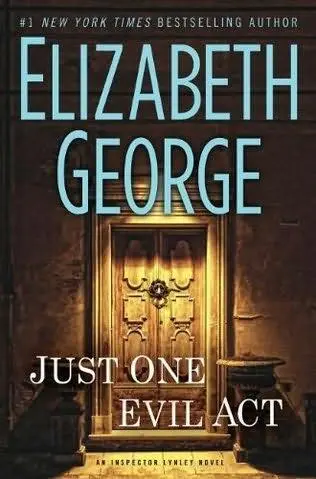
- Название:Just One Evil Act
- Автор:
- Издательство:Dutton
- Жанр:
- Год:2013
- ISBN:978-0-698-13828-5
- Рейтинг книги:5 / 5. Голосов: 1
-
Избранное:Добавить в избранное
- Отзывы:
-
Ваша оценка:
Just One Evil Act: краткое содержание, описание и аннотация
Предлагаем к чтению аннотацию, описание, краткое содержание или предисловие (зависит от того, что написал сам автор книги «Just One Evil Act»). Если вы не нашли необходимую информацию о книге — напишите в комментариях, мы постараемся отыскать её.
bestselling author Elizabeth George offers the latest in her Inspector Lynley series: a gripping child-in-danger story featuring fan favorite Barbara Havers. Detective Sergeant Barbara Havers is at a loss: The daughter of her friend Taymullah Azhar has been taken by her mother, and Barbara can't really help—Azhar had never married Angelina, and his name isn't on Hadiyyah's, their daughter's, birth certificate. He has no legal claim. Azhar and Barbara hire a private detective, but the trail goes cold.
Azhar is just beginning to accept his soul-crushing loss when Angelina reappears with shocking news: Hadiyyah is missing, kidnapped from an Italian marketplace. The Italian police are investigating, and the Yard won't get involved, until Barbara takes matters into her own hands. As she attempts to navigate the complicated waters of doing anything for the case against her superior's orders, her partner, Inspector Thomas Lynley, is dispatched to Italy as the liaison between the Italian police and Hadiyyah's distraught parents.
In time, both Barbara and Lynley discover that the case is far more complex than just a kidnapping, revealing secrets about Angelina; her new lover, Lorenzo; and even Azhar—secrets Barbara may not be willing to accept. With both her job and the life of a little girl on the line, Barbara must decide what matters most and how far she's willing to go to protect it.
Just One Evil Act — читать онлайн бесплатно полную книгу (весь текст) целиком
Ниже представлен текст книги, разбитый по страницам. Система сохранения места последней прочитанной страницы, позволяет с удобством читать онлайн бесплатно книгу «Just One Evil Act», без необходимости каждый раз заново искать на чём Вы остановились. Поставьте закладку, и сможете в любой момент перейти на страницу, на которой закончили чтение.
Интервал:
Закладка:
Salvatore swore. This was not a development he’d anticipated. Nor was it a development he liked.
“He’ll stay out of the way,” Fanucci told him. “His purpose, I’m told, will be to liaise between the investigation and the girl’s mother.”
Salvatore swore again. Not only would he now have to attend to the demands of il Pubblico Ministero but he’d also have to do the same for a Scotland Yard officer. More exasperating calls upon his time.
“Who is this officer?” he asked in resignation.
“Thomas Lynley is his name. That’s all I know. Except for one detail you should keep in mind.” Fanucci paused for dramatic effect and, as their encounter had gone on quite long enough, Salvatore played along with him for once.
“What’s the detail?” he asked wearily.
“He speaks Italian,” Fanucci said.
“How well?”
“Well enough, I understand. Stai attento , Topo .”
LUCCA
TUSCANY
Salvatore chose Café di Simo as their meeting place. In other circumstances, he might have met the parents of the missing child in the questura , but his preference generally was to save the questura for purposes of intimidation. He wished to see the parents as much at ease as he could possibly make them, and requiring them to come to the questura with its hustle, bustle, and inescapable police presence would not effect the degree of calm he wanted in them. Café di Simo, on the other hand, was rich in history, atmosphere, and delectable items from its pasticceria . It spoke not of suspicion but of comfort: a cappuccino or caffè macchiato for each of them, a plate of cantucci to be shared among all of them, and a quiet chat in the soothing side room with its panelled walls, small tables, and bright white floor.
They did not come together, the mother and the father. She arrived alone, without her partner Lorenzo Mura, and the professor arrived three minutes later. Salvatore placed the order for their drinks at the bar and, piatto di biscotti in hand, led them to the back of the café, where a doorway gave onto the interior room and where, conveniently, no one else was sitting at present. Salvatore intended to keep things that way.
“Signor Mura?” was how he politely asked about the signora’s partner. Odd, he thought, that Mura was not with her. In their earlier meetings, he’d hovered about like the woman’s guardian angel.
“ Verrà ,” she said. He would be coming. She added, “ Sta giocando a calcio ,” with a sad little smile. Obviously, Angelina Upman knew how it looked that her lover was off at a football match instead of at her side. She added, “ Lo aiuta ,” as if to clarify.
Salvatore wondered at this. It didn’t seem likely that football—either played or watched or coached—would do much to help anyone in the situation, as she claimed. But perhaps an hour or two of the sport took Mura’s mind off things. Or perhaps it merely got him away from his partner’s understandable, unceasing, and probably frenzied worry about her daughter.
She did not, however, appear frenzied now. She appeared deadened. She looked quite ill. The girl’s father—the Pakistani from London—did not look much better. Both of them were raw nerve endings and twisted stomachs. And who could blame them?
He noted how the professor held out a chair for the signora before taking a seat himself. He noted how the signora’s hands shook when she put the zucchero into her espresso. He noted how the professor offered her the plate of biscotti although Salvatore had gently pushed it in his own direction. He noted the signora’s use of Hari in speaking to the father of her child. He noted the father wince when he heard her use this name.
Every detail of every interaction between these two people was important to Salvatore. He had not spent twenty years of his life as a policeman only to escape knowing that family came under suspicion first when tragedy fell upon a member of it.
Using a combination of his wretched English and the signora’s moderately decent Italian, Salvatore brought them as up-to-date as he wished them to be. The airports had all been checked, he told them. So had the train stations. So had the buses. The net of their search for the child had been cast and was still in place: not only in Lucca but outward into the surrounding towns. So far, purtroppo , there was nothing to report.
He waited for the signora to make a slow translation for the father of her child. Her serviceable Italian got the main points across to the dark-skinned man.
“None of this is as . . . as simple as it used to be,” he said when she was finished. “Before EU, the borders were, of course, a different thing. Now?” He made a what-you-will gesture, not to show indifference but rather to indicate the difficulties they faced. “It has been a good thing for criminals, this lack of strong borders. Here in Italy”—with an apologetic smile—“with EU we gain a system of money that is no longer mad, eh? But as for everything else, as for policing . . . tracing movements is much more difficult now. And if the motorway is used to access the border . . . These things can be checked, but it takes much time.”
“And the ports?” The child’s father asked the question. The mother translated, unnecessarily in this case.
“Ports are being checked.” He didn’t tell them what anyone with a basic knowledge of geography knew. How many ports and accessible beaches were there in a narrow country with a coastline of thousands of kilometres? If someone had smuggled the child out of Italy via the sea, she was lost to them. “But there is a chance—every chance—that your Hadiyyah is still in Italy,” he told them. “Possibly she is still in the province. This is how you must think, please.”
The signora’s eyes shone with tears, but she blinked quickly and did not shed them. She said, “How many days is it usually, Inspector, before . . . something . . . some kind of clue? . . . is found.” She did not, of course, wish to say “before a body is found.” None of them wished to say that despite all of them probably thinking it.
He explained to her as best he could the complexity of the area in which they lived. Not only were the Tuscan hills nearby, but beyond them the Apuan Alps rose like threats. Within both these places were hundreds of villages, hamlets, villas, farms, cottages, retreats, caves, churches, convents, monasteries, and grottoes. The child could be literally anywhere, he told them. Until they had a sighting, a clue, a memory shaken from someone’s busy life, they were playing a waiting game.
Angelina Upman’s tears fell then. She accompanied them with not the slightest drama. They merely leaked out of her eyes and down her cheeks, and she did nothing to blot them away. The professor moved his chair closer to hers. He put his hand on her arm.
Salvatore told them about Carlo Casparia to give them a small hope to hold on to. The drug addict had been questioned and would be questioned again, he said. They were still trying to excavate something from the wasteland that was his brain. At first he had seemed a possible candidate to have orchestrated an abduction, Salvatore explained. But as there was no ransom demanded by anyone . . . ? He paused questioningly.
“ Sì , no ransom,” Angelina Upman affirmed in a whisper.
. . . Then they had to assume he was not involved. He could, of course, have taken the child and handed her over to someone else for payment. But this suggested a degree of planning and an ability to go unnoticed in the mercato that did not seem possible for Carlo. He was as well known as the accordion player to whom their daughter had given money. Had he led the child off somewhere, one of the venditori would have seen this.
Читать дальшеИнтервал:
Закладка:
Похожие книги на «Just One Evil Act»
Представляем Вашему вниманию похожие книги на «Just One Evil Act» списком для выбора. Мы отобрали схожую по названию и смыслу литературу в надежде предоставить читателям больше вариантов отыскать новые, интересные, ещё непрочитанные произведения.










Обсуждение, отзывы о книге «Just One Evil Act» и просто собственные мнения читателей. Оставьте ваши комментарии, напишите, что Вы думаете о произведении, его смысле или главных героях. Укажите что конкретно понравилось, а что нет, и почему Вы так считаете.