Elizabeth George - Just One Evil Act
Здесь есть возможность читать онлайн «Elizabeth George - Just One Evil Act» весь текст электронной книги совершенно бесплатно (целиком полную версию без сокращений). В некоторых случаях можно слушать аудио, скачать через торрент в формате fb2 и присутствует краткое содержание. Год выпуска: 2013, ISBN: 2013, Издательство: Dutton, Жанр: Детектив, на английском языке. Описание произведения, (предисловие) а так же отзывы посетителей доступны на портале библиотеки ЛибКат.
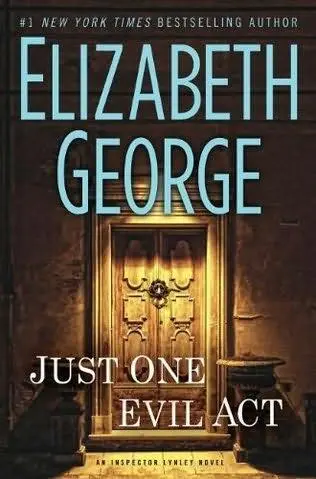
- Название:Just One Evil Act
- Автор:
- Издательство:Dutton
- Жанр:
- Год:2013
- ISBN:978-0-698-13828-5
- Рейтинг книги:5 / 5. Голосов: 1
-
Избранное:Добавить в избранное
- Отзывы:
-
Ваша оценка:
Just One Evil Act: краткое содержание, описание и аннотация
Предлагаем к чтению аннотацию, описание, краткое содержание или предисловие (зависит от того, что написал сам автор книги «Just One Evil Act»). Если вы не нашли необходимую информацию о книге — напишите в комментариях, мы постараемся отыскать её.
bestselling author Elizabeth George offers the latest in her Inspector Lynley series: a gripping child-in-danger story featuring fan favorite Barbara Havers. Detective Sergeant Barbara Havers is at a loss: The daughter of her friend Taymullah Azhar has been taken by her mother, and Barbara can't really help—Azhar had never married Angelina, and his name isn't on Hadiyyah's, their daughter's, birth certificate. He has no legal claim. Azhar and Barbara hire a private detective, but the trail goes cold.
Azhar is just beginning to accept his soul-crushing loss when Angelina reappears with shocking news: Hadiyyah is missing, kidnapped from an Italian marketplace. The Italian police are investigating, and the Yard won't get involved, until Barbara takes matters into her own hands. As she attempts to navigate the complicated waters of doing anything for the case against her superior's orders, her partner, Inspector Thomas Lynley, is dispatched to Italy as the liaison between the Italian police and Hadiyyah's distraught parents.
In time, both Barbara and Lynley discover that the case is far more complex than just a kidnapping, revealing secrets about Angelina; her new lover, Lorenzo; and even Azhar—secrets Barbara may not be willing to accept. With both her job and the life of a little girl on the line, Barbara must decide what matters most and how far she's willing to go to protect it.
Just One Evil Act — читать онлайн бесплатно полную книгу (весь текст) целиком
Ниже представлен текст книги, разбитый по страницам. Система сохранения места последней прочитанной страницы, позволяет с удобством читать онлайн бесплатно книгу «Just One Evil Act», без необходимости каждый раз заново искать на чём Вы остановились. Поставьте закладку, и сможете в любой момент перейти на страницу, на которой закончили чтение.
Интервал:
Закладка:
From his room’s chest of drawers, he took a map. He explained that he was about to set out for the rest of the day to continue canvassing the area with Hadiyyah’s picture. If Inspector Lynley had the time, he would show him where he had gone so far. Lynley nodded and they descended the stairs. They went out into the piazza, where, across from the pensione , a café offered a handful of small tables and, more important, shade. There they sat and ordered Coca-Cola, after which Azhar opened his map.
Lynley saw that he’d circled the towns he’d so far visited, and although he himself was familiar with the Tuscan landscape, he allowed Azhar to explain the difficulties he was encountering just going from one point to another in the nearby hills. Lynley could tell Azhar’s mere act of speaking about what he was doing acted to assuage what had to be tremendous anxiety, so he nodded, looked over the map with him, and noted how assiduous Azhar was being in his search for his daughter.
Finally, though, the London professor ran out of words. So he said what he no doubt had been trying to avoid saying from the first. “It’s been a week, Inspector.” And when Lynley said nothing but merely nodded, Azhar went on. “What do you think? Please tell me the truth. I know how reluctant you might be, but I wish to hear it.”
Lynley did Azhar the honour of believing that he meant what he said. He looked away from him for a moment, seeing the students at work on their drawings around the piazza, noting the ubiquitous green, shuttered windows protecting interiors of Italian apartments from the sun. A dog barked from somewhere within one of these apartments. From another the sound of piano music drifted. Lynley thought of how to approach the truth. There seemed no other way but to tell it directly.
“This is different from the kidnapping of a very small child,” he said quietly to Hadiyyah’s father. “A toddler snatched from a pushchair or a baby from its pram? That kind of kidnapping with no request for ransom suggests an intention to keep the child or to pass her along for a purpose that doesn’t involve harming her. An illegal ‘adoption’ perhaps, effected by money. Or just handing the child over to relatives desperate for a little one of their own. But to take a child Hadiyyah’s age—nine years old—suggests something else.”
Azhar asked no questions. His hands, folded on his map, gripped each other tightly. “There has,” he said quietly, “been no sign of . . . There has been no indication . . .”
No body was what he meant. “Which is a very good sign.” Lynley did not add how easily hidden in the Tuscan hills or in the Apuan Alps beyond them a body could be. Instead he said, “From this, we can conclude she’s well. Perhaps frightened, but well. We can also conclude that if someone’s intention is to pass Hadiyyah along to someone else, she would have to be hidden away for a time first.”
“Why is this?”
Lynley sipped his Coke and poured more from the can into the glass where three ice cubes did their limited best to keep it cold. He said, “It’s not likely a nine-year-old is going to forget her parents, is it? So she has to be held for a period of time until she becomes docile, used to her captivity, and reconciled to it and to her situation. She’s in a foreign country; her ability to speak the language is, perhaps, limited. Within time and in order to survive, she needs to learn to see her captors as her saviours. She needs to learn to depend upon them. But all of this works to our benefit. It puts time on our side and not on theirs.”
“Yet if she is not to be handed to another family for purposes of adoption,” Azhar pointed out, “then I do not see—”
Lynley cut him off quickly, to spare him speculations. “She’s young enough to be schooled in any number of things a child might be wanted for, but the point isn’t what those things are so much as it’s she’s alive and must be kept safe and well.” He didn’t add the more horrifying kind of scenario that was possible in this situation of Hadiyyah’s potential imprisonment, however. He didn’t point out that she was the perfect age to be held prisoner for a paedophile’s pleasure: in a basement, in a house with a carefully hidden and even more carefully soundproofed room, in a cellar, in an abandoned building high in the hills. For someone to have taken her so successfully from a market in the middle of the day, someone had to have prepared the abduction. Preparation for abduction also indicated preparation for use. Nothing could have been left to chance. So while time was on their side, the truth of the matter was that circumstances were not.
Yet there was one hope which could be to their benefit, and it came from Hadiyyah herself. For not everyone behaved as human psychology otherwise indicated she would behave. And there was a relatively simple way to ascertain if Hadiyyah was, potentially, among those people who acted differently from what might otherwise be expected of them in similar circumstances.
“May I ask,” Lynley said, “how likely is it that Hadiyyah would fight her situation?”
“What do you mean?”
“Children are often extremely resourceful. Might she raise a ruckus at an opportune moment? Might she draw attention to herself in some way?”
“In what way?”
“Behaving other than she’s told to behave. Trying to escape her captivity. Throwing herself into an attack on her captors. Producing a convenient tantrum. Setting a fire. Slashing a vehicle’s tyres. Anything other than being docile.” Anything other, Lynley didn’t add, than being a little girl.
Azhar seemed to go within himself to find a reply. Church bells rang somewhere in the town, joined by other church bells echoing off the narrow Lucchese streets. A flock of pigeons circled overhead, domesticated homing birds by the close formation they kept in the sky.
Azhar cleared his throat. “None of those things,” he said to Lynley. “She has not been brought up to be a trouble to anyone. I have—God forgive me—been very careful about that.”
Lynley nodded. It was, unfortunately, the way of the world. So often little girls—no matter their culture—were taught by their parents and by society to be pliant and sweet. It was little boys who were taught to use their wits and their fists.
“Inspector Lo Bianco,” Azhar added, “seems to feel there is . . . despite a week . . . there is hope . . . ?”
“And I agree,” Lynley said. But what he didn’t point out to the other man was that, with no word from kidnappers or anyone else, the hope he was clinging to was fading ever faster.
VICTORIA
LONDON
Barbara Havers put it off as long as possible. Indeed, she tried to restrain herself altogether. But by early afternoon she could no longer wait for her first report from DI Lynley. So she rang his mobile.
She knew he was unhappy with her. Any other officer would have kissed her feet for having bulldogged the circumstances of Hadiyyah’s disappearance in such a way that he ended up getting sent to Italy as a liaison officer for the girl’s family. But Lynley had other matters on his mind that went far beyond travelling to Italy at the expense of the Met. He had roller derby matches to attend and Daidre Trahair to . . . to whatever he was attempting to do with the large animal vet.
When Lynley answered with a single word—“Barbara”—she said in a rush, “I know you’re cheesed off. I’m bloody sorry, sir. You’ve got things on your . . . on your mind or whatever and I’ve put a spanner and I know that.”
He said, “Ah. As I suspected.”
She said, “I’m not admitting to anything. But how could anyone who knows her—and her dad and her mum—not want to do something? You see that, don’t you?”
Читать дальшеИнтервал:
Закладка:
Похожие книги на «Just One Evil Act»
Представляем Вашему вниманию похожие книги на «Just One Evil Act» списком для выбора. Мы отобрали схожую по названию и смыслу литературу в надежде предоставить читателям больше вариантов отыскать новые, интересные, ещё непрочитанные произведения.










Обсуждение, отзывы о книге «Just One Evil Act» и просто собственные мнения читателей. Оставьте ваши комментарии, напишите, что Вы думаете о произведении, его смысле или главных героях. Укажите что конкретно понравилось, а что нет, и почему Вы так считаете.