Elizabeth George - Just One Evil Act
Здесь есть возможность читать онлайн «Elizabeth George - Just One Evil Act» весь текст электронной книги совершенно бесплатно (целиком полную версию без сокращений). В некоторых случаях можно слушать аудио, скачать через торрент в формате fb2 и присутствует краткое содержание. Год выпуска: 2013, ISBN: 2013, Издательство: Dutton, Жанр: Детектив, на английском языке. Описание произведения, (предисловие) а так же отзывы посетителей доступны на портале библиотеки ЛибКат.
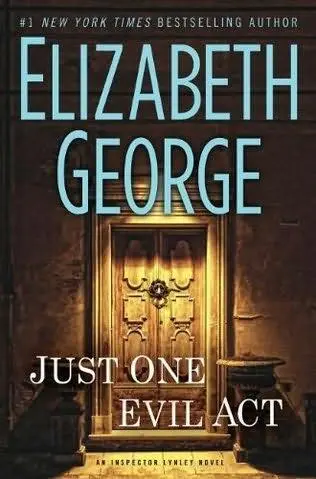
- Название:Just One Evil Act
- Автор:
- Издательство:Dutton
- Жанр:
- Год:2013
- ISBN:978-0-698-13828-5
- Рейтинг книги:5 / 5. Голосов: 1
-
Избранное:Добавить в избранное
- Отзывы:
-
Ваша оценка:
Just One Evil Act: краткое содержание, описание и аннотация
Предлагаем к чтению аннотацию, описание, краткое содержание или предисловие (зависит от того, что написал сам автор книги «Just One Evil Act»). Если вы не нашли необходимую информацию о книге — напишите в комментариях, мы постараемся отыскать её.
bestselling author Elizabeth George offers the latest in her Inspector Lynley series: a gripping child-in-danger story featuring fan favorite Barbara Havers. Detective Sergeant Barbara Havers is at a loss: The daughter of her friend Taymullah Azhar has been taken by her mother, and Barbara can't really help—Azhar had never married Angelina, and his name isn't on Hadiyyah's, their daughter's, birth certificate. He has no legal claim. Azhar and Barbara hire a private detective, but the trail goes cold.
Azhar is just beginning to accept his soul-crushing loss when Angelina reappears with shocking news: Hadiyyah is missing, kidnapped from an Italian marketplace. The Italian police are investigating, and the Yard won't get involved, until Barbara takes matters into her own hands. As she attempts to navigate the complicated waters of doing anything for the case against her superior's orders, her partner, Inspector Thomas Lynley, is dispatched to Italy as the liaison between the Italian police and Hadiyyah's distraught parents.
In time, both Barbara and Lynley discover that the case is far more complex than just a kidnapping, revealing secrets about Angelina; her new lover, Lorenzo; and even Azhar—secrets Barbara may not be willing to accept. With both her job and the life of a little girl on the line, Barbara must decide what matters most and how far she's willing to go to protect it.
Just One Evil Act — читать онлайн бесплатно полную книгу (весь текст) целиком
Ниже представлен текст книги, разбитый по страницам. Система сохранения места последней прочитанной страницы, позволяет с удобством читать онлайн бесплатно книгу «Just One Evil Act», без необходимости каждый раз заново искать на чём Вы остановились. Поставьте закладку, и сможете в любой момент перейти на страницу, на которой закончили чтение.
Интервал:
Закладка:
“I have a solicitor,” he told her. “He is called Aldo Greco. I wanted to give you his phone number, Barbara.”
She had a pencil but no paper, and she searched the floor frantically for something to write on before she had to give in and use the faded yellow wall. She took the number down for later programming into her mobile. She said, “Good. That’s an important step.”
“He speaks English very well,” Azhar said. “I’m told that it is lucky indeed that I found myself in need of a solicitor while being detained in this part of Italy. I’m told had this . . . this situation occurred in one of the small towns deeply south of Naples, it would be more difficult as a solicitor would have had to be willing to come from a larger city. I do not know why this is the case. It is merely what they told me.”
Barbara knew he was only making conversation. Her heart cracked a little at the thought that he would have to do this with her, his friend. She said, “What’s the embassy going to do? Have you spoken to anyone there?”
He said that he had, that it was the embassy who had given him a list of solicitors in Tuscany. But aside from that list, they could do little else for him beyond phoning his relatives, which he hardly wanted them to do. “They say that when a British national gets into difficulties on foreign soil, it’s up to that British national to get himself out of those difficulties.”
“Nice of them, informing you of that,” Barbara noted sardonically. “I always did wonder what our bloody taxes are going for.”
“Of course they have other concerns,” he said. “And as they do not know me and only have my word that there is no reason for the police to wish to question me . . . I suppose I can understand.”
Barbara found she could see him even without his presence. He’d be wearing one of the crisp white shirts he usually wore, she reckoned, along with trousers that were dark and simple. Cut well to fit him, the clothing would inadvertently reveal his slender frame. He’d always looked so delicate, she thought, so insubstantial when compared to other men. His appearance along with how well she knew him—and she knew him well, she told herself—spoke of his essential goodness. Which was, at the end of the day, why she gave him the information he needed in order to prepare himself for what was coming. This wasn’t about her loyalty to anyone, she told herself. This was about basic fairness.
She said, “Her kidney failure was caused by a toxin, Azhar. Shiga toxin it’s called.”
There was silence for a moment. Then he said, “What?” as if he hadn’t heard her clearly or, hearing her, couldn’t quite believe what she was telling him.
“DI Lynley rang the Italian bloke for me. He got the information.”
“From Chief Inspector Lo Bianco?”
“That’s the name. This bloke Lo Bianco said that Shiga toxin caused her kidneys to fail.”
“How is this possible? The strain of E. coli that results in Shiga toxin—”
“She picked it up somewhere, the E. coli . Apparently a bloody nasty strain of it. The doctors didn’t know what they were dealing with because of her earlier problems with the pregnancy, so they did a few basic tests and when the tests were negative or whatever they gave her a course of antibiotics—”
“Oh my God,” he murmured.
Barbara said nothing, and after a moment, he seemed to begin thinking aloud because he went on in a meditative tone with, “This is why he asked me about . . .” And then his voice altered to insistence as he said, “It has to be a mistake, Barbara. For one person alone to die from this? No. Virtually impossible. This is a bacteria, E. coli . It infects a food supply. Someone else would fall ill. Many people would fall ill because they would eat from the same food supply as Angelina. Do you see what I mean? This cannot have happened. There has to be a laboratory error.”
“As to laboratories, Azhar . . . You see where they’re heading, don’t you? The Italian coppers? With the whole idea of laboratories?”
He was silent then. The pieces were clicking into place. Or at least that was what Barbara had to believe. He wasn’t speculating in this silence, he wasn’t wondering, and he wasn’t planning his next move. He was merely concluding, completing for himself the chain of events that began with Angelina’s disappearance from London with their daughter in tow and ended with her death in Lucca.
He finally said quietly, “ Streptococcus , Barbara.”
“What?”
“This is what we study in my laboratory at University College: Streptococcus . Some laboratories study more than one bacteria. We do not. We study more than one strain of it, of course. But only strains of Streptococcus . Of personal interest to me is the Strep that causes meningitis in newborn infants.”
“Azhar. You don’t have to tell me this.”
“The mother, you see,” he said insistently as if she hadn’t spoken, “passes it to the infant as the baby travels through the birth canal. From this develops—”
“I believe you, Azhar.”
“—the infant’s meningitis. We’re seeking a way to prevent this.”
“I understand.”
“And there are other forms as well, other forms of Strep that we study in the lab since the graduate students are working on dissertations and the postgraduates are working on papers to be published. But the one I study . . . It is as I said. And of course Angelina was pregnant so they will ask about this, won’t they? How coincidental is it that I would study a bacteria found in pregnant women? And they will wonder as you are wondering because, after all, I arranged the kidnapping of my own child—”
“Azhar, Azhar .”
“I did not harm Angelina,” he said. “You cannot think I harmed her.”
She hadn’t been thinking that. She couldn’t even bring herself close to thinking that. But the truth was that in this entire Italian situation, there was more than one kind of harm, and Azhar knew this as well as Barbara herself. She said, “The kidnapping. Those tickets to Pakistan. You have to see how it’s going to look in conjunction with her death if word gets out.”
“Only you and I know about these things, Barbara.” His voice was wary.
“What about Doughty and Smythe?”
“They work for us,” he said. “We do not work for them. They’ve been instructed . . . You must believe me because if you of all people do not believe . . . I did not harm her. Yes, the kidnapping was a terrible thing to arrange, but how else could she ever be made to experience what it feels like when your child is there one day and gone the next and you have no idea . . . ?”
“Pakistan, Azhar. One-way tickets. Lynley knows about them. And he’s doing his homework.”
“You are not thinking,” he cried. “Why would I purchase tickets for July but arrange Angelina’s death in May? Why would I do that when I would have no need of tickets to Pakistan with Angelina dead?”
Because, Barbara thought, those tickets absolve you of suspicion and I did not see that until this moment because I couldn’t see it until I learned how Angelina Upman died. She said none of this, but her silence seemed to tell Azhar that something more was required of him, if not now then the next time Inspector Lo Bianco wanted to question him.
He said, “If you think I harmed her, you must ask yourself where I got this bacteria. Of course, someone somewhere in England studies it and perhaps in London but I do not know who. And yes, of course, this is an easy enough thing for me to find out. So I could have found out. But so could anyone else.”
“I see that, Azhar. But you have to ask how likely it is . . .” And here she paused because she had to consider what she owed: not only to Lynley, to Azhar, to Hadiyyah, but also to herself. She said, “The thing is . . . you lied to me once and—”
Читать дальшеИнтервал:
Закладка:
Похожие книги на «Just One Evil Act»
Представляем Вашему вниманию похожие книги на «Just One Evil Act» списком для выбора. Мы отобрали схожую по названию и смыслу литературу в надежде предоставить читателям больше вариантов отыскать новые, интересные, ещё непрочитанные произведения.









Обсуждение, отзывы о книге «Just One Evil Act» и просто собственные мнения читателей. Оставьте ваши комментарии, напишите, что Вы думаете о произведении, его смысле или главных героях. Укажите что конкретно понравилось, а что нет, и почему Вы так считаете.