Elizabeth George - Just One Evil Act
Здесь есть возможность читать онлайн «Elizabeth George - Just One Evil Act» весь текст электронной книги совершенно бесплатно (целиком полную версию без сокращений). В некоторых случаях можно слушать аудио, скачать через торрент в формате fb2 и присутствует краткое содержание. Год выпуска: 2013, ISBN: 2013, Издательство: Dutton, Жанр: Детектив, на английском языке. Описание произведения, (предисловие) а так же отзывы посетителей доступны на портале библиотеки ЛибКат.
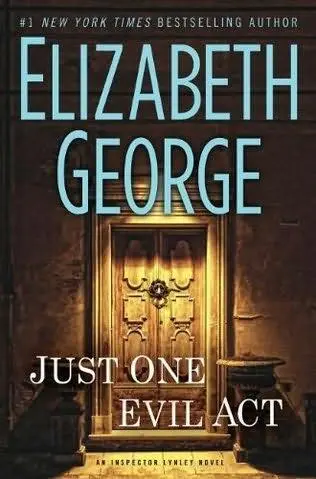
- Название:Just One Evil Act
- Автор:
- Издательство:Dutton
- Жанр:
- Год:2013
- ISBN:978-0-698-13828-5
- Рейтинг книги:5 / 5. Голосов: 1
-
Избранное:Добавить в избранное
- Отзывы:
-
Ваша оценка:
Just One Evil Act: краткое содержание, описание и аннотация
Предлагаем к чтению аннотацию, описание, краткое содержание или предисловие (зависит от того, что написал сам автор книги «Just One Evil Act»). Если вы не нашли необходимую информацию о книге — напишите в комментариях, мы постараемся отыскать её.
bestselling author Elizabeth George offers the latest in her Inspector Lynley series: a gripping child-in-danger story featuring fan favorite Barbara Havers. Detective Sergeant Barbara Havers is at a loss: The daughter of her friend Taymullah Azhar has been taken by her mother, and Barbara can't really help—Azhar had never married Angelina, and his name isn't on Hadiyyah's, their daughter's, birth certificate. He has no legal claim. Azhar and Barbara hire a private detective, but the trail goes cold.
Azhar is just beginning to accept his soul-crushing loss when Angelina reappears with shocking news: Hadiyyah is missing, kidnapped from an Italian marketplace. The Italian police are investigating, and the Yard won't get involved, until Barbara takes matters into her own hands. As she attempts to navigate the complicated waters of doing anything for the case against her superior's orders, her partner, Inspector Thomas Lynley, is dispatched to Italy as the liaison between the Italian police and Hadiyyah's distraught parents.
In time, both Barbara and Lynley discover that the case is far more complex than just a kidnapping, revealing secrets about Angelina; her new lover, Lorenzo; and even Azhar—secrets Barbara may not be willing to accept. With both her job and the life of a little girl on the line, Barbara must decide what matters most and how far she's willing to go to protect it.
Just One Evil Act — читать онлайн бесплатно полную книгу (весь текст) целиком
Ниже представлен текст книги, разбитый по страницам. Система сохранения места последней прочитанной страницы, позволяет с удобством читать онлайн бесплатно книгу «Just One Evil Act», без необходимости каждый раз заново искать на чём Вы остановились. Поставьте закладку, и сможете в любой момент перейти на страницу, на которой закончили чтение.
Интервал:
Закладка:
He said through Birgit, “ Dottore , can you tell me about your relationship with Hadiyyah’s mamma? She left you for Signor Mura. She returned to you at some point into her relationship with Signor Mura, sì ?, to soothe you into believing she’d come back. She disappeared then with Hadiyyah. You were left not knowing what had become of them, vero ?”
Unlike so many people who rely on a translation of the speaker’s words, Azhar didn’t look at Birgit as she repeated Salvatore’s statements in English. Nor would he do so for the rest of the interview. Salvatore wondered at this unnatural form of discipline in the man.
“It was not a good relationship,” Azhar said. “How could it have been otherwise? As you have said, she took Hadiyyah from me.”
“She had other men from time to time, vero ? While you and she were together?”
“I understand this now to be the case.”
“You did not know this previously?”
“While she lived with me in London? I did not know. Not until she left me for Lorenzo Mura. And even then I did not know about him. Just that it was likely there was someone, somewhere. When she returned to me, I thought she had . . . returned to me. When she left with Hadiyyah, my thought was that she had gone back to whoever it was she had left me for. To him or to someone else.”
“Do you mean that the first time she left you, she might have left you for someone other than Signor Mura?”
“That is what I mean,” Azhar affirmed. “We did not discuss it. When we saw each other again once Hadiyyah had been taken, there was no point to that sort of discussion.”
“And once you reached Italy?”
Azhar drew his eyebrows together as if to say, What about it? He didn’t answer at first as Signora Vallera came into the room with the caffè and a plate of biscotti . They were shaped like balls and covered with powdered sugar. Salvatore took one and let it melt in his mouth. Signora Vallera poured caffè from a tall crockery jug.
When she’d departed, Azhar said, “ Non capisco, Ispettore ,” and waited for elucidation.
Salvatore said, “I wonder if you carried with you the understandable anger at this woman for her sins against you.”
“We all commit sins against each other,” Azhar said. “I have no immunity from this. But I think she and I had forgiven each other. Hadiyyah was—she is—more important than the grievances Angelina and I had.”
“So you did hold grievances.” And when Azhar nodded, “Yet in your time here, those did not rise between you? You did not accuse? There were no recriminations?”
Birgit stumbled a bit with the word recriminations . But after a pause to consult a pocket dictionary, she carried on. Azhar said that there had been no recriminations once Angelina understood that he had had nothing to do with their daughter’s disappearance, although it had taken him much to convince her of this, including a call upon his estranged wife and their children as well as proof of his own presence in Berlin at the time of Hadiyyah’s disappearance.
“Ah, yes, Berlin,” Salvatore said. “A conference, vero ?”
Azhar nodded. A conference of microbiologists, he said.
“Many of them?”
Perhaps three hundred, Azhar told him.
“Tell me, what does a microbiologist do? Forgive my ignorance. We policemen . . . ?” Salvatore smiled regretfully. “Our lives, they are very narrow, you see.” He put a packet of sugar into his caffè . He took another biscotto and let it melt on his tongue like the other.
Azhar explained, although he didn’t look convinced by Salvatore’s declaration of ignorance. He spoke about the classes he taught, the graduate and postgraduate students he worked with, the studies carried out in his laboratory, and the papers he wrote as a result of those studies. He spoke of conferences and colleagues as well.
“Dangerous things, these microbes, I would think,” Salvatore said.
Azhar explained that microbes came in all shapes and sizes and levels of danger. Some, he said, were completely benign.
“But one does not interest oneself with those that are benign?” Salvatore said.
“I do not.”
“Yet to protect yourself from the danger of exposure to them? This must be crucial, eh?”
“When one works with dangerous microbes, there are many safeguards,” Azhar informed him. “And laboratories are differently designated according to what’s studied within them. Those that have higher biohazard levels have more safeguards built into them.”
“ Sì, sì, capisco . But let me ask: What, really, is the point of studying such dangerous little things as these microbes?”
“To understand how they mutate,” Azhar said, “to develop a treatment should one be infected by them, to increase the response time when one is trying to locate the source. There are many reasons to study these microbes.”
“Just as there are many types of microbes, eh?”
“Many types of microbes,” he agreed. “As vast as the universe and mutating all the time.”
Salvatore nodded thoughtfully. He poured more caffè into his cup from the crockery jug and held it up to both Birgit and Azhar. Birgit nodded; Azhar shook his head. He tapped his fingers against the tabletop and looked beyond Salvatore towards the door of the room. Hadiyyah’s high, excited chattering came to them. She was speaking Italian. Children, he thought, were so quick to pick up languages.
“And in your laboratory, Dottore ? What is being studied there? And is this laboratory a . . . what did you call it? A biohazard laboratory?”
“We study the evolutionary genetics of infectious diseases,” he said.
“ Molto complesso ,” Salvatore murmured.
This required no translation. “It is complex indeed,” Azhar said.
“Do you favour one microbe over another in this biohazard laboratory of yours, Dottore ?”
“ Streptococcus ,” he said.
“And what do you do with this Streptococcus ?”
Azhar seemed thoughtful at this. He frowned and once again his eyebrows drew together. He explained his hesitation by saying, “Forgive me. It is difficult to—forgive me—to simplify what we do for a layman’s understanding.”
“ Certo ,” Salvatore acknowledged. “ Ma provi, Dottore .”
Azhar did so after another moment of thinking. He said, “Perhaps to make it simple, it’s best to say that we engage in a process that allows us to answer questions about the microbe.”
“Questions?”
“About its pathogenesis, emergence, evolution, virulence, transmission . . .” Azhar paused to give Birgit time to work upon the more complicated words in Italian.
“And the reason for all this?” Salvatore asked. “I mean, the reason for all this in your laboratory?”
“The studying of mutations and how they affect virulence,” he said.
“In other words, how the mutation makes the microbe more deadly?”
“This is correct.”
“How the mutation makes the microbe more likely to kill?”
“This is also correct.”
Salvatore nodded thoughtfully. He observed Azhar at greater length than was called for by their conversation about his work. This obviously told the Pakistani man that something was up and, considering that he had been asked to turn his passport over to the police, what was up was obviously the death of his daughter’s mother and its possible connection to his own work.
Azhar said with apparent great care, “You are asking me these questions for a reason, Inspector. May I know what it is?”
Instead of replying in answer, Salvatore asked, “What happens to these microbes of yours if they are transported, Dottore ? What I mean is, what happens to them if someone transports them from one place to another?”
Читать дальшеИнтервал:
Закладка:
Похожие книги на «Just One Evil Act»
Представляем Вашему вниманию похожие книги на «Just One Evil Act» списком для выбора. Мы отобрали схожую по названию и смыслу литературу в надежде предоставить читателям больше вариантов отыскать новые, интересные, ещё непрочитанные произведения.










Обсуждение, отзывы о книге «Just One Evil Act» и просто собственные мнения читателей. Оставьте ваши комментарии, напишите, что Вы думаете о произведении, его смысле или главных героях. Укажите что конкретно понравилось, а что нет, и почему Вы так считаете.