Elizabeth George - Just One Evil Act
Здесь есть возможность читать онлайн «Elizabeth George - Just One Evil Act» весь текст электронной книги совершенно бесплатно (целиком полную версию без сокращений). В некоторых случаях можно слушать аудио, скачать через торрент в формате fb2 и присутствует краткое содержание. Год выпуска: 2013, ISBN: 2013, Издательство: Dutton, Жанр: Детектив, на английском языке. Описание произведения, (предисловие) а так же отзывы посетителей доступны на портале библиотеки ЛибКат.
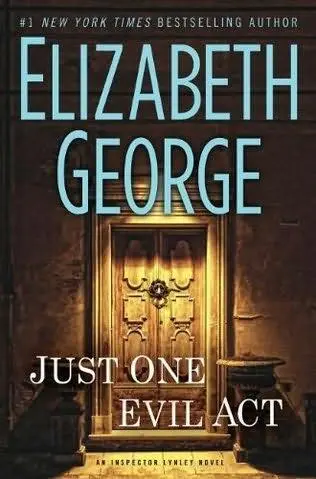
- Название:Just One Evil Act
- Автор:
- Издательство:Dutton
- Жанр:
- Год:2013
- ISBN:978-0-698-13828-5
- Рейтинг книги:5 / 5. Голосов: 1
-
Избранное:Добавить в избранное
- Отзывы:
-
Ваша оценка:
Just One Evil Act: краткое содержание, описание и аннотация
Предлагаем к чтению аннотацию, описание, краткое содержание или предисловие (зависит от того, что написал сам автор книги «Just One Evil Act»). Если вы не нашли необходимую информацию о книге — напишите в комментариях, мы постараемся отыскать её.
bestselling author Elizabeth George offers the latest in her Inspector Lynley series: a gripping child-in-danger story featuring fan favorite Barbara Havers. Detective Sergeant Barbara Havers is at a loss: The daughter of her friend Taymullah Azhar has been taken by her mother, and Barbara can't really help—Azhar had never married Angelina, and his name isn't on Hadiyyah's, their daughter's, birth certificate. He has no legal claim. Azhar and Barbara hire a private detective, but the trail goes cold.
Azhar is just beginning to accept his soul-crushing loss when Angelina reappears with shocking news: Hadiyyah is missing, kidnapped from an Italian marketplace. The Italian police are investigating, and the Yard won't get involved, until Barbara takes matters into her own hands. As she attempts to navigate the complicated waters of doing anything for the case against her superior's orders, her partner, Inspector Thomas Lynley, is dispatched to Italy as the liaison between the Italian police and Hadiyyah's distraught parents.
In time, both Barbara and Lynley discover that the case is far more complex than just a kidnapping, revealing secrets about Angelina; her new lover, Lorenzo; and even Azhar—secrets Barbara may not be willing to accept. With both her job and the life of a little girl on the line, Barbara must decide what matters most and how far she's willing to go to protect it.
Just One Evil Act — читать онлайн бесплатно полную книгу (весь текст) целиком
Ниже представлен текст книги, разбитый по страницам. Система сохранения места последней прочитанной страницы, позволяет с удобством читать онлайн бесплатно книгу «Just One Evil Act», без необходимости каждый раз заново искать на чём Вы остановились. Поставьте закладку, и сможете в любой момент перейти на страницу, на которой закончили чтение.
Интервал:
Закладка:
“It depends on how they’re transported,” Azhar said. “But I don’t understand why you ask me this, Inspector Lo Bianco.”
“So they can indeed be transported?”
“They can. But again, Inspector, you ask me these questions because—”
“The kidneys of an otherwise healthy woman fail,” Salvatore cut in. “Obviously, there must be a reason for this.”
Azhar said nothing at all in reply. He was still as a statue, as if any movement he made would tell a tale he did not wish to be told.
“So you see, we ask you to remain in Italy for a bit of time,” Salvatore went on. “You would wish, perhaps, to have an English-speaking attorney at this point? You would wish, perhaps, to see to it that little Hadiyyah has someone to care for her in the event—”
“I will care for Hadiyyah,” Azhar said abruptly. But he sat so stiffly in his chair that Salvatore could imagine every muscle in his body tensing as all the implications behind Salvatore’s questions, his own frank responses, and the advice about an avvocato fell upon him.
“What I would suggest, Dottore ,” Salvatore said carefully, “is your preparation for all possible outcomes to this conversation you and I are having.”
Azhar rose then. He said quietly, “I must go to my daughter now, Inspector Lo Bianco. I have promised her that we will take flowers to her mother’s grave. I will keep that promise.”
“As a father should,” Salvatore said.
CHELSEA
LONDON
The glorious May weather made Lynley long for a convertible as he coursed along the river. There were other routes to get to Chelsea from New Scotland Yard, but none of them provided what first Millbank and then Grosvenor Road provided on this day: trees bursting forth with brilliant green leaves still untouched by the city’s dust, dirt, and pollution; the sight of runners taking exercise on the wide pavement that followed the course of the Thames; barges in the water and pleasure craft heading towards Tower Bridge or Hampton Court. Gardens were brilliant with grass renewed and with shrubbery bearing its new spring growth. It was a fine day to be alive, he thought. He breathed in life deeply and felt momentarily at peace with his world.
That had not been the case a few minutes earlier when he’d reported to Superintendent Ardery the phone call he’d received from Salvatore Lo Bianco. Her immediate response was “Christ. This becomes worse and worse, Tommy,” and she’d left her desk and begun to pace her office. On her second circuit of the room, she’d closed the door upon anyone who might wander by.
The fact that she was in mental disarray was unlike her. Lynley said nothing but merely waited for what was coming next. It was “I need some air and so do you,” to which his admonitory “Isabelle” was met with her sharp “I said air , for God’s sake. Do me the courtesy of taking me at my word until you find me passed out on this floor with a vodka bottle in my hand.”
He winced at how well she knew him. He said, “Right. Sorry,” and she accepted this with a sharp nod. Then she strode to the door that she’d just closed, and she threw it open. She said to Dorothea Harriman—always lingering nearby to be of assistance or to glean gossip—“I have my mobile,” and she headed in the general direction of the lifts.
The two of them went outside, where Isabelle stood for a moment in the vicinity of the Met’s revolving sign. She said, “At moments like this, I wish I still smoked.”
He said, “If you tell me what’s happened, I’ll let you know if I feel the same.”
“Over there.” She inclined her head towards the junction of Broadway and Victoria Street. A park lay there, its grass shaded by great London plane trees. At a far corner stood a memorial to the suffragette movement, but she didn’t move towards this immense scroll but rather to one of the trees. She leaned against it.
“So how do you propose to do this without alerting Professor Azhar?” Isabelle asked him. “Obviously, you can’t go yourself. And sending Barbara would be tantamount to shooting yourself in a crucial bodily organ. You do know that, Tommy. At least and by God, I hope you know that.”
The passion with which she said her last bit told Lynley she’d either been withholding information the last time they’d spoken or she’d received yet another damning report from DI Stewart. It turned out to be the latter.
She said, “She’s been to see both the private investigator—”
“Doughty,” he said.
“Doughty,” she agreed. “And this Bryan Smythe.”
“But we knew that, Isabelle.”
“In the company of Taymullah Azhar, Tommy,” Isabelle added. “Why wasn’t this part of her report?”
He cursed inwardly. This was something new, something more, another brick in the wall, nail in the coffin, whatever on earth one wanted to call it. He said, although he knew the answers as well as he knew his own name, “When did she see him? When did they go? And how did you—”
“That’s where she was the morning she claimed whatever she claimed—Was it a stop for petrol? Traffic? God, I can’t even remember now—about why she was late to our meeting.”
“John Stewart again, then? Christ, Isabelle, how much longer are you going to put up with his machinations? Or did you order him, at this point, to start tailing Barbara?”
“Don’t let’s make this about something other than what it is. And what it is is beginning to look like a cover-up, which as you bloody well know is far more serious than creating a story about her miserable mother falling over a stool or whatever the hell it was supposed to be in her care home.”
“I’m the first to admit she was out of order doing that.”
“Oh, let me call on the saints and angels in praise,” Isabelle said. “And now what we have is a set of behaviours on the part of Sergeant Havers that strongly suggest she’s stitching up evidence.”
“We have no UK crime,” he reminded her.
“Don’t take me for a fool. She’s over the side, Tommy. You and I both know it. I may have started out investigating arson in my career, but one thing I learned from examining fire scenes is that if my nose is picking up the scent of smoke, there’s bloody well been a fire.”
He waited for her to tell him the rest, which constituted those airline tickets to Pakistan. Still she did not. He concluded once again that, for whatever little good it did Havers, Isabelle continued not to know about the tickets. Had she known, she would have told him at this point. There was no reason to hold back that information.
She said to him, “Did you know she’d been to see Smythe and Doughty in the company of Azhar?”
He looked at her steadily as he formulated his reply: which way to go and what it would mean if he went there. He had hoped she wouldn’t ask the question, but as she said, she wasn’t a fool.
“Yes,” he told her.
She looked heavenward, crossing her arms beneath her breasts. “You’re protecting her by stitching up evidence yourself, I take it?”
“I am not,” he said.
“So what am I to think . . . ?”
“That I don’t know everything yet, Isabelle. And until I know it, I saw no reason to worry you.”
“You mean to protect her, don’t you? No matter the cost. God in heaven, what’s wrong with you, Tommy? This is your bloody career we’re talking about.” And when he didn’t answer, she said, “Never mind. It isn’t , is it? What was I thinking? The earldom awaits. Is that what they call it, by the way, an earldom? And the family pile in Cornwall is always there ready for you to decamp to if you want to throw all of this over. You don’t need to do this kind of work. It’s all a lark for you. It’s a walk in the park. It’s a bloody joke. It’s—”
Читать дальшеИнтервал:
Закладка:
Похожие книги на «Just One Evil Act»
Представляем Вашему вниманию похожие книги на «Just One Evil Act» списком для выбора. Мы отобрали схожую по названию и смыслу литературу в надежде предоставить читателям больше вариантов отыскать новые, интересные, ещё непрочитанные произведения.









Обсуждение, отзывы о книге «Just One Evil Act» и просто собственные мнения читателей. Оставьте ваши комментарии, напишите, что Вы думаете о произведении, его смысле или главных героях. Укажите что конкретно понравилось, а что нет, и почему Вы так считаете.