Elizabeth George - Just One Evil Act
Здесь есть возможность читать онлайн «Elizabeth George - Just One Evil Act» весь текст электронной книги совершенно бесплатно (целиком полную версию без сокращений). В некоторых случаях можно слушать аудио, скачать через торрент в формате fb2 и присутствует краткое содержание. Год выпуска: 2013, ISBN: 2013, Издательство: Dutton, Жанр: Детектив, на английском языке. Описание произведения, (предисловие) а так же отзывы посетителей доступны на портале библиотеки ЛибКат.
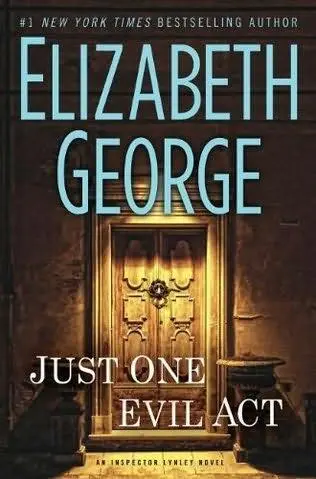
- Название:Just One Evil Act
- Автор:
- Издательство:Dutton
- Жанр:
- Год:2013
- ISBN:978-0-698-13828-5
- Рейтинг книги:5 / 5. Голосов: 1
-
Избранное:Добавить в избранное
- Отзывы:
-
Ваша оценка:
Just One Evil Act: краткое содержание, описание и аннотация
Предлагаем к чтению аннотацию, описание, краткое содержание или предисловие (зависит от того, что написал сам автор книги «Just One Evil Act»). Если вы не нашли необходимую информацию о книге — напишите в комментариях, мы постараемся отыскать её.
bestselling author Elizabeth George offers the latest in her Inspector Lynley series: a gripping child-in-danger story featuring fan favorite Barbara Havers. Detective Sergeant Barbara Havers is at a loss: The daughter of her friend Taymullah Azhar has been taken by her mother, and Barbara can't really help—Azhar had never married Angelina, and his name isn't on Hadiyyah's, their daughter's, birth certificate. He has no legal claim. Azhar and Barbara hire a private detective, but the trail goes cold.
Azhar is just beginning to accept his soul-crushing loss when Angelina reappears with shocking news: Hadiyyah is missing, kidnapped from an Italian marketplace. The Italian police are investigating, and the Yard won't get involved, until Barbara takes matters into her own hands. As she attempts to navigate the complicated waters of doing anything for the case against her superior's orders, her partner, Inspector Thomas Lynley, is dispatched to Italy as the liaison between the Italian police and Hadiyyah's distraught parents.
In time, both Barbara and Lynley discover that the case is far more complex than just a kidnapping, revealing secrets about Angelina; her new lover, Lorenzo; and even Azhar—secrets Barbara may not be willing to accept. With both her job and the life of a little girl on the line, Barbara must decide what matters most and how far she's willing to go to protect it.
Just One Evil Act — читать онлайн бесплатно полную книгу (весь текст) целиком
Ниже представлен текст книги, разбитый по страницам. Система сохранения места последней прочитанной страницы, позволяет с удобством читать онлайн бесплатно книгу «Just One Evil Act», без необходимости каждый раз заново искать на чём Вы остановились. Поставьте закладку, и сможете в любой момент перейти на страницу, на которой закончили чтение.
Интервал:
Закладка:
“Isabelle, Isabelle .” He took a step towards her.
She held up her hand. “Don’t.”
“Then what?” he asked her.
“Can you not for one moment see where this is heading, for all of us? Can you not look beyond Barbara Havers for a bloody instant and realise the position she’s putting us in? Not only herself, but us as well.”
He had to see it because, like her, he was not a fool. But he also had to admit to himself that before this moment he hadn’t thought about the impact Barbara’s behaviour would have upon Isabelle herself should all of what she had done come out into the open. Hearing Isabelle’s voice tinged as it was with despair, he felt as if the clouds were parting and where the sun was shining was not, at this moment, upon Barbara. For Isabelle Ardery was in charge of all the officers, and the responsibility for what the members of her squad did and did not do ultimately rested upon her shoulders.
Cleaning house was what it was generally called in the aftermath of corruption’s coming to light. The rubbish got tossed to appease the public, and Isabelle Ardery stood in very good stead to be part of that rubbish.
He said to her, “This situation . . . It’s not going to come to that, Isabelle.”
“Oh, you know that, do you?”
“Look at me,” he said. And when she finally did so and when he read the fear in her eyes, he said, “I do. I won’t allow you to be damaged. I swear it.”
“You don’t have that power. No one does.”
Now as Lynley guided the Healey Elliott into Cheyne Walk, he tried to put his promise to Isabelle from his mind. There were bigger issues even than Barbara’s involvement with Taymullah Azhar, Dwayne Doughty, and Bryan Smythe, and those needed to be dealt with as soon as possible. Still, his heart was heavy as he parked the car near the top of Lawrence Street. He walked the distance back to Lordship Place and went in through the gate that led to a garden he knew as well as he knew his own.
They were in the last stages of an alfresco lunch beneath a cherry tree in magnificent bloom in the centre of the lawn: his oldest friend, that friend’s wife, and her father. They were watching an enormous grey cat slinking along an herbaceous border thick with lunaria, bellis, and campanula. They were apparently hot into a discussion on the subject of Alaska—said cat—and whether his best mousing days were over.
When they heard the squeak of the garden gate, they turned. Simon St. James said, “Ah, Tommy. Hullo.”
Deborah said, “You’re just in time to settle an argument. How are you on the subject of cats?”
“Nine lives or otherwise?”
“Otherwise.”
“Not an expert, I’m afraid.”
“Damn.”
Deborah’s father, Joseph Cotter, rose to his feet and said, “Afternoon, m’lord. A coffee?”
Lynley waved Cotter back to his seat. He fetched another chair from the terrace at the top of the steps that led to the house’s basement kitchen. He joined them at the table and took a look at the remains of their meal. Salad, a dish with green beans and almonds, lamb bones littering their plates, the tail end of a loaf of crusty bread, a bottle of red wine. Cotter had been cooking, obviously. Deborah’s talents were artistic, but her artistry was decidedly minimal in the kitchen. As for St. James . . . If he managed marmite on toast, it was cause for massive celebration.
“How old is Alaska?” he enquired, preparatory to giving his opinion.
“Lord, I don’t know,” Deborah said. “I think we got him . . . Was I ten years old, Simon?”
“He can’t possibly be seventeen,” Lynley said. “How many lives can he have?”
“I think he’s been through eight of them at least,” St. James told him. He said to his wife, “Perhaps fifteen.”
“Me or the cat?”
“The cat, my love.”
“Then I proclaim his mousing days . . . still ongoing,” Lynley said. He made a hasty benediction over the animal, who was at that moment attacking a fallen leaf with an enthusiasm that suggested he thought it was dinner.
“There you have it,” Deborah said to her husband. “Tommy knows best.”
“Having vast experience with felines?” St. James asked.
“Having vast experience of knowing with whom I ought to agree when paying a social call,” Lynley said. “I had a feeling that Deborah was on the side of mousing. She’s always been an advocate for your animals. Where’s the dog?”
“Being punished, if one can actually punish a dachshund,” Deborah told him. “She was being far too insistent about having her share of lamb, and she’s been put back into the kitchen.”
“Poor Peach.”
“You only say that because you weren’t present to witness her machinations,” St. James told him.
“We call it ‘love eyes,’” Deborah added. “She casts them upon one and it’s impossible to deny her.”
Lynley chuckled. He leaned back in his chair and took a final moment to enjoy their company, the day, the simple pleasure of gathering in the garden for lunch. Then he said, “It’s business I’ve come on, actually,” and as Joseph Cotter then rose as if to make himself scarce, Lynley told him to stay if he wished as there was no secret involved in his mission in Chelsea.
But Cotter said it was time for him to do the washing up. He took a tray from its resting place on the lawn and loaded it efficiently. Deborah helped him, and in a moment she and her father left the two men alone.
“What sort of business?” St. James asked him.
“Scientific, actually.” Lynley brought him into the picture regarding the death of Angelina Upman in Italy. He related the details from the phone call Salvatore Lo Bianco had made to him. St. James listened in his usual fashion, his angular face reflective.
At Lynley’s conclusion, he was silent for a moment before he said, “Could there have been a laboratory error? Having an isolated case of so virulent a strain of bacteria . . . To me, it doesn’t suggest murder as much as it suggests human error in examining what came from the dead woman’s gut. The point at which bacterial involvement is suspected . . . ? That should have happened while she was alive. It’s going to be difficult for Lo Bianco to prove anything, isn’t it? For example, how the E. coli entered her system at all.”
“I suppose that’s why he wants to begin with the lab. Will you do it for me?”
“Pay a call at University College? Of course.”
“Azhar claims his lab’s studying Streptococcus . Lo Bianco’s looking for anything else they might be studying. As for transport . . .” Lynley shifted in his chair. Movement in the corner of his eye caught his attention. Alaska had dived into the herbaceous border and a furious battle appeared to be going on among a patch of violas. He said, “ Could he have transported a bacteria safely from London to Lucca, Simon?”
St. James nodded. “It merely needs to be put on a medium that allows it to survive, a broth and a solidifier. Onto the solid, one would streak the bacteria. Placed onto a petri dish, it not only would survive but grow.”
“How much would be needed to kill someone?”
“That depends, doesn’t it?” St. James said. “Toxicity is the key.”
“I have the impression from Salvatore that the E. coli we’re seeking is particularly toxic.”
“I’ll have to be careful, then,” Simon said. He folded his linen table napkin and pushed himself to his feet. He was disabled, so rising was always a rather awkward business for St. James, but Lynley knew better than to offer his assistance.
VICTORIA
LONDON
When Barbara saw who was ringing her mobile, she ducked into the stairwell to take the call. There were voices echoing up the stairs from somewhere far below, but they disappeared as whoever was climbing left the stairwell for one of the lower floors. She said to Azhar, “How are you? Where are you? What’s happening over there?” and although she tried to keep from her voice the desperate urgency that she was feeling, she could tell from his hesitation prior to responding that he heard it and wondered about it.
Читать дальшеИнтервал:
Закладка:
Похожие книги на «Just One Evil Act»
Представляем Вашему вниманию похожие книги на «Just One Evil Act» списком для выбора. Мы отобрали схожую по названию и смыслу литературу в надежде предоставить читателям больше вариантов отыскать новые, интересные, ещё непрочитанные произведения.











Обсуждение, отзывы о книге «Just One Evil Act» и просто собственные мнения читателей. Оставьте ваши комментарии, напишите, что Вы думаете о произведении, его смысле или главных героях. Укажите что конкретно понравилось, а что нет, и почему Вы так считаете.