Elizabeth George - Just One Evil Act
Здесь есть возможность читать онлайн «Elizabeth George - Just One Evil Act» весь текст электронной книги совершенно бесплатно (целиком полную версию без сокращений). В некоторых случаях можно слушать аудио, скачать через торрент в формате fb2 и присутствует краткое содержание. Год выпуска: 2013, ISBN: 2013, Издательство: Dutton, Жанр: Детектив, на английском языке. Описание произведения, (предисловие) а так же отзывы посетителей доступны на портале библиотеки ЛибКат.
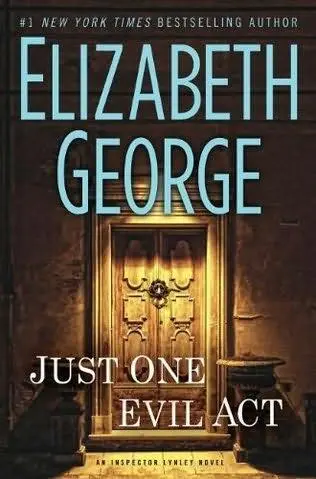
- Название:Just One Evil Act
- Автор:
- Издательство:Dutton
- Жанр:
- Год:2013
- ISBN:978-0-698-13828-5
- Рейтинг книги:5 / 5. Голосов: 1
-
Избранное:Добавить в избранное
- Отзывы:
-
Ваша оценка:
Just One Evil Act: краткое содержание, описание и аннотация
Предлагаем к чтению аннотацию, описание, краткое содержание или предисловие (зависит от того, что написал сам автор книги «Just One Evil Act»). Если вы не нашли необходимую информацию о книге — напишите в комментариях, мы постараемся отыскать её.
bestselling author Elizabeth George offers the latest in her Inspector Lynley series: a gripping child-in-danger story featuring fan favorite Barbara Havers. Detective Sergeant Barbara Havers is at a loss: The daughter of her friend Taymullah Azhar has been taken by her mother, and Barbara can't really help—Azhar had never married Angelina, and his name isn't on Hadiyyah's, their daughter's, birth certificate. He has no legal claim. Azhar and Barbara hire a private detective, but the trail goes cold.
Azhar is just beginning to accept his soul-crushing loss when Angelina reappears with shocking news: Hadiyyah is missing, kidnapped from an Italian marketplace. The Italian police are investigating, and the Yard won't get involved, until Barbara takes matters into her own hands. As she attempts to navigate the complicated waters of doing anything for the case against her superior's orders, her partner, Inspector Thomas Lynley, is dispatched to Italy as the liaison between the Italian police and Hadiyyah's distraught parents.
In time, both Barbara and Lynley discover that the case is far more complex than just a kidnapping, revealing secrets about Angelina; her new lover, Lorenzo; and even Azhar—secrets Barbara may not be willing to accept. With both her job and the life of a little girl on the line, Barbara must decide what matters most and how far she's willing to go to protect it.
Just One Evil Act — читать онлайн бесплатно полную книгу (весь текст) целиком
Ниже представлен текст книги, разбитый по страницам. Система сохранения места последней прочитанной страницы, позволяет с удобством читать онлайн бесплатно книгу «Just One Evil Act», без необходимости каждый раз заново искать на чём Вы остановились. Поставьте закладку, и сможете в любой момент перейти на страницу, на которой закончили чтение.
Интервал:
Закладка:
B ah! was Salvatore’s reaction when the packet of information from London arrived on his desk. It was— merda! —entirely in English. But Salvatore recognised the name repeated on nearly every sheet: Michelangelo Di Massimo.
Salvatore knew he was meant to turn this material over to Nicodemo Triglia. Nicodemo was, after all, in charge of all matters relating to the kidnapping enquiry. As it was, though, he decided to hold on to it until he better understood its contents. For this, he needed an English speaker who had nothing to gain from reporting Salvatore Lo Bianco’s activities to il Pubblico Ministero for personal gain. That left out everyone associated with the police. Remaining, once again, was Birgit.
His ex-wife would not allow him at her house, she told him briskly when he phoned. He couldn’t blame her. Just as she had no wish for Bianca and Marco to see his beaten face, so also did he not wish it. They agreed to meet across the street from Scuola Dante Alighieri. There, a children’s park contained benches for their parents as well as swings, slides, roundabouts, and such, and Birgit would wait for him on one of those benches. He was to make certain that their children were fully enclosed in the embrace of the scuola before he arrived, chiaro ?
Chiaro , he assured her.
He found her on the bench farthest from the school, shaded by a large sycamore tree. Nearby, two women with toddlers in pushchairs sat on opposite ends of a bench in the pleasant sunlight, smoking and speaking on their mobile phones. Their children dozed in the warm morning air.
Salvatore walked to join his ex-wife. He eased himself onto the bench. He’d wrapped his chest tightly with elastic bandages, and while they did something for the pain in his ribs, they constricted his movement and made his breathing shallow.
“How is it?” she asked. “You look even worse.” She shook a cigarette from a pack and offered him one. He thought the taste would be nice and the nicotine nicer. But he didn’t believe his lungs could handle the experience.
“It’s the bruising,” he replied. “It has to go purple first, then yellow. I’m fine.”
She tutted. “You should have reported him, Salvatore.”
“To whom? To himself?”
She lit her cigarette. “Then you should beat him senseless when you have the chance. What’s Marco to think if his own father won’t defend himself when he is set upon?”
There was no good answer to this question, and after their years of marriage, Salvatore liked to think he was wise enough not to engage Birgit in these sorts of vague philosophical debates. So from a manila envelope he took the report and he handed it to her. He understood the bank statements, the receipts, and the telephone records, of course, he informed Birgit. It was the larger reports he needed her help in translating.
“You need to work on your English,” she told him with a scowl. “How you’ve got this far without more than one language . . . And don’t tell me that at least you have French, Salvatore. I remember rescuing you from trying to speak to the waiters in Nice.” She began to read.
For some minutes she did this in silence. He watched one of the toddlers struggling to get out of his pushchair as the poor child’s mother continued her chat on her mobile phone. The other woman had ended her conversation, but she’d promptly begun texting and her child went ignored. Salvatore sighed and silently cursed modern life.
Birgit flicked ash from her cigarette, flipped the page, continued reading, made a few hmphs , gave a few nods, and looked up at him. “This is all from a man called Dwayne Doughty,” she said, inclining her head at the document, “sent to you as directed by an officer of New Scotland Yard. This Doughty gives you an account of hiring Michelangelo Di Massimo to assist in the finding of a London woman who disappeared with her daughter. He tracked them himself to Pisa airport by means of their ticket purchases and through information provided by the border agents in England. He asked Michelangelo Di Massimo to take it from there and Michelangelo made the attempt. He describes the various methods this Michelangelo used and, as proof of this, he sends you also copies of his bills for services and costs incurred. He says that having checked with trains, with taxis, with private car companies, and with the buses—both touring buses and city buses—Signor Di Massimo claimed to have found no trace of the woman beyond the airport. All of the car hire agencies, too, showed no trace of her having picked up a hire car, either at the airport or in Pisa. What’s known is that she landed at Galileo with her daughter and then disappeared. According to Signor Doughty, his conclusion—Michelangelo Di Massimo’s—was that the woman and girl had been fetched by a private party and taken somewhere. This is what he told the London detective in his reports and the London detective tells you that he relayed this information to the child’s father, along with Signor Di Massimo’s name and details. He says it is his belief that all arrangements from that point were made between these two men privately as he had nothing more to do with the matter.”
Salvatore speculated upon the information. That it contradicted what Di Massimo was telling the police came as no surprise to him. In a situation like this, it was understandable that the individuals under suspicion would soon enough begin pointing fingers at each other.
Birgit said, “He also includes records that he has managed to come by, showing amounts of money leaving the bank account of”—she fingered through the papers to find what she was looking for—“Taymullah Azhar and he speculates that they might have entered the account of Signor Di Massimo once his own business with Signor Azhar was concluded. He encourages you to seek this information about Signor Di Massimo’s bank yourself. He points out that while he has no way of knowing what this exchange of money was for, it bears looking into since it suggests that long after his own business with Signor Di Massimo was concluded, Signor Azhar hired him on his own to do something. It was probably to kidnap his daughter, eh?, although he doesn’t say that directly in the report. He says that his own business with Di Massimo ended last December within a few weeks of hiring, and he assures you that all the documents he’s attaching will support that fact. As will, he says, Di Massimo’s bank records if you are able to obtain them.” She handed the report and its appended documents to Salvatore, who returned them to the envelope. She said, “Interesting that he mentions them twice, those banking records of Di Massimo, no? Have you looked at his bank records, Salvatore? You can do that, can’t you?”
He crossed his arms and leaned back against the bench, stretching his legs with a wince. He said, “ Certo . And Di Massimo was paid by this man as he says. But he tells a different story altogether, as you would expect.”
“But if the bank records that this London man sends and the telephone records and all his invoices and receipts—”
“Untrustworthy as a puttana ’s claim of love, cara . There are too many ways to manipulate information, and the London man believes I do not know this. I suspect that this man would like to engage me in chasing down all of his nonsense”—Salvatore nodded at the report between them—“because that will keep me busy and away from the truth and because, to him, I’m an Italian fool who drinks too much wine and does not know when someone is leading me by my nose like an ass.”
“You’re talking nonsense. What do you mean?”
“I mean that Signor Doughty wishes the door to shut upon this investigation, with Michelangelo behind it and no one else. Or, perhaps, with Michelangelo and the professor behind it. But in either case, with himself uninvolved.”
Читать дальшеИнтервал:
Закладка:
Похожие книги на «Just One Evil Act»
Представляем Вашему вниманию похожие книги на «Just One Evil Act» списком для выбора. Мы отобрали схожую по названию и смыслу литературу в надежде предоставить читателям больше вариантов отыскать новые, интересные, ещё непрочитанные произведения.











Обсуждение, отзывы о книге «Just One Evil Act» и просто собственные мнения читателей. Оставьте ваши комментарии, напишите, что Вы думаете о произведении, его смысле или главных героях. Укажите что конкретно понравилось, а что нет, и почему Вы так считаете.