Elizabeth George - Just One Evil Act
Здесь есть возможность читать онлайн «Elizabeth George - Just One Evil Act» весь текст электронной книги совершенно бесплатно (целиком полную версию без сокращений). В некоторых случаях можно слушать аудио, скачать через торрент в формате fb2 и присутствует краткое содержание. Год выпуска: 2013, ISBN: 2013, Издательство: Dutton, Жанр: Детектив, на английском языке. Описание произведения, (предисловие) а так же отзывы посетителей доступны на портале библиотеки ЛибКат.
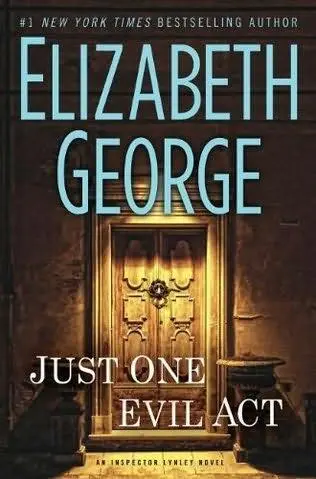
- Название:Just One Evil Act
- Автор:
- Издательство:Dutton
- Жанр:
- Год:2013
- ISBN:978-0-698-13828-5
- Рейтинг книги:5 / 5. Голосов: 1
-
Избранное:Добавить в избранное
- Отзывы:
-
Ваша оценка:
Just One Evil Act: краткое содержание, описание и аннотация
Предлагаем к чтению аннотацию, описание, краткое содержание или предисловие (зависит от того, что написал сам автор книги «Just One Evil Act»). Если вы не нашли необходимую информацию о книге — напишите в комментариях, мы постараемся отыскать её.
bestselling author Elizabeth George offers the latest in her Inspector Lynley series: a gripping child-in-danger story featuring fan favorite Barbara Havers. Detective Sergeant Barbara Havers is at a loss: The daughter of her friend Taymullah Azhar has been taken by her mother, and Barbara can't really help—Azhar had never married Angelina, and his name isn't on Hadiyyah's, their daughter's, birth certificate. He has no legal claim. Azhar and Barbara hire a private detective, but the trail goes cold.
Azhar is just beginning to accept his soul-crushing loss when Angelina reappears with shocking news: Hadiyyah is missing, kidnapped from an Italian marketplace. The Italian police are investigating, and the Yard won't get involved, until Barbara takes matters into her own hands. As she attempts to navigate the complicated waters of doing anything for the case against her superior's orders, her partner, Inspector Thomas Lynley, is dispatched to Italy as the liaison between the Italian police and Hadiyyah's distraught parents.
In time, both Barbara and Lynley discover that the case is far more complex than just a kidnapping, revealing secrets about Angelina; her new lover, Lorenzo; and even Azhar—secrets Barbara may not be willing to accept. With both her job and the life of a little girl on the line, Barbara must decide what matters most and how far she's willing to go to protect it.
Just One Evil Act — читать онлайн бесплатно полную книгу (весь текст) целиком
Ниже представлен текст книги, разбитый по страницам. Система сохранения места последней прочитанной страницы, позволяет с удобством читать онлайн бесплатно книгу «Just One Evil Act», без необходимости каждый раз заново искать на чём Вы остановились. Поставьте закладку, и сможете в любой момент перейти на страницу, на которой закончили чтение.
Интервал:
Закладка:
“That may well be the truth, no?”
“It may be.”
“And even if it is not, even if this London man Doughty directed Signor Di Massimo in the matter of the kidnapping . . . What can you do to him from Lucca? How do you extradite on such speculation? And how do you prove anything anyway?”
“He assumes in this”—Salvatore indicated the report—“that I have not earlier looked into Michelangelo Di Massimo’s banking records, Birgit. He assumes I have no copy of them. He assumes I would not compare them to what he sends me now. And he does not know that I have this.” He took from his jacket pocket the copy of the card he’d received from Captain Mirenda. He handed it to her.
She read it, frowned, and handed it back. “What is this khushi ?”
“The name he calls her.”
“Who?”
“The child’s father.” And he explained the rest: how it went from Squali to the child and how she had kept it beneath a mattress at Villa Rivelli. Squali, he told her, may have dreamed up the card, but he had certainly not dreamed up khushi . Whoever had written it knew the child’s pet name. And that was a narrow field of people indeed.
“Is this his handwriting?” Birgit asked.
“Squali’s?”
“Her papà’s.”
“I have little enough to compare to it—just the documents and written remarks at his pensione and I am no expert in the matter of handwriting, of course—but it looks the same to me and when I show it to the professor, I expect his face will tell me the truth. Very few people lie well. I think he will be among those who cannot. Beyond that, it is clear that his daughter believed he wrote it.” Salvatore explained how the card had been used.
Birgit, however, made a very good point, saying, “Would she know her papà ’ s handwriting, though? Think of Bianca. Would she know yours? What have you ever written to her other than ‘Love from Papà’ on a birthday card?”
He inclined his head to indicate that she had a good point.
“And if it is her papà’s writing, does this not show that the London detective is telling the truth? Her papà writes the card and hands it over—or posts it—to Michelangelo Di Massimo, who takes it from there, hiring Squali to take the child from the mercato because he himself does not wish to be implicated in a public abduction.”
“All of this is true,” he said. “But at the moment, you see, it is no longer the abduction of the child that interests me.” He shifted his position on the bench so that he could gaze upon his ex-wife. Despite their differences and the regrettable alacrity with which her lust for him had faded away, Birgit had a good mind and clear vision. So he asked her the question he’d come to ask. “The investigation into the kidnapping is, of course, no longer mine to direct. By rights, I should pass along this copy of the card to Nicodemo Triglia, vero ? And yet if I do, all matters pertaining to Taymullah Azhar will be taken from me. You see this, no?”
“What ‘matters’ will be taken from you?” she asked shrewdly.
He told her of the means of Angelina Upman’s death. He said, “Murder is a larger question than kidnapping. Keeping Nicodemo and—let us face the truth squarely—Piero Fanucci occupied with Michelangelo Di Massimo as their culprit allows me access to the child’s father that I would not have if Nicodemo and Piero knew about this card.”
“Ah. That alters the situation. I see.” She wiped her hands together as if dismissing every qualm he had about the nature of what he was obliquely suggesting. She said, “I say keep the copy of the card and let Piero Fanucci sink in his own stew.”
“But to let Michelangelo Di Massimo take all the blame for the kidnapping of the child . . . ,” he murmured.
“You do not know when this card reached Italy in the first place. You do not even know who sent it. It could be years old and written for another matter entirely—the little girl’s keepsake of her father, per esempio —or it could be something someone came across and saw how it could be used . . . Anything is possible, caro ,” she said. And then she quickly altered the endearment to “Salvatore” as colour flooded her cheeks. “And anyway isn’t it time that Piero was taught his lesson? I suggest you allow him to trumpet to the newspapers as much as he would like: ‘Di Massimo’s our man! We have the evidence! Put the stronzo on trial!’ And then, of course, a copy of this card sent on the sly to Di Massimo’s attorney . . . ? You owe Piero nothing. And, as you say, murder is a larger issue than abduction.” She smiled at him. “I tell you: Do your worst, Salvatore. Solve this murder and the abduction and send Fanucci directly to hell.”
He smiled in turn and winced just a bit at the pain. “You see? This is why I fell in love with you,” he told her.
“Had it only lasted” was her reply.
LUCCA
TUSCANY
Back in his office, at the centre of his desk, Salvatore found a stack of photographs along with a note from the resourceful Ottavia Schwartz. She had managed to have them printed on the sly, and they featured everyone who had attended the funeral and the burial of Angelina Upman.
“Bruno was there, Salvatore.”
He looked up. She’d seen him and slipped into his office, closing the door behind her. She blanched at the sight of his face. She said shrewdly, “ Il drago? ” and made a colourful suggestion as to what il Pubblico Ministero could do to himself. Then she joined Salvatore at the desk and pointed out Daniele Bruno, with his bulbous ears, standing among a group of men consoling Lorenzo Mura. Ottavia unearthed another picture of him, head bent to Lorenzo as they spoke by the gravesite. But the import of this? Salvatore asked her. How could it mean anything more than all of the other mourners who spoke to Lorenzo Mura that day? Like Mura, Bruno was on the city’s squadra di calcio . Was Ottavia suggesting that he alone of the team members had gone to the funeral of Lorenzo Mura’s beloved?
That had not been the case, of course. The other team members had been there. So had the parents of the children whom Lorenzo Mura coached in private sessions. So had other individuals from the community. So had the Mura and the Upman families.
It was this last group upon whom Salvatore focused. He brought a magnifying glass from his desk drawer and he gazed upon the face of Angelina Upman’s sister. He’d never seen twins who bore such a remarkable likeness to each other. There was usually something—some tiny detail—that differentiated them, but in the case of Bathsheba Ward, he could not tell what it was. She might have been Angelina Upman sprung to life once more. It was quite astounding, he thought.
VICTORIA
LONDON
The fact that the wife of one Daniele Bruno was a flight attendant on the regular route between Pisa and London turned out to be a nonstarter, as Lynley had thought it might when he checked into it for Salvatore Lo Bianco. She flew into and out of Gatwick several times a day, but that was an end to it. She never had cause to spend the night. She would do, on the off chance that an extreme flight delay resulted in aircraft being held overnight. But when that occurred—which it had not done in the past twelve months—she stayed with the rest of the flight crew at an airport hotel and left the next morning.
Lynley reported all this to Salvatore, who agreed that the matter of Daniele Bruno was turning into an unmistakable dead end. He’d seen all the photos of the funeral, he said. Bruno was there, certo , but so was everyone else. “I think he has nothing to do with nothing,” Salvatore said in English.
Читать дальшеИнтервал:
Закладка:
Похожие книги на «Just One Evil Act»
Представляем Вашему вниманию похожие книги на «Just One Evil Act» списком для выбора. Мы отобрали схожую по названию и смыслу литературу в надежде предоставить читателям больше вариантов отыскать новые, интересные, ещё непрочитанные произведения.










Обсуждение, отзывы о книге «Just One Evil Act» и просто собственные мнения читателей. Оставьте ваши комментарии, напишите, что Вы думаете о произведении, его смысле или главных героях. Укажите что конкретно понравилось, а что нет, и почему Вы так считаете.