Doreen Tovey - Donkey Work
Здесь есть возможность читать онлайн «Doreen Tovey - Donkey Work» весь текст электронной книги совершенно бесплатно (целиком полную версию без сокращений). В некоторых случаях можно слушать аудио, скачать через торрент в формате fb2 и присутствует краткое содержание. Год выпуска: 2013, Издательство: Summersdale Publishers Ltd, Жанр: Старинная литература, на английском языке. Описание произведения, (предисловие) а так же отзывы посетителей доступны на портале библиотеки ЛибКат.
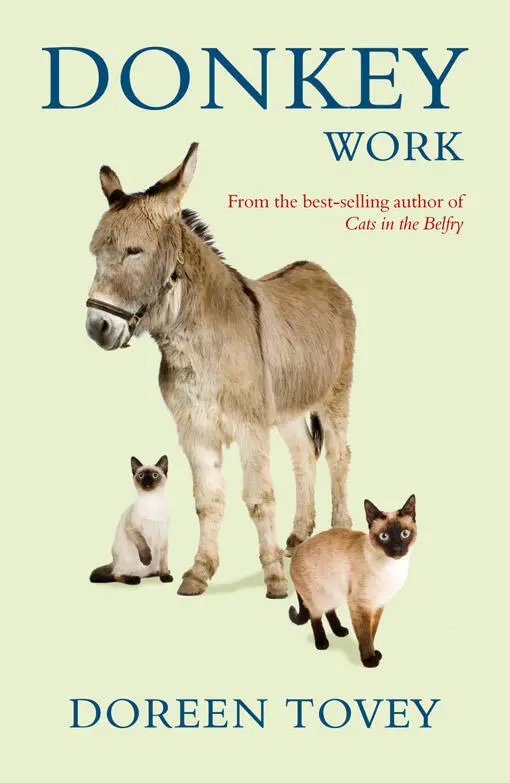
- Название:Donkey Work
- Автор:
- Издательство:Summersdale Publishers Ltd
- Жанр:
- Год:2013
- ISBN:нет данных
- Рейтинг книги:3 / 5. Голосов: 1
-
Избранное:Добавить в избранное
- Отзывы:
-
Ваша оценка:
Donkey Work: краткое содержание, описание и аннотация
Предлагаем к чтению аннотацию, описание, краткое содержание или предисловие (зависит от того, что написал сам автор книги «Donkey Work»). Если вы не нашли необходимую информацию о книге — напишите в комментариях, мы постараемся отыскать её.
Donkey Work — читать онлайн бесплатно полную книгу (весь текст) целиком
Ниже представлен текст книги, разбитый по страницам. Система сохранения места последней прочитанной страницы, позволяет с удобством читать онлайн бесплатно книгу «Donkey Work», без необходимости каждый раз заново искать на чём Вы остановились. Поставьте закладку, и сможете в любой момент перейти на страницу, на которой закончили чтение.
Интервал:
Закладка:
How he'd got there in the first place was amazing, for behind the cottage garden was a ten-foot wall backing on the hill, and behind the cottage itself was an almost vertical stone-lined bank that one would have thought would have stopped an elephant let alone a tortoise. He spat at us when we took him back. Didn't want to live in the valley, he said, and we could tell from his expression he was mad. And so, seeing that a painted shell is useless when a tortoise takes to midsummer undergrowth or goes climbing above one's head, we fitted him with a ping-pong ball on the end of a long length of string tied round his waist on the principle of a marker buoy, offered him some bread and milk at which he withdrew his head and said he supposed we were trying to poison him now, and let him go. Outside the kitchen door where he immediately started out across the yard, which Charles was still in the process of paving, and got his ping-pong ball caught between a couple of stones.
We unhitched him from there, struggling away like a beleaguered Channel swimmer and spitting at us with disgust, and put him in the garden. There, for a few days while he learned the ropes, he stayed. Once, seeing the string pulled taut and Tarzan on the end doing his Channel-swimming act, I found he'd got the ping-pong ball anchored in the chrysanthemums. Shortly afterwards, seeing Tarzan struggling valiantly behind the dahlias, I looked to see what was holding him this time and found Solomon sitting on his string. Watching Tarzan's struggles on the end of it with the interest of an entomologist, but pretending, when he spotted me, that he hadn't a clue he was holding him up.
The third time it was the ping-pong ball I noticed, wrapped by its string round a rose tree. Three times round as if Tarzan had gone berserk and started walking in circles. But there was nothing berserk about that tortoise. Three times round for leverage that had been. When I trailed the string to where it ended in the Michaelmas Daisies, there was an empty red string waist-band and Tarzan once more had gone.
We never saw him again. He didn't appear the following Spring and we had, in fact, given him up as perished when, in the ensuing summer, we were invited out to supper by some people who lived up the hill a quarter of a mile away. They supposed, they said during the course of the evening, that we hadn't lost a tortoise? When we said we had as a matter of fact, nearly a year ago, they said they'd found one three weeks previously climbing up the hill. Two days following they'd seen him and the second day, fearing he might get run over, they'd taken him in and put him in their herbaceous border. Where, they said, he seemed to be pottering happily, came out to see them on occasion, and they'd grown quite fond of him.
It was Tarzan all right. The fact that he'd been found mountaineering was proof of that. But if he was going to keep leaving home and making for the heights; if he was happier when he got there – and the fact that he'd been pottering voluntarily in their flower-bed for weeks when he wouldn't stay five minutes in ours seemed proof enough of that – then they had, we said beneficently, better keep him.
They did. I, never having had Tarzan around long enough to strike up a bosom friendship with him, was content to let them. And Charles, after thinking it over for a fortnight, announced that he missed Tarzan and was going to ask for him back. When I said he couldn't, we'd given him to the people, he said he was going to lure him back. People had no right to other people's tortoises, he said, and if he went up there with a lettuce and Tarzan looked through the hedge at it he had as much right to pick him up as anybody. Tortoises, he said, were jolly interesting. Which was why the following week, to prevent Charles carrying out his threat of tortoise-napping and no doubt ruining our reputations for ever, I brought home two small baby tortoises.
Victoria and Albert we called them because at the time there was a move, quite rightly, to ban the importation of tortoises on account of bad conditions of transport, the petshop man said this might be the last consignment he'd have and Charles – quite brilliantly I thought, when I told him – said in that case they'd be museum pieces. We didn't know whether they were really a pair. According to our reference book the undershell of a male tortoise is concave and that of a female convex, but when I turned these two upside down in the petshop they were both, with my usual luck, flat. They were the only small ones they had, however, so I bought them in hope. And Charles and Solomon thought they were wonderful.
They lived temporarily, until Charles could make them a movable run in the garden, in a big cardboard box in the conservatory. Five feet by four, with a smaller cardboard box with a door in it in the corner for sleeping in, a couple of clumps of grass and a shallow dish of water. After we found that the cats were going into the box every time they passed the conservatory and drinking the water – he, said Solomon, lapping soulfully away amid the grass, was a Jungle Cat and he liked his water from a pool; she, said Sheba, didn't like silly old tortoises and drinking their water would annoy them – we put some chicken wire over the top.
Occasionally we put them out for exercise on the lawn, in a makeshift wooden frame that Charles had used the previous winter for growing anemones. It stopped them from straying but it was shallow and had no top, so that they were forever plodding round it one behind the other like circus elephants looking for a way out and Solomon, when he passed by and saw them in action, could never resist getting in and sitting bolt upright in the middle like a ring-master. Prodding them encouragingly when they stopped, or – if one of them did manage to find a foothold in a corner and by dint of terrific struggle get its chin over the edge – nipping excitedly out of the frame, lying flat on his stomach outside, and surprising them with a spidery black paw as their heads came over the top.
Eventually Albert did get out and we found him hiding under a nut tree. After that I balanced a tile on each of the corners of the run when they were exercising to prevent similar escapes and that – a strange wooden frame on our lawn, roof tiles set mysteriously on the corners and a Siamese cat in the middle prodding interestedly at something with his paw – was how people came to know we had tortoises. By opening the gate, country-fashion, and looking. That was also how we came to acquire another tortoise. Somebody rang up one day to say they'd found one wandering near the main road and could we – as they understood we kept tortoises – look after him while they enquired for his owner.
Charles, though he'd been found a mile away coming from quite a different direction, said it must be Tarzan returning home. It wasn't Tarzan because this one had a sort of frill to his shell and a broken hole in the edge whereby he'd obviously once been tethered. Moreover Tarzan, as I confirmed by ringing his current owners, was still in residence with them and had just eaten all the lettuce. But we kept him. Loose in the conservatory with a board across the doorway to stop him getting out. Albert and Victoria lived safe from his possibly predatory attentions in their cardboard box when they weren't out in their run. And there – once Charles got over his conviction that the new boy, left at large, would decapitate his grape-vine overnight by eating through the four-inch stem – they thrived. Paddling in their water-bowls, eating plums and lettuce – the big one, said Charles, had a remarkable bite; you could hear it like the action of a mechanical grabber, and after he'd bitten a piece of lettuce it was absolute seconds before he took the first slow chew and seconds after that before he took the next. He hoped, said Charles, that nobody would claim him. Tortoises were jolly interesting and next year, when he'd finished the goldfish pond, he was going to build a proper tortoise pit.
Читать дальшеИнтервал:
Закладка:
Похожие книги на «Donkey Work»
Представляем Вашему вниманию похожие книги на «Donkey Work» списком для выбора. Мы отобрали схожую по названию и смыслу литературу в надежде предоставить читателям больше вариантов отыскать новые, интересные, ещё непрочитанные произведения.








Обсуждение, отзывы о книге «Donkey Work» и просто собственные мнения читателей. Оставьте ваши комментарии, напишите, что Вы думаете о произведении, его смысле или главных героях. Укажите что конкретно понравилось, а что нет, и почему Вы так считаете.