Doreen Tovey - Donkey Work
Здесь есть возможность читать онлайн «Doreen Tovey - Donkey Work» весь текст электронной книги совершенно бесплатно (целиком полную версию без сокращений). В некоторых случаях можно слушать аудио, скачать через торрент в формате fb2 и присутствует краткое содержание. Год выпуска: 2013, Издательство: Summersdale Publishers Ltd, Жанр: Старинная литература, на английском языке. Описание произведения, (предисловие) а так же отзывы посетителей доступны на портале библиотеки ЛибКат.
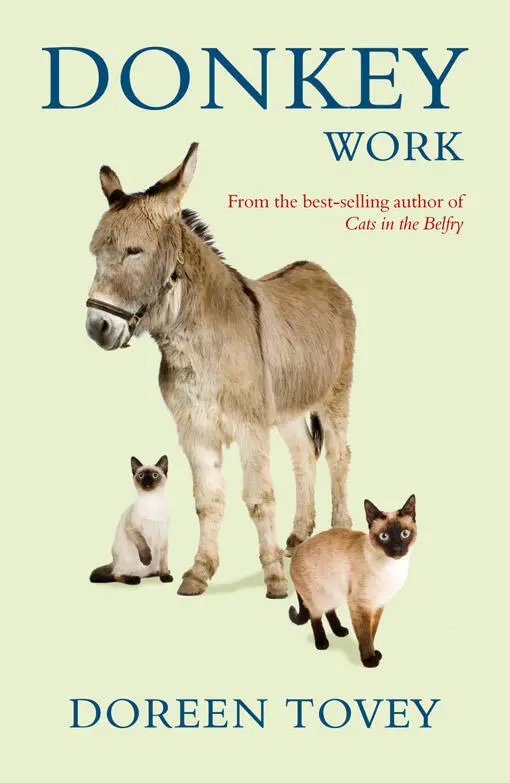
- Название:Donkey Work
- Автор:
- Издательство:Summersdale Publishers Ltd
- Жанр:
- Год:2013
- ISBN:нет данных
- Рейтинг книги:3 / 5. Голосов: 1
-
Избранное:Добавить в избранное
- Отзывы:
-
Ваша оценка:
Donkey Work: краткое содержание, описание и аннотация
Предлагаем к чтению аннотацию, описание, краткое содержание или предисловие (зависит от того, что написал сам автор книги «Donkey Work»). Если вы не нашли необходимую информацию о книге — напишите в комментариях, мы постараемся отыскать её.
Donkey Work — читать онлайн бесплатно полную книгу (весь текст) целиком
Ниже представлен текст книги, разбитый по страницам. Система сохранения места последней прочитанной страницы, позволяет с удобством читать онлайн бесплатно книгу «Donkey Work», без необходимости каждый раз заново искать на чём Вы остановились. Поставьте закладку, и сможете в любой момент перейти на страницу, на которой закончили чтение.
Интервал:
Закладка:
There were snags, of course, to letting her run free. One was that we didn't imagine this business of her creeping around on tiptoe. Sometimes she caught us up at a gallop. Other times, when the sense of humour took her, she came up behind us so quietly that the first I knew of it was a yell from Charles as she nipped him in the rear, I jumped yards with fright – and there, when we looked round, was Annabel right behind us, head demurely bent, eyelashes fetchingly lowered, and with an unmistakable wobble to her underlip which meant she was being funny. Guess who did that? she would enquire, looking coyly at us with her big brown eyes.
That was why – though I agreed with Charles indubitably that she was joking and it was only a pinch and it showed how much she liked us – that I usually walked ahead of him. That was why for quite a while, as an extra precaution, I always went out in a duffle coat. If Charles liked having his pants bitten by a donkey by way of affection I most certainly didn't. And that was why, on these long, free walks with her, we couldn't take the cats.
She might have nipped one of them on the tail – only in fun, but the result would have been two cats up the nearest pine tree and ourselves ringing up the fire brigade. She might have kicked them as she galloped. Again quite by accident. Annabel's kicks, light-hearted as a breeze; were never calculated to land. We'd long noticed that when she passed us in a wide track her kick was wide, too – exuberant, outflung as an arabesque and apparently missing us by a mere hair's breadth – but that when she passed us on a narrow path her kick was narrow to match. A mere slight sideways tipping of a hoof as she passed, and the surest proof she could give that we were friends and she was only playing.
But Solomon, when she galloped, got excited and galloped too. He and Annabel were doing Agincourt, he would roar, pelting along at her heels, his ears streamlined with excitement, filled with his old ambition to be a horse. So, just in case she kicked Henry the Fifth by accident, not knowing he was there, we entered on a new department of the daily routine whereby we took them for walks separately. Usually – for the sake of variety – in opposite directions. With the result that people doing circular tours in the neighbourhood would quite often meet us going up the valley accompanied, to their interest, by a pair of Siamese cats – up trees like monkeys, complaining that the lane was Wet or pretending to be courting – and then, coming back an hour or so later in the opposite direction, they'd meet us going along with a donkey.
They stared like mad the second time. They eyed us from beneath their eyebrows as if we were not quite all there – which, when we stopped to consider that we now quite voluntarily owned two Siamese and a donkey, we sometimes wondered about ourselves. If we turned to look at them we found they were invariably standing in the lane looking incredulously back at us.
One day, going out initially with Annabel, we passed a man on horseback who, after he'd got his frightened mare down on to all four feet again, said Funny little pet to have wasn't she, ha! ha! and rode on. An hour later, going the opposite way with Solomon and Sheba, we met him again. Hearing him coming, afraid that his horse might rear once more in the narrow lane, we grabbed the cats and jumped into the ditch. There, as he passed, we stood. Sheba scrambling over Charles's head with her back up. Solomon, who liked horses, complacently on my shoulder but with his tail anchored round my face so that it looked as if I was wearing a big black moustache. The man looked quite alarmed. Then, pulling himself together and probably assuring himself that if he humoured us he might make it even yet – 'Taking them for a walk?' he said.
We didn't care. We liked the cats. We liked Annabel, too, though we still weren't certain to what extent she liked us. Until, that was, the day I went out to see her after lunch and there, thinking nobody was about to shout at, she lay drowsily in siesta, outside her house in the sun. She had her front legs stretched before her like a sheepdog, as we'd seen her lie so often. Only this time there was no jumping up as I approached, nor even as I sat down cautiously in the straw beside her. Annabel, blinking contentedly in the sun, was half asleep. Annabel to my amazement, as I sat there stroking her nose and ears and wondering how fast I could get up if she decided to bite me, snorted dreamily, lowered her head and rested it lovingly on my shoulder.
There was no mistake about it. Once she lifted her head to reach down and bite her leg where a fly was tickling her. Again she lifted it when Charles – wondering from the silence, he said, whether I'd fallen in her feeding bowl and she'd eaten me – came and looked over the fence and nearly dropped at what he saw. Each time she drooped her lashes, snorted softly, and laid her head back on my shoulder to be stroked.
I told people about Annabel's responsiveness that day till they must have been tired of hearing it. I gave her peppermints. I went up to talk to her practically every half-hour. I saw myself achieving things unheard-of in the rapport between donkey – properly treated – and man.
It didn't take her long to blot that small beginning of a copybook. The next day, wandering up the lane with her in an atmosphere of mutual affection, on our own because Charles was spraying the grape-vine, minus my duffle coat because it was hot – and what need had I of protection now, when there was such a wonderful understanding between us? – Annabel bit me in the pants. A good hard nip like being caught by a pair of nutcrackers. Guess who did that? she enquired when I touched ground again, wobbling her underlip amiably at me à la Maurice Chevalier.
EIGHT
The Trouble with Tortoises
Our donkey apparently liked us. Solomon was mine to the extent that he alone was allowed to snuggle down with his head on my pillow when he and Sheba came into our bedroom in the mornings and if Sheba tried it on he bit her. Sheba would jump into a bath at any time to be with Charles, and when he worked at home she sat companionably on his desk like a paperweight, enquiring didn't he think she was pretty and making footmarks on his documents. The ingrate of the family – the one we never mentioned – was Tarzan the tortoise.
Tarzan, two years previously, had run away. Run was the operative word. Scarcely had we got to know him – scarcely, even, had the cats discovered which end to prod to make him work – than Tarzan bolted up the path one day while we were having lunch and vanished again till the following Spring. Tarzan, after that, had had a blue and white circle painted on his shell to make him more identifiable. Tarzan, we decided, thinking that might be what made him wander, should forthwith have a mate. We even decided on her name. Tosca we intended to call her. But there was a shipping strike on at the time. Tarzan wouldn't wait. By the time the boat came in and the Tortoises for Sale notice went up outside the local pet-shop, Tarzan, camouflaging himself presumably under a dandelion leaf, had gone again.
It was May when he disappeared and it was August – too late, we thought, to provide him with his Tosca at that time of year – when we discovered him again. Up on the hillside behind the cottage, where we'd gone quite by chance to call for Solomon, who as usual was missing when we wanted to go out. And there, as we shouted 'Tolly-wolly-wolly' and searched the neighbourhood with field glasses, for by this time he'd been missing for an hour and a half and we'd searched every thinkable place till we were exhausted, we discovered him. Not Solomon – whom we found eventually sitting conspicuously on the coalhouse roof saying he'd been there all the time though we knew jolly well he hadn't – but Tarzan. Standing on a rocky outcrop looking at us with his head out and a defiant expression on his face, and with the weather-worn remnants of the blue and white paint on his back to prove that he was ours.
Читать дальшеИнтервал:
Закладка:
Похожие книги на «Donkey Work»
Представляем Вашему вниманию похожие книги на «Donkey Work» списком для выбора. Мы отобрали схожую по названию и смыслу литературу в надежде предоставить читателям больше вариантов отыскать новые, интересные, ещё непрочитанные произведения.





Обсуждение, отзывы о книге «Donkey Work» и просто собственные мнения читателей. Оставьте ваши комментарии, напишите, что Вы думаете о произведении, его смысле или главных героях. Укажите что конкретно понравилось, а что нет, и почему Вы так считаете.