Doreen Tovey - Donkey Work
Здесь есть возможность читать онлайн «Doreen Tovey - Donkey Work» весь текст электронной книги совершенно бесплатно (целиком полную версию без сокращений). В некоторых случаях можно слушать аудио, скачать через торрент в формате fb2 и присутствует краткое содержание. Год выпуска: 2013, Издательство: Summersdale Publishers Ltd, Жанр: Старинная литература, на английском языке. Описание произведения, (предисловие) а так же отзывы посетителей доступны на портале библиотеки ЛибКат.
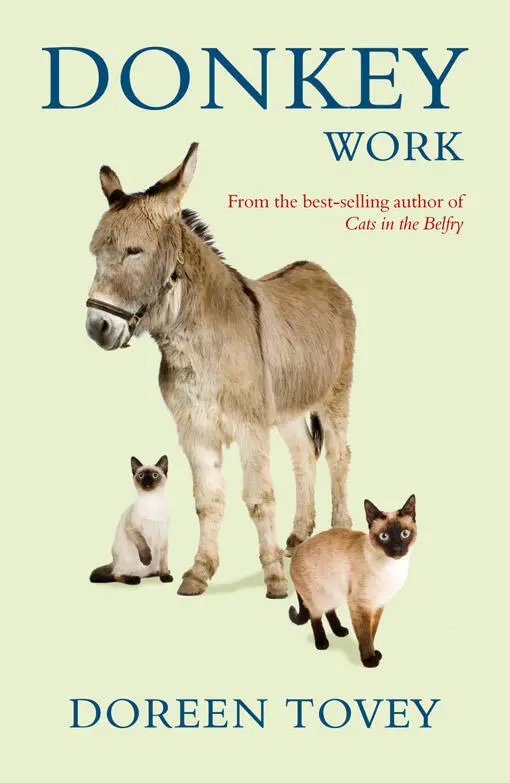
- Название:Donkey Work
- Автор:
- Издательство:Summersdale Publishers Ltd
- Жанр:
- Год:2013
- ISBN:нет данных
- Рейтинг книги:3 / 5. Голосов: 1
-
Избранное:Добавить в избранное
- Отзывы:
-
Ваша оценка:
Donkey Work: краткое содержание, описание и аннотация
Предлагаем к чтению аннотацию, описание, краткое содержание или предисловие (зависит от того, что написал сам автор книги «Donkey Work»). Если вы не нашли необходимую информацию о книге — напишите в комментариях, мы постараемся отыскать её.
Donkey Work — читать онлайн бесплатно полную книгу (весь текст) целиком
Ниже представлен текст книги, разбитый по страницам. Система сохранения места последней прочитанной страницы, позволяет с удобством читать онлайн бесплатно книгу «Donkey Work», без необходимости каждый раз заново искать на чём Вы остановились. Поставьте закладку, и сможете в любой момент перейти на страницу, на которой закончили чтение.
Интервал:
Закладка:
Touching in that when we walked behind her and watched those sturdy young legs trudging along with the typical forward-leaning stance of the donkey, as though already she was pulling some heavy load, we could see all the donkeys through the ages in her small but powerful gait. Plodding the deserts and the mountain tracks. Young and strong and eager when they started; weary, beaten and defeated when they were old. The donkey, which has been –and in some countries still is – the worst-treated of all animals by man.
That, we said at such poignant moments, hastening to fondle her ears and rub her nose while Annabel stood demurely between us contriving to look Worse Treated than Anybody by reason of the fact that we now put a halter on her when she went out, would never happen to our little donkey. Our little donkey was going to stay with us for ever.
You bet she was. Our little donkey, in a few short weeks, had us where she wanted us as surely as if she was a Siamese cat. She wouldn't even wear her halter the way it was meant to go, which was round her nose and behind her ears. When we put it on like that she stood stock still, closed her eyes, and refused to budge. She didn't, we were given to understand from her coy but firm expression, like things on her nose.
We thought it rather sweet the first time, when we lifted her fringe to reason with her and there underneath was Annabel with her eyes shut. We didn't think it nearly so sweet when we tried it after she lost her fringe and she still closed her eyes the moment we put the halter on. Now her objection was obvious to the world and while we were trying to reason with her invariably somebody would come along and say, Look at that donkey with its eyes shut, and somebody else would say, Poor little thing, fancy treating it like that, and then they'd glare at us and we would sigh and take the halter off and put it on again the way which Annabel approved. Round her neck in a big loose loop, as she'd worn her rope when she came to us. Making her look – seeing that we'd bought her a show halter which was wide and white and noticeable – as if she was to be shot at dawn. And so we would set forth. Annabel trudging meekly between us like a miniature Burgher of Calais, people looking compassionately at her as we passed – and he hoped, Charles informed Annabel grimly, that she was happy.
She was. She was even happier when, unable to stand being looked at as if we were executioners any longer, we decided the time had come to try her without a halter at all.
Annabel following us freely round the countryside was like a dream. True it was offset by intermittent nightmares when we went near traffic roads or through the village and Annabel had to go on her rope for safety. Then – by way of rebellion even at that slight restriction now that for most of the time she ran free – she drooped and wilted on the end of it in a way that turned us hot and cold with embarrassment. Usually outside people's cottages, where we reached a state of complete impasse because the only form of persuasion that worked with Annabel in circumstances like these was to smack her bottom.
If we smacked it by hand a cloud of cement dust rose from her coat, our hands went numb, and Annabel, her nose sunk dreamily in a clump of toadflax on somebody's wall, informed us via the stolid set of her rump that she hadn't felt a thing. If we smacked it with the halter-end Annabel moved at once, but with such a downcast droop of her head and a tucking-in of her tail – in case, we understood, we Beat Her Again – that we hated ourselves on the spot.
Whichever we did we could depend on somebody appearing immediately in a doorway with a look that indicated one finger more on that dear little donkey and they'd call the police. And there, while Annabel Frrrmphed friendlily at them between mouthfuls, lowered her eyes so they could see her eyelashes and generally indicated that this was the first time we'd let her stop for days, we waited. Sometimes for what seemed like days too, until Annabel, with a final sad farewell Frrmph that doubtless meant See them in the Salt Mines if she lasted that long, ambled slowly on down the road. We'd read about Stevenson using a pin on Modestine. We couldn't, under any circumstances, have done it ourselves. But, as Charles remarked many a time and oft as we stood there waiting for our own particular donkey to develop a glimmer of conscience and get a move on, he knew how Stevenson felt.
Twenty yards round the corner, away from the traffic roads, away from cottages and the need to impress their inhabitants and minus her rope, Annabel was a different donkey altogether. She still lingered to eat when she came to a particularly tasty patch, but with the air now of an independent deer stopping to graze, not a captive grabbing a last few mouthfuls en route for the hulks. And there was no need to cajole her to follow us. We only had to walk on round the bend and, with a drumming of hooves and the flash of a familiar pair of ears, Annabel was with us. Only for a second, mind you. A kick of a heel in our direction as she went to show that she wasn't really following us – she happened to be going this way herself and we'd better jump for the ditch Or Else – and Annabel was past us. Zooming round the bend ahead, whence she would either appear a second or so later coming like an express train in the other direction or else – if it was dusk and she was wondering whether we meant to go much further – peering cautiously back at us round the corner.
Annabel didn't like the dusk. She was frightened of the shadows and refused point blank to pass the cement patch in the dark because it shone whitely at her and she thought it was a ghost. Annabel wasn't as tough as she pretended in many ways. She knew our usual route through the forest – up the valley, across the stream, over the moor-top and down the hill behind the cottage – like the back of her hoof. She galloped that, in daylight, practically non-stop – backwards and forwards as we walked; leaping the stream like a steeplechaser now, not wading it with tremulous fear; and all this in a size so small it was like seeing a rocking-horse come to life.
We watched her, scarcely able to believe it. That a donkey could move like this, as fast and graceful as a colt. That she had this desire to stay with us even when she was free and full of spirit. And that if we did stop en route, to sit by the stream in the valley or admire the view across the river from the top, fast though she might be galloping when we halted, Annabel would stop too, and draw quietly nearer in the background. Close enough to keep an eye on us. Far enough, according to her lights, for us not to know she was doing it. And there, till we moved, she would wait. Our donkey of two months' standing.
On unfamiliar ground her determination to stay with us was even more noticeable. We would perhaps come up a track with a minor one leading from it and, calling Annabel, who in strange surroundings was apt to stop and gawk around her with the air of a tourist taking in the Grand Canyon, we would turn off along the side one. Annabel, wresting her interest a second or two later from an intriguing rustle in the undergrowth or a speculation as to whether it was worth going the other way to see what it was like up there, would look round, see that the main path was empty, and start galloping. Past the turning we'd taken, on till she came to the next bend and then, when she found we weren't around it, her hoofbeats would stop.
Sometimes she would gallop back. Sometimes she apparently crept back on tiptoe, because the first we knew of her being in the vicinity was a pair of ears poked antennaewise round a nearby bush. For quite a second or two until, having satisfied herself that she'd found us but we couldn't see her, could we? back she would come with a snort and a gallop, to pass us and start grazing a few feet ahead.
Читать дальшеИнтервал:
Закладка:
Похожие книги на «Donkey Work»
Представляем Вашему вниманию похожие книги на «Donkey Work» списком для выбора. Мы отобрали схожую по названию и смыслу литературу в надежде предоставить читателям больше вариантов отыскать новые, интересные, ещё непрочитанные произведения.




Обсуждение, отзывы о книге «Donkey Work» и просто собственные мнения читателей. Оставьте ваши комментарии, напишите, что Вы думаете о произведении, его смысле или главных героях. Укажите что конкретно понравилось, а что нет, и почему Вы так считаете.