Doreen Tovey - Donkey Work
Здесь есть возможность читать онлайн «Doreen Tovey - Donkey Work» весь текст электронной книги совершенно бесплатно (целиком полную версию без сокращений). В некоторых случаях можно слушать аудио, скачать через торрент в формате fb2 и присутствует краткое содержание. Год выпуска: 2013, Издательство: Summersdale Publishers Ltd, Жанр: Старинная литература, на английском языке. Описание произведения, (предисловие) а так же отзывы посетителей доступны на портале библиотеки ЛибКат.
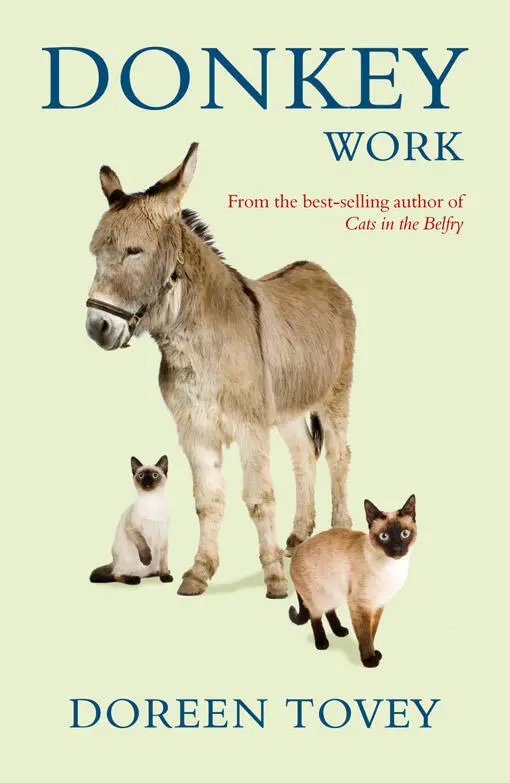
- Название:Donkey Work
- Автор:
- Издательство:Summersdale Publishers Ltd
- Жанр:
- Год:2013
- ISBN:нет данных
- Рейтинг книги:3 / 5. Голосов: 1
-
Избранное:Добавить в избранное
- Отзывы:
-
Ваша оценка:
Donkey Work: краткое содержание, описание и аннотация
Предлагаем к чтению аннотацию, описание, краткое содержание или предисловие (зависит от того, что написал сам автор книги «Donkey Work»). Если вы не нашли необходимую информацию о книге — напишите в комментариях, мы постараемся отыскать её.
Donkey Work — читать онлайн бесплатно полную книгу (весь текст) целиком
Ниже представлен текст книги, разбитый по страницам. Система сохранения места последней прочитанной страницы, позволяет с удобством читать онлайн бесплатно книгу «Donkey Work», без необходимости каждый раз заново искать на чём Вы остановились. Поставьте закладку, и сможете в любой момент перейти на страницу, на которой закончили чтение.
Интервал:
Закладка:
She'd worried another time about what she thought was a neighbour's cat. A big fat black one which she kept seeing sitting soulfully on the neighbour's doorstep and which, being Miss Wellington, she kept opening the door and letting in again, announcing loudly for the neighbour's benefit that it was draughty on the doorstep and she was sure its Mummy wouldn't mind.
Actually its Mummy minded very much. She was new to the village. She had, though Miss Wellington didn't know it, two black cats, both exactly alike. Right then she was trying to keep them at the back of the house because she had someone staying with her who was allergic to cats while the cats, typically enough, were marching indignantly round to the front door saying they wanted to go in that way. What with Miss Wellington popping them in at the front and their owners putting them out again at the back they were going round like Red Indians doing a war-dance by the time the new people discovered who was responsible, and they weren't half mad with Miss Wellington when they did.
In our case Miss Wellington decided that Annabel was shouting because she was lonely, and when we said she wasn't, she was only talking, she said we didn't Understand. In order to convince us that we didn't understand she started inviting friends to tea who apparently did, and bringing them down to see us. Nearly every day when we were home a little group could be seen advancing down the hill around half-past four. All ladies. All of somewhat indeterminate age. All dressed like Miss Wellington in macintoshes and – as it was summer – straw hats that had been rained on and gone rather bumpy-looking in the process. And all nature-lovers to the last eye-tooth, in evidence of which they darted about the lane like dragonflies as they came, picking little bunches of flowers.
At this time of day we were usually having tea ourselves on the lawn and Charles, if he spotted them first, was not above slipping out of his deck-chair on all fours and making for the garage. What most often happened, however, was that there was a coy little cry of 'ANNN-abell!' from Miss Wellington, Charles swore soundly into his teacup, and when we looked up there they were, standing in a group on the corner, gazing enchantedly across the garden at our donkey.
Annabel from that angle was a particularly enchanting sight. All you could see of her was her head. The wall hid the rest of her from view and the Alice in Wonderland effect of her rabbit ears, enormous puffball fringe and inquisitive white nose framed in the tall May grass filled her visitors with delight.
They swept up the lane to pet her like a swarm of bees. When we for politeness' sake left our tea and went up to join them, there they were having their flowers eaten and their coat-hems pulled, one of the party was by that time generally clasping her jaw and assuring her companions that she could hardly feel it, and Miss Wellington was looking worried.
Not about the jaw. That was the result of somebody bending down to whisper affectionately in Annabel's ear and Annabel whose idea it was of being affectionate back, docking them soundly under the chin with her nose. That Miss Wellington, who never remembered to warn people that Annabel did it dismissed with an absent-minded smile. Lucille, she would inform us anxiously as we approached – or Violet, or Agatha, or whoever she considered the most impressive of this particular batch – was afraid that Annabel was lonely.
When they marched back up the hill again Miss Wellington, despite the weight of her supporters, was still looking worried. Annabel, we informed her at least three times a week, could not go and live with the riding school for company. The horses didn't like her. Annabel, we said, could not wander loose in our garden. We wouldn't have any plants. Annabel, we explained, could not have another donkey to talk to because we only wanted one and anyway she talked to us. Annabel, we assured her, was perfectly happy as she was.
Annabel certainly should have been. She had her own house with a tarpaulin roof to keep out the rain, she had her own paddock with a private ant-hill on which to roll, and by this time – despite Miss Wellington's conviction – she was acquiring a wide circle of friends.
There was the marsh-tit whom she allowed to perch on her back and, while she stood demurely in the sunshine, take beakfuls of her hair for its nest. There was the blackbird who pottered unconcernedly round her feet for breadcrumbs while Annabel, as we crept quietly closer to watch, looked down with tilted ears and a benign little droop of her lips to see him do it. There was Prune the poodle with whom Annabel had struck up the same sort of friendship she had with Solomon consisting of watching him with invitingly lowered ears while he got in through her fence and then chasing him round the paddock like a Derby runner. Just to confound all the rules, there was also an Alsatian and a horse called Major.
Annabel, according to the man we bought her from, didn't like Alsatians. Little dogs she could butt with her nose were acceptable, he said. And, he had no doubt, Siamese cats. But not Alsatians, one of which had chased her as a baby and she'd been scared of them ever since... On the understanding that horses didn't like donkeys, it gave us quite a turn one morning when we glanced out of the window to see a great grey hunter towering over the fence, looking patronisingly down at Annabel in just the way we'd seen her looking at the blackbird. On the understanding that Annabel didn't like Alsatians, it gave us even more of a turn when we took another look and there, leaping wildly at her ears and apparently about to seize her by the throat at any moment, was an Alsatian the size of a wolf. We went up the garden like greyhounds. At times like this I realised the probability of Charles's forecast that with the sort of animals we kept we'd still be running when we were ninety.
She hoped we didn't mind, said the owner of the animals, who when we got there was leaning patiently against a tree – but Major, her horse, was mad about our donkey and wouldn't pass the paddock till he'd seen it, and Misha, her Alsatian, insisted on having a game. While we watched with trembling knees they had a game. Misha put his head under one strand of wire and drank from Annabel's water bowl while Annabel leaned over another and apparently bit his tail. Misha rushed into the paddock, leapt playfully at Annabel's ears, and Annabel butted him with her head. Side by side, apparently doing their best to knock one another flat, they cantered round the field a couple of times at least before, with a last nip at her ear and a bark which presumably meant he'd see her again tomorrow, Misha bounded up to join his owner. What, said Charles as the riding party moved off up the lane while Annabel watched them from the gate with the air of a small girl seeing guests off from her birthday party – would Miss Wellington have thought of that as company for Annabel?
What would she have thought, if it came to that, of the morning three of the riding school children turned up on foot and asked if they could take Annabel for a walk. It was a fine opportunity for exercise for her, and with reservations we agreed. They were only, we stipulated, to take her up the valley where she couldn't run away. If she did get loose, said Charles, at which they raised professional eyebrows at one another and sighed politely inaudible sighs, they must come back and tell us immediately. They shouldn't, I advised them, walk too close to her head in case she butted. Or too close to her heels, put in Charles, in case she frisked and kicked them by accident.
With that, and final instructions that she wouldn't cross the stream except when we were with her and to watch out if she rolled because although she was small she was heavy, they set out. One each side, one behind and Annabel plodding demurely away in the middle, like a string of miniature Canterbury pilgrims.
Читать дальшеИнтервал:
Закладка:
Похожие книги на «Donkey Work»
Представляем Вашему вниманию похожие книги на «Donkey Work» списком для выбора. Мы отобрали схожую по названию и смыслу литературу в надежде предоставить читателям больше вариантов отыскать новые, интересные, ещё непрочитанные произведения.






Обсуждение, отзывы о книге «Donkey Work» и просто собственные мнения читателей. Оставьте ваши комментарии, напишите, что Вы думаете о произведении, его смысле или главных героях. Укажите что конкретно понравилось, а что нет, и почему Вы так считаете.