Doreen Tovey - Donkey Work
Здесь есть возможность читать онлайн «Doreen Tovey - Donkey Work» весь текст электронной книги совершенно бесплатно (целиком полную версию без сокращений). В некоторых случаях можно слушать аудио, скачать через торрент в формате fb2 и присутствует краткое содержание. Год выпуска: 2013, Издательство: Summersdale Publishers Ltd, Жанр: Старинная литература, на английском языке. Описание произведения, (предисловие) а так же отзывы посетителей доступны на портале библиотеки ЛибКат.
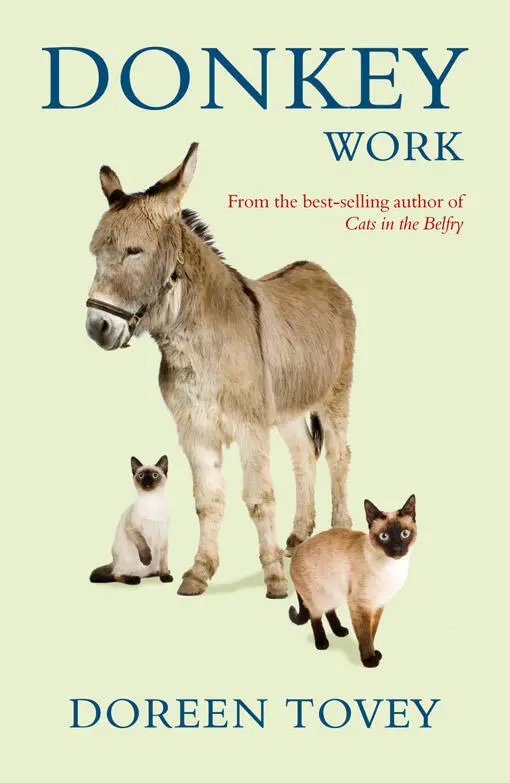
- Название:Donkey Work
- Автор:
- Издательство:Summersdale Publishers Ltd
- Жанр:
- Год:2013
- ISBN:нет данных
- Рейтинг книги:3 / 5. Голосов: 1
-
Избранное:Добавить в избранное
- Отзывы:
-
Ваша оценка:
Donkey Work: краткое содержание, описание и аннотация
Предлагаем к чтению аннотацию, описание, краткое содержание или предисловие (зависит от того, что написал сам автор книги «Donkey Work»). Если вы не нашли необходимую информацию о книге — напишите в комментариях, мы постараемся отыскать её.
Donkey Work — читать онлайн бесплатно полную книгу (весь текст) целиком
Ниже представлен текст книги, разбитый по страницам. Система сохранения места последней прочитанной страницы, позволяет с удобством читать онлайн бесплатно книгу «Donkey Work», без необходимости каждый раз заново искать на чём Вы остановились. Поставьте закладку, и сможете в любой момент перейти на страницу, на которой закончили чтение.
Интервал:
Закладка:
Micawber was. It was Solomon who, within an hour of Micawber's arrival, was being rushed by car to the Vet's. Sheba, seeing us shut ourselves in the garage with a mysterious-looking basket and refuse to let her in, had climbed precipitously up to spy on us through a high outside window. Solomon, seeing her perched aloft like a mountain goat and inspired with his usual desire to imitate her, had tried to climb up to the sill himself and missed. Unknown to us there was a cloche beneath the window. And, as inevitably as everything happened to him, poor old Solomon fell through it.
His long black leg was ripped from top to bottom. Twelve stitches he had in it while, sick with remorse, we held him on the surgery table. Ten days he spent with his leg sewn up in a pathetic seam, turning our hearts every time we looked at him but not inconveniencing Solomon an inch. A fortnight we had Micawber and it seemed, in our extremity, like years.
Micawber said he was going to live in the garage. That was all right by us. We took down every cloche in sight. Charles put a ladder against the inside wall to give him a high, safe perch. We had to be careful, when we drove in, not to hit the ladder, otherwise the ladder immediately fell down and hit the car, but we soon got used to that. We put Micawber on the ladder by way of demonstration... Snag number one. Raised, presumably, in a low-hung cage, Micawber didn't like heights. He, he said, planing to earth so frantically you could practically see him mop his brow with relief when he got there, was a Ground Magpie. He took up residence on a box two feet off the ground, with a derelict door leaning against it one way which formed a sort of cave and a plank leaning against it the other way which formed a sloping gangplank and down this, to the detriment of Charles' rash, every time we or the cats approached he strolled grandly to meet us on foot.
Micawber liked having baths. Our friends discovered that when they saw him splashing earnestly in a garden puddle and we, to keep up the good work, provided him with a soup tureen. Snag number two. Micawber insisted on having that on the ground as well. Out in the drive in the sun, where he ducked and splashed like a grampus, sat blissfully on the edge of the tureen to dry, and we kept nerve-racked watch because if there was anything more vulnerable than a magpie who wouldn't fly it was a waterlogged magpie who couldn't.
That was how it appeared at first sight. Actually Micawber wasn't nearly as vulnerable as he looked. The moment a cat got within striking distance – sometimes, to make it even more hair-raising, the moment the cat actually struck – and Micawber, throwing the business of being a Ground Magpie to the winds, was away. Not, unfortunately, very far. Flapping heavily to the sharp thin top of a beanstick with, a second later, Sheba threatening to leap up there as well and turn herself into a kebab. Fluttering precariously to the top of the garage door with Solomon, sewn-up leg or not, crouched beneath ready for a suicidal spring. Sitting, most dangerous of all, on the apex of the greenhouse, with the car nearby where we normally left it, Solomon and Sheba on the car roof preparing to dive in unison straight through the greenhouse glass, and Charles and I diving even faster to prevent them.
We nearly went mad over the car. We moved it a dozen times a day to a different part of the drive, but it was no use. If we left it nearer the lane it was nearer the bean rows too. Within seconds, the cats were on the roof crouched ready for the take-off and Micawber was sitting like a coconut on the nearest stick. If we left it nearer the garage it was correspondingly nearer the garage door with, this time, Micawber sitting seductively on the top of that. If we put it in the garage and shut the door Micawber immediately flew down, drooped his wings in the dust, huddled dejectedly against the door of what he said was his Only Home and, we gathered from his attitude, wept.
We practically wept, too. We netted the greenhouse and conservatory roofs to afford some protection to the cats. Resulting, needless to say, in the neighbours asking what the mackerel catch was like this morning. We took the netting off again when the cats weren't about in case Micawber got his legs entangled in the mesh and hurt himself. We enticed Micawber down to the cottage proper – away, we thought, from the perils of car and glass. Only to find that he then either sat interminably on the windowsills with the cats charging like Bengal Lancers at the panes from the inside or else kept walking affably at ground level through a kitchen door which had, if we didn't keep eternal watch on them, two equally affable Siamese behind it.
We felt absolutely besieged. We were besieged. That was obvious when we opened the door one day in a thunderstorm, peered apprehensively out to check whether Micawber was sitting on the doorstep, breathed a sigh of relief to see that he wasn't and prayed it might rain for a week – and there, in a flash, he was. Padding wetly to the edge of the coalhouse roof from his vigil under a lilac branch; flapping his wings to attract our attention; assuring us in his loud, harsh voice, while the rain ran off his tail in streams, that he was there and ready and watching.
He was there and ready and watching whatever we did, wherever we went, whatever the hour. At dawn on our bedroom windowsill. Waiting like a customer for the sales to open because, to prevent him coming in during the night, we now slept with the windows shut. At night, having abandoned the garage as too far removed from the centre of things, he watched from a nearby tree. Twice when we'd been away all day until late evening we crept down the path at dusk, admonishing one another not to make a noise, fond as ever of Micawber but hoping, in view of the problems he set us, that he might have given us up for lost this time and gone to live elsewhere. It was no use. Even at nightfall, with every other magpie in England asleep and snoring long before, Micawber was watching us. Down through the dusk he came, circling our shoulders like a bat, sitting on the greenhouse while we put the car away, huddling – the last we saw of him as we closed the kitchen door – a watching outline on the coalshed roof.
That one day was the last we ever saw of Micawber as we knew him. Our first feeling, when next morning he was missing from our bedroom windowsill, was one of relief. No Micawber waddling demoralisingly through the kitchen door the moment we opened it. No Micawber, when we looked round the corner, sitting picket-fashion in the porch. No Micawber, when we went up to feed Annabel, running flat-footedly after us with raucous squawks to play with our shoe-laces, pull at our sandal buckles or jump with a splash into her water-bowl.
It was Charles, growing worried, who found him, lying stunned in a nearby lane. It was nobody's fault that we could see. A rough, bumpy lane where nothing could possibly have speeded. A car lumbering up in bottom gear. Micawber wandering about the verge under the overhanging grass and flying up at the last moment, as was his wont with people and animals, only this time into a car... Sadly we took him in and fought to save him. Micawber fought too, but he died.
It sobered us all for a while. He'd been a nuisance, a danger to the cats and a chaser of other birds. Even the blackbird and the robin had deserted us, chased off so fast by Micawber when they came down to land that, scuttling about the yard on his big flat feet, he looked like a character in a silent film. It was, perhaps, for the best, but we wished it had been some other way. We wished Micawber had taken to the woods where, with no danger to anybody, he might be flashing still between the trees.
The cats missed him. Sheba sniffed puzzledly round the windowsills and thoroughly searched the garage; Solomon sat for hours behind the kitchen door for a Micawber who didn't come; the pair of them scanned the sky when they went out for the familiar flapping of wings. We missed him too. Poking his meat fussily into corners of the yard for storage; raising his head in enjoyment as he drank from a saucer at our feet; sitting – the memory that stayed with us longest of all – at nightfall on the coalshed roof.
Читать дальшеИнтервал:
Закладка:
Похожие книги на «Donkey Work»
Представляем Вашему вниманию похожие книги на «Donkey Work» списком для выбора. Мы отобрали схожую по названию и смыслу литературу в надежде предоставить читателям больше вариантов отыскать новые, интересные, ещё непрочитанные произведения.






Обсуждение, отзывы о книге «Donkey Work» и просто собственные мнения читателей. Оставьте ваши комментарии, напишите, что Вы думаете о произведении, его смысле или главных героях. Укажите что конкретно понравилось, а что нет, и почему Вы так считаете.