Doreen Tovey - Donkey Work
Здесь есть возможность читать онлайн «Doreen Tovey - Donkey Work» весь текст электронной книги совершенно бесплатно (целиком полную версию без сокращений). В некоторых случаях можно слушать аудио, скачать через торрент в формате fb2 и присутствует краткое содержание. Год выпуска: 2013, Издательство: Summersdale Publishers Ltd, Жанр: Старинная литература, на английском языке. Описание произведения, (предисловие) а так же отзывы посетителей доступны на портале библиотеки ЛибКат.
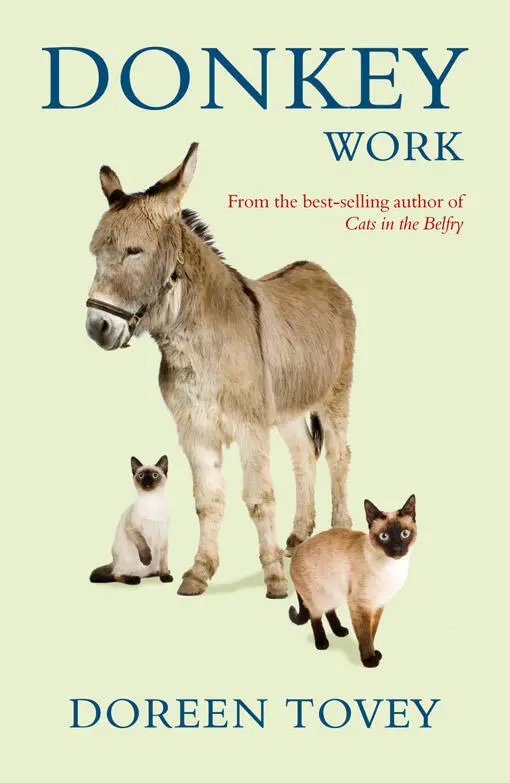
- Название:Donkey Work
- Автор:
- Издательство:Summersdale Publishers Ltd
- Жанр:
- Год:2013
- ISBN:нет данных
- Рейтинг книги:3 / 5. Голосов: 1
-
Избранное:Добавить в избранное
- Отзывы:
-
Ваша оценка:
Donkey Work: краткое содержание, описание и аннотация
Предлагаем к чтению аннотацию, описание, краткое содержание или предисловие (зависит от того, что написал сам автор книги «Donkey Work»). Если вы не нашли необходимую информацию о книге — напишите в комментариях, мы постараемся отыскать её.
Donkey Work — читать онлайн бесплатно полную книгу (весь текст) целиком
Ниже представлен текст книги, разбитый по страницам. Система сохранения места последней прочитанной страницы, позволяет с удобством читать онлайн бесплатно книгу «Donkey Work», без необходимости каждый раз заново искать на чём Вы остановились. Поставьте закладку, и сможете в любой момент перейти на страницу, на которой закончили чтение.
Интервал:
Закладка:
It took another setback to return us to normal. Annabel, eating her way steadily through the summer, had chewed her hedge quite threadbare. From that, with Annabel's eye for effect, it had been a short step to putting her head through the gaps when people passed and reaching, seemingly ignorant of their presence, across the ditch for an odd, stray bramble leaf or an overlooked blade of grass. A touching sight, particularly now that she'd lost her baby coat completely and looked more defenceless than ever with her rounded limbs, minute feet, tiny little tail and the winsomest golden cowlick outside a toyshop. Quite unnecessary, of course, seeing that the paddock was big enough for a dozen donkeys, she had two meals a day and the neighbours fed her till she was fit to pop. But it got her buns and sympathy, and people – watched approvingly by Annabel over the side-fence once their backs were turned – coming to tell us she was hungry.
It also got her out. Annabel, leaning through the wires one day after an elusive dandelion, discovered that she could stretch the top strand up with her head, the middle strand out by leaning on it like a dray horse with her chest – and thereafter, having reduced them in a couple of performances to sagging loops, all she had to do was up with her head, through (stepping carefully) with her feet, and she was free. Running up the hill with Charles and me after her, Timothy racing to cut her off up a side-track, and the lot of us going round like Paul Revere.
Three times she did it in a day, each time at a different point, till the wires hung like Christmas bunting, Annabel was wild with excitement and we were practically flat on our backs. The next day we had to tether her. We didn't like it but there was no alternative until we could get home from town with additional poles and wire and reinforce her fence. She'd be all right, we told ourselves. We'd tethered her for days when we first had her, till we got her fence up. Apart from regularly winding herself up like a maypole till she was on ten feet of rope instead of thirty – plodding self-pityingly round being a Treadmill Donkey, we supposed, though we'd never seen her do it – she hadn't come to harm. Never, as we imagined her doing now, breaking a leg, or strangling herself, or tying herself to a tree. She just couldn't do it, we assured ourselves.
So we left her. Watching us downtroddenly from the middle of the field on the end of her rope. Practising, for the benefit of the day's passers-by, her Burgher of Calais look. And when we got back she'd done it. Hogtied herself so thoroughly in a corner of the paddock that at first we thought she was dead.
She lay there unmoving under the elder tree. Eyes closed, legs bound to her muzzle, coat damp with fear and sweat. Only later had we time to work out how she'd done it – rolling like a puppy in a dust patch with the rope tightening round her with every kick. Meanwhile, panic-stricken, we cut her loose, helped her to her feet, trembled to see that she limped and that, when she opened her mouth to trumpet, only a squeak came out.
She recovered all right. Water, a couple of peppermints, Charles massaging her legs while she leaned convalescently against his head and Annabel was as right as rain. Only Charles was back where he started from, with a flaming peanut rash.
TEN
Time to Take the Pledge
Ours, though sometimes we queried the fact, weren't the worst Siamese in the world. They didn't get drunk, for instance. Like the cat belonging to one of our friends who, enjoying a sherry one night before dinner, put it down by her chair while she read the paper and, when she picked up the glass a moment or two later, found it empty. It gave her the shock of her life, she said, particularly as she was alone in the house. It gave her an even bigger one when she looked apprehensively round and there behind her chair, regarding her from behind the paw he'd used to dip the sherry from the glass and was now licking to extract the last lingering flavour, was her seal-point Siamese Pinocchio. He absolutely leered at her, she said. When she tried to make him stand upright he couldn't. She laid him on her bed. He leered at her again she said, awestruck at the memory, and then he passed out for two solid hours.
They didn't push people in pianos, like a Siamese we knew called Soraya. She, a complete disgrace to her name, leapt on the back of a tuner one day when he was looking into a Bechstein Grand, laid him flat with surprise in the works, and fled. The worst of that was that when the tuner came out again he wouldn't believe a cat was responsible. He'd heard a terrible Yell, he kept insisting. And as there was nobody else in the house at the time but Soraya's owner, undoubtedly she went down in his works report as having done it. Had a sudden mad moment and pushed him in the piano.
Ours weren't particularly temperamental, either. Sheba wouldn't eat if you were looking at her, Solomon created hell and howled if, summer and winter, I didn't wear a particular skirt he liked at night so that he could sit on it, but that was normal Siamese behaviour. Not, for instance, like a cat we knew called Sabre, who had such attacks of nerves when people rang the doorbell that his owners disconnected it. After that people used the knocker. That made him nervous too, so they took the knocker off. A rather drastic step, but the alternative was a cat who spent most of his time hiding traumatically under the gas-stove. So, following complaints from callers who now couldn't make themselves heard at all, they'd connected the doorbell button to a series of lights placed strategically in the hall, the kitchen and over the television set. Red they were, going on and off in ghostly silence. An ingenious invention it was, too. Save for the fact that, apart from their effect on human beings, the last we heard of him Sabre was staring traumatically at the lights as well.
Annabel, similarly, wasn't a particularly wicked donkey, compared with the tales we heard of donkeys who bit, donkeys who kicked carts out of shafts and the donkey who lay at the roadside and pretended to be dead. Father Adams told us that one, and if we'd thought we were unique in introducing a donkey into the valley that, we understood, was where we were wrong. William his name were, Father Adams informed us reminiscently, and sixty years earlier William had been a familiar sight plodding up and down the hill with his little ironmonger's cart. Until the day when, it seemed, William had stumbled at the bottom of the hill, sagged dramatically to his knees and lain down, saucepans and all, in the gutter.
Considerable fuss had been made of William. Once they'd discovered he wasn't dead he'd been lifted wiltingly from the shafts, given whisky in hot water, led gently up the hill when he recovered while the villagers hauled up his cart. The Vet could find nothing wrong with him. He'd lived for another twenty years. What had caused him to collapse initially no one knew. Except that thereafter William collapsed so often at the same spot, to be revived only by whisky and water or the sound of his cart being dragged up the hill by volunteers, that in the end his owner gave up bringing him down. William waited seraphically at the top, the ironmonger trudged blisteringly up and down with a basket, and William never fainted again. You couldn't put one over on a donkey, Father Adams advised us repeatedly when he saw us with Annabel.
We'd learned that for ourselves. Annabel's gate, for instance, fastened with a strap. Annabel playing with the strap when we were there was one thing – nuzzling at the end, tossing her head good-humouredly at us through the fence, indicating that she knew this was the way out and what about a walk. Annabel going at it when our backs were turned was another. We spotted her one day when, in leisurely mood, we were watching swallows on our telephone wire through binoculars. Four swallow fledglings they were, sitting obediently in a row while their parents hunted for food. There was an obvious pattern to the business. Absolute silence while Mum and Dad hunted; a fluttering of wings like a Parisian chorus as Mum and Dad returned; shrieks, gaping beaks and clamours for more as Mum and Dad stuffed the food down their throats; and finally, quiet again as Mum and Dad took off for the next instalment. What intrigued us was the bird sitting on the wire alongside them – fluttering his wings, opening his beak, stretching out his neck at the appropriate moments but quite obviously not a swallow. He, announced Charles, inspecting him knowledgeably through the binoculars, was a whitethroat and obviously one of the valley's wide boys. Trying to horn in on feeding time but the parent birds weren't having any. Wasn't Nature marvellous? demanded Charles enthusiastically. Weren't these creatures characters? Whereupon he brought the glasses downwards from the telephone wire, swept them by way of interest across the paddock, and lit quite by accident upon another character. Annabel – with no one, so she thought, to see her working doggedly away at her strap.
Читать дальшеИнтервал:
Закладка:
Похожие книги на «Donkey Work»
Представляем Вашему вниманию похожие книги на «Donkey Work» списком для выбора. Мы отобрали схожую по названию и смыслу литературу в надежде предоставить читателям больше вариантов отыскать новые, интересные, ещё непрочитанные произведения.





Обсуждение, отзывы о книге «Donkey Work» и просто собственные мнения читателей. Оставьте ваши комментарии, напишите, что Вы думаете о произведении, его смысле или главных героях. Укажите что конкретно понравилось, а что нет, и почему Вы так считаете.