Doreen Tovey - Donkey Work
Здесь есть возможность читать онлайн «Doreen Tovey - Donkey Work» весь текст электронной книги совершенно бесплатно (целиком полную версию без сокращений). В некоторых случаях можно слушать аудио, скачать через торрент в формате fb2 и присутствует краткое содержание. Год выпуска: 2013, Издательство: Summersdale Publishers Ltd, Жанр: Старинная литература, на английском языке. Описание произведения, (предисловие) а так же отзывы посетителей доступны на портале библиотеки ЛибКат.
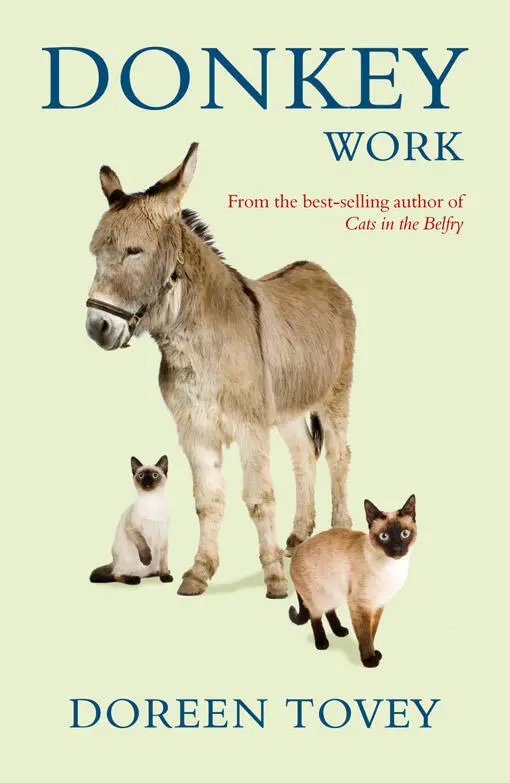
- Название:Donkey Work
- Автор:
- Издательство:Summersdale Publishers Ltd
- Жанр:
- Год:2013
- ISBN:нет данных
- Рейтинг книги:3 / 5. Голосов: 1
-
Избранное:Добавить в избранное
- Отзывы:
-
Ваша оценка:
Donkey Work: краткое содержание, описание и аннотация
Предлагаем к чтению аннотацию, описание, краткое содержание или предисловие (зависит от того, что написал сам автор книги «Donkey Work»). Если вы не нашли необходимую информацию о книге — напишите в комментариях, мы постараемся отыскать её.
Donkey Work — читать онлайн бесплатно полную книгу (весь текст) целиком
Ниже представлен текст книги, разбитый по страницам. Система сохранения места последней прочитанной страницы, позволяет с удобством читать онлайн бесплатно книгу «Donkey Work», без необходимости каждый раз заново искать на чём Вы остановились. Поставьте закладку, и сможете в любой момент перейти на страницу, на которой закончили чтение.
Интервал:
Закладка:
She was right. October, with its bonfires and garden tidying and Charles working diligently away at the goldfish pond, had gone with the wind without our realising it. Annabel's Mum had gone with the wind too, as we discovered when we rang the donkey-man. She was up in Wiltshire, he informed us apologetically. He'd lost the envelope, we hadn't rung, a farmer had taken her for winter board with the rest of the donkeys... He'd got a jennet or two left behind though, he suggested helpfully. He could let us have one of those if we liked. And, so help me, we said yes.
When the jennet arrived a week later I was in bed. Suffering from a cold, with a gale blowing outside, the cats sitting side by side on top of me and Charles, as husbands usually do when their helpmeets are unable to reply, holding conversation with me up the stairs. 'You there?' he called solicitously, following with an enquiry as to whether I'd like some coffee. 'You there?' he called a little later. This time to the effect that the papers had come and where were the sweets for Timothy. 'You there?' came the familiar cry a moment or two after that. And, while I gathered my strength to enquire where he thought I was with a cold like this, up a perishing pine tree – 'The jennet's come!' he said.
I wasn't there very much longer. Five minutes later, with the jennet in the paddock and the van grinding irrevocably away up the hill, Charles came up the stairs. He hoped he'd done the right thing in taking it in, he said. It wasn't one of the little chestnut ones we'd anticipated; it was black. It wasn't very small; he reckoned I could ride it. It wasn't a she either, he revealed, the story developing by leaps and bounds with the intensity of a Victorian melodrama. It was a he by the name of Henry. The man said it was definitely a jennet, though, he'd be all right with Annabel, and he'd be coming to fetch him back in March.
A few more salient points like that, such as that Annabel only came up to Henry's middle, Henry appeared to be hungry and Annabel was kicking him – Annabel had long since eaten all the leaves off her trees up to Annabel height; Henry, according to Charles, was now going methodically round the paddock eating them off up to Henry height, and that was why Annabel was kicking him – and I was up all right. Staggering up to the paddock in pyjamas, duffle coat and gumboots to see for myself. Greeting a neighbour, whom I met inevitably because I was in the lane on Sunday afternoon in pyjamas and with my hair on end, with what I hoped was a nonchalant smile. Falling for Henry the moment I saw him.
Henry was big and black and sleek with a tail that fell like a waterfall. Henry's mane had been clipped like a horse's but, presumably to take some sort of trapping, a stiff black tuft had been left on top like the scalp lock of a Mohawk Indian. Henry was a jennet all right – you could see it, though only faintly, in the sturdiness of his legs and the slightly long black ears. But Henry was very handsome. That Annabel realised it too was obvious from the way she was standing by his side. Coyly; femininely; emphasising with unmistakable deliberation the fact that she indeed only came up to his middle. Helen and Paris, said Charles, forgetting his apprehension in his admiration of the scene. Annabel and Henry, I said with equal pride. I put out my hand to pat him, and Annabel immediately kicked Henry.
Annabel kicked Henry a lot. Determinedly but coquettishly, obviously fully aware of her feminine prerogative. She kicked him when we tried to stroke him. She was our donkey – he wasn't Allowed, she said, pushing imperiously between us and Henry and giving a few sharp back-kicks to emphasise the fact. She kicked him when we gave him titbits. She was our donkey and everything was Hers, she said, interposing her bottom in so many directions at once to fend him off that at times she appeared to be doing the Charleston. We evolved a system of holding sugar or a piece of bread close to the fence for her and then, while she was eating it, surreptitiously handing another piece over her back to Henry. Henry, reaching equally surreptitiously over her to get it, soon cottoned on. So, unfortunately, did Annabel. Following a trick or two like that she only had to see the shadow of a hand pass over her head and Annabel kicked capriciously behind and clocked Henry on principle. She knew he was there and that'd teach him not to Sneak, she snorted into her bread and honey.
It wasn't that she didn't like Henry. She just intended to be boss. The first night he was there, for instance, Henry moved into the shelter at dusk as if it was his right. It was too small for him, being only Annabel size, so he stood up all night as if he was in a sentry box with his rump inside and his head and forefeet out. Annabel, presumably under the impression he was standing there on guard and had his eye on her, didn't attempt to throw him out that evening. She stood up too, under a nearby tree, looking warily across at him, pretending she was grazing, and working out a plan. There must have been a plan because the next night it was Annabel who got there first and stood Horatio-like in the doorway while Henry loitered under the tree. And the next night and the next night, till Henry got the idea it was Annabel's shelter and stopped trying to go in there himself, Annabel Frrmphed triumphantly and said she should think so, too – and the next thing we saw, going out one night with a torch to check on the position to date, was Henry standing under his tree and no sign of Annabel at all. Annabel, ascendancy established, had given up keeping guard. Annabel, when we looked inside her house, was back where she belonged. Asleep flat out in the straw with her hooves crossed, her cowlick over her eyes and a pout of triumph on her small white mouth. The only concession to watchfulness being that she had her head towards the door.
Banned from the shelter, kicked when he spoke to us – kicked, according to the neighbours, even when he spoke to them and the people up the lane said the way Annabel ate ginger-cake now was a revelation – Henry might have been excused for developing a temper. He did in fact kick me a couple of times. On account of their jealousy we fed them separately – oats and hay for Annabel outside her shelter, oats and hay for Henry under his tree – and still they squabbled. Annabel marched over to Henry's heap and said it was better than hers, Henry moved over to Annabel's heap and said very well he'd eat that, Annabel charged back in a towering temperament snorting That was hers as well, she'd have the Law on him... Feeding time in the paddock was less a matter of eating than of Annabel and Henry playing musical chairs and, when they stopped, Annabel standing truculently over whichever pile she fancied at the moment, snorting and threatening to kick Henry off.
At first Henry, being a gentleman, gave in to the lady and went. Eventually Henry, goaded beyond endurance, began to kick back in retaliation. Never, even then, to land. Simply thrashing out in a powerful arc to show her he could, if he wanted to, kick her over the cottage; missing her deliberately on account of she was a girl by a good six inches; and having no effect on Annabel the Wilful at all. Only on me, whom he kicked by accident in the stomach.
I thoughtlessly went too close behind him; he, lashing out in what was meant to be a warning to Annabel, caught me amid-ships and laid me flat; and Charles (it was one of my more off-moments in donkey-keeping) picked me winded from the grass and cheerily said No Harm Done. Fortunately not, as Henry didn't wear shoes. I only had a bruise the size of a plate on my stomach, and an assurance from Charles that he'd had that many a time playing cricket. Which I took leave to doubt because I used to play cricket myself at school and we never caught balls on our stomachs. Though, as Sidney said when he heard about it, you never knew with the Gaffer.
Читать дальшеИнтервал:
Закладка:
Похожие книги на «Donkey Work»
Представляем Вашему вниманию похожие книги на «Donkey Work» списком для выбора. Мы отобрали схожую по названию и смыслу литературу в надежде предоставить читателям больше вариантов отыскать новые, интересные, ещё непрочитанные произведения.






Обсуждение, отзывы о книге «Donkey Work» и просто собственные мнения читателей. Оставьте ваши комментарии, напишите, что Вы думаете о произведении, его смысле или главных героях. Укажите что конкретно понравилось, а что нет, и почему Вы так считаете.