Doreen Tovey - Donkey Work
Здесь есть возможность читать онлайн «Doreen Tovey - Donkey Work» весь текст электронной книги совершенно бесплатно (целиком полную версию без сокращений). В некоторых случаях можно слушать аудио, скачать через торрент в формате fb2 и присутствует краткое содержание. Год выпуска: 2013, Издательство: Summersdale Publishers Ltd, Жанр: Старинная литература, на английском языке. Описание произведения, (предисловие) а так же отзывы посетителей доступны на портале библиотеки ЛибКат.
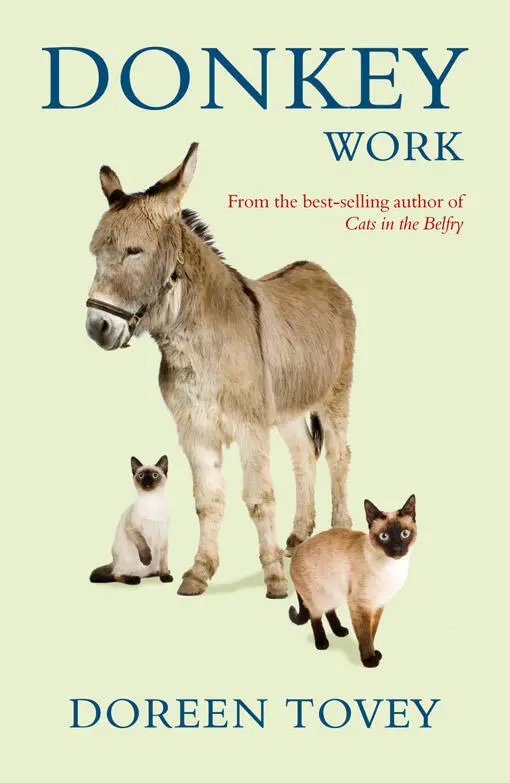
- Название:Donkey Work
- Автор:
- Издательство:Summersdale Publishers Ltd
- Жанр:
- Год:2013
- ISBN:нет данных
- Рейтинг книги:3 / 5. Голосов: 1
-
Избранное:Добавить в избранное
- Отзывы:
-
Ваша оценка:
Donkey Work: краткое содержание, описание и аннотация
Предлагаем к чтению аннотацию, описание, краткое содержание или предисловие (зависит от того, что написал сам автор книги «Donkey Work»). Если вы не нашли необходимую информацию о книге — напишите в комментариях, мы постараемся отыскать её.
Donkey Work — читать онлайн бесплатно полную книгу (весь текст) целиком
Ниже представлен текст книги, разбитый по страницам. Система сохранения места последней прочитанной страницы, позволяет с удобством читать онлайн бесплатно книгу «Donkey Work», без необходимости каждый раз заново искать на чём Вы остановились. Поставьте закладку, и сможете в любой момент перейти на страницу, на которой закончили чтение.
Интервал:
Закладка:
We tethered them in a nearby field while we carried out repair work on the paddock. Inspiring though it was to see the latest development in their relationship, we could work a whole lot faster without the prospect of being kicked to the boundary if anything upset Henry, or of Annabel's latest little trick of leaning innocently on the fence wire while we were stringing it so that when she stood upright again it hung in loops and was – as she archly demonstrated by lifting it with her nose – absolutely useless.
All day long it took us. Strengthening the fence. Enlarging Annabel's house with the help of Timothy so we could lock them in at night. Roofing it with hurdles and a huge tarpaulin and filling it with straw. We brought back Heloise and Abelard. Put them in the house and fed them. Fastened them in as it was now nightfall. Looked through the hurdle door a little later to see Henry stretched out like a great black sultan in the straw and Annabel contentedly eating hay...
If only it could have continued like that. Annabel and Henry together for the winter. Miss Wellington happy at last. Ourselves sleeping blissfully at night with the thought of all our animals under lock and key. But the next night Henry broke out again. At dusk this time, before we'd even thought of shutting them in. Fortunately we heard the twanging of the paddock wires as he squirmed his way through and the sound of his hoof-beats going like coconuts on the hill. Fortunately the wiring was too complicated this time for anybody but an expert to get through it and Annabel was unable to follow him. Even more fortunately, as we panted desperately up the hill in his wake Farmer Pursey came round the corner in his land-rover and headed him back to the valley.
That was the end as far as Henry was concerned. Obviously he was a bolter and had escaping in his blood. Keep him, said Farmer Pursey, and not only would we never, however much we wired the place, fence him in, but he'd teach Annabel his tricks as well. Keep him, he said, and we'd probably have the pair of them killed. What Henry wanted was exercise to tire him out, not mooning round a field with Annabel.
So Henry went back to his owner. To our regret because we liked him. With such regret on Miss Wellington's part that she turned up two days later with the news that she'd seen several donkeys in a field from a bus window and had got off at the next stop to enquire. The man, she said, was perfectly willing for us to have one of his little donkeys to keep Annabel company, and when Charles said he bet he was – one of his little bolters too, he expected, and if anybody brought any more donkeys here we were emigrating to Jamaica – she went off us again for days.
Annabel, to our surprise, showed no concern at all. She snorted contentedly when we fed her, lingering gloatingly over her bowl with the intimation that it was all hers wasn't it and nobody to have to share it with. She pranced so joyously out at Charles when he unbarred her door in the mornings that there was no mistaking the inference that there was Much more room for fun now, with old Big Feet out of the way. Despite the morning when she'd trailed Henry up the valley, acting as though the skies would fall if she lost sight of him for an instant, there was such an air of Things being like they Used to be, Annabel having Triumphed, and it was Hoped we realised now who was the best donkey around here, that we wondered if we'd been mistaken in taking him on in the first place.
The cats, who'd kept strictly to the outside of the fence for the past few weeks, appeared in the paddock again like Spring crocuses. Sheba rolling celebratorily on Annabel's new roof, Solomon getting so excited that when I was playing tag with him with Annabel's empty halter he seized the end of it in his mouth and ran away with it, as he sometimes did with string. I yelled in case the loop end of it caught on something and pulled out Solomon's teeth. Father Adams, blissfully en route from a mid-day session at the Rose and Crown, nearly dropped. God Almighty, he said, mopping his brow. He thought he was used to us by now. But when I shouted like that and a cat tore down the lane like a thunderbolt carrying a halter-now he'd seen everything, he said.
Not quite everything he hadn't. A few nights later I was sitting in the shed across the lane with Solomon. Guarding him against foxes, as a matter of fact. We never let them out unsupervised on winter evenings and when somebody roared for air or a desire to see the great outdoors one or other of us always went with them. This evening it was raining. Instead of walking up the lane Solomon and I were sitting in the open-fronted shed. I, to pass the ten minutes or so allocated to Fatso's airing, was shining my torch on the falling rain saying 'Look at the rain, Solomon'. At which moment Father Adams walked past, shone his torch on me and a Siamese sitting talking in the dark on a sand-heap, and demanded apprehensively 'Bist thee feelin' all right?'
Things having a habit of happening in threes, he strolled up the lane the following day and nearly stopped breathing altogether. The people in the modernised cottage had moved in some time before. One of their innovations had been a long, low lounge in stone with picture windows, built on at the side. Another had been a bridge over the stream to get their car across which Father Adams forecast would collapse at any moment – not for any structural reason but just because there hadn't been one there before – and kept going up to see if it had.
We always got the latest news when he came back. 'Plantin' their cabbages,' he would announce as he stumped past our gate. 'Seedin' their lawn.' 'Got their drains stopped up.' Always conveying an up-to-the-minute summary of what was going on, an implied disappointment that that was all that was happening and that the bridge hadn't fallen in yet, and the unfortunate impression, if we happened to have visitors, that he'd gone up there prospecting on our behalf.
'Thee's ought to see!' he greeted us stentoriously on this occasion from a good hundred yards away. We were wrong in gathering that the bridge had at last come up to expectations, however. What had happened was that autumn had come, the Segals had started their lounge fire on a free-standing, Swedish-style hearth that was plainly visible from the lane through their picture window, and had discovered that it smoked. Raising the hearth experimentally up and down on blocks they'd found that the correct height at which it didn't smoke was about three feet from the ground. Contemporarily correct inside their lounge, highly spectacular viewed from the lane when one saw a fire apparently burning on a shelf halfway up a wall – 'Thee's all be nuts!' was Father Adams' verdict when we explained that nowadays that was a perfectly normal idea.
A few days later I felt like agreeing with him as far as we were concerned. I called at the stables to thank Miss Linley, who'd been out with her riding school the morning we collected Annabel and Henry, and I hadn't seen her since. I told her about Henry's second escape and our returning him to his owner. Funny that Annabel didn't miss him, I said, since they got on so well together.
It was one of the biggest shocks in my career as a donkey-keeper when she said they certainly did – the morning after they'd run away they'd got married in her paddock. I felt myself turn pale. 'He's barren though, isn't he – like a mule?' she said in a hearty, used-to-animals voice which brought me partly back to consciousness. Of course he was, I agreed with her. Ha ha, of course he was. I was forgetting that.
It was Charles's turn to turn pale when I got home and told him. They were supposed to be barren, he groaned. One of the things the donkey-man had told him the day he brought Henry, though, which he'd forgotten to tell me but the man had said that in any case it was so remote it was bound to be all right, was that occasionally... there had been a couple of cases... where they weren't.
Читать дальшеИнтервал:
Закладка:
Похожие книги на «Donkey Work»
Представляем Вашему вниманию похожие книги на «Donkey Work» списком для выбора. Мы отобрали схожую по названию и смыслу литературу в надежде предоставить читателям больше вариантов отыскать новые, интересные, ещё непрочитанные произведения.







Обсуждение, отзывы о книге «Donkey Work» и просто собственные мнения читателей. Оставьте ваши комментарии, напишите, что Вы думаете о произведении, его смысле или главных героях. Укажите что конкретно понравилось, а что нет, и почему Вы так считаете.