Erin Bow - Plain Kate
Здесь есть возможность читать онлайн «Erin Bow - Plain Kate» весь текст электронной книги совершенно бесплатно (целиком полную версию без сокращений). В некоторых случаях можно слушать аудио, скачать через торрент в формате fb2 и присутствует краткое содержание. Год выпуска: 2010, ISBN: 2010, Издательство: Scholastic Inc., Жанр: Старинная литература, на английском языке. Описание произведения, (предисловие) а так же отзывы посетителей доступны на портале библиотеки ЛибКат.
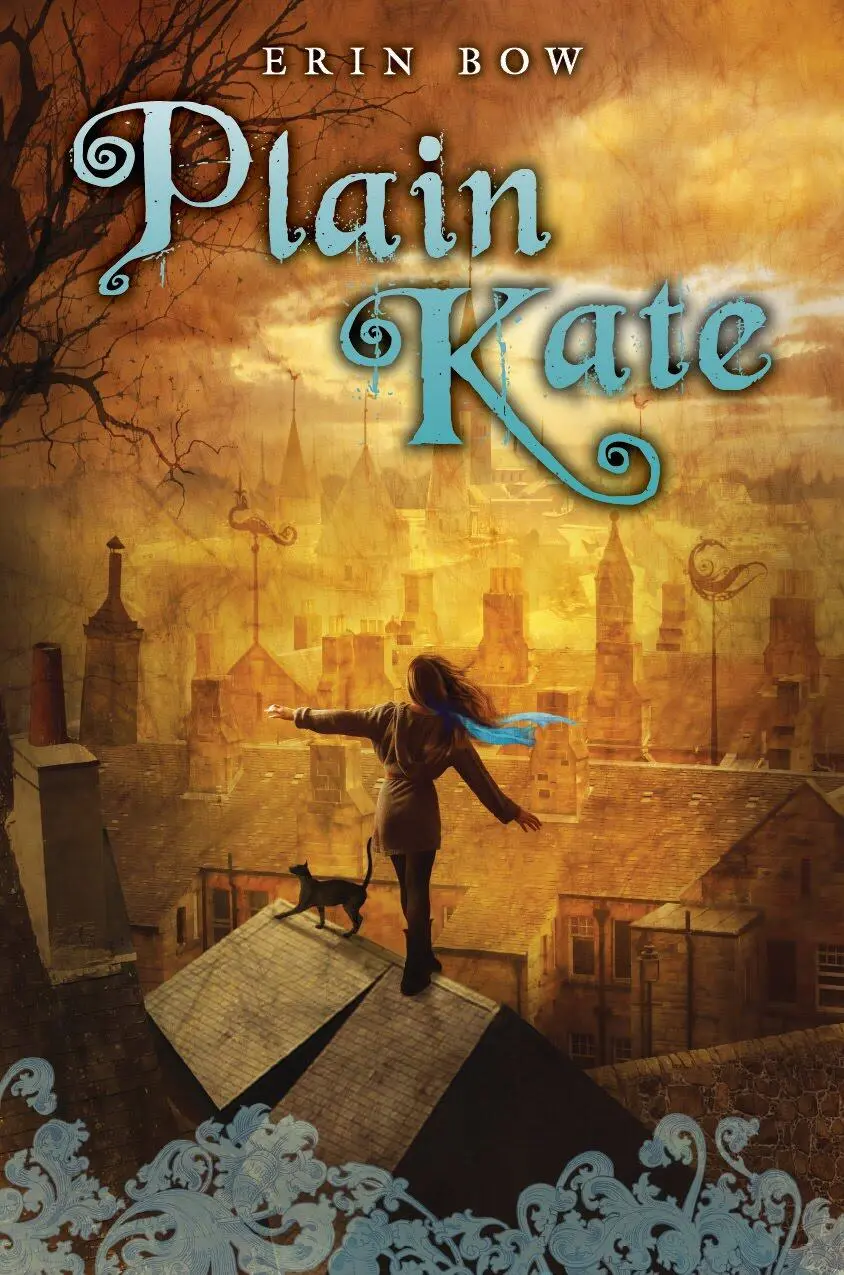
- Название:Plain Kate
- Автор:
- Издательство:Scholastic Inc.
- Жанр:
- Год:2010
- ISBN:9780545166645
- Рейтинг книги:3 / 5. Голосов: 1
-
Избранное:Добавить в избранное
- Отзывы:
-
Ваша оценка:
Plain Kate: краткое содержание, описание и аннотация
Предлагаем к чтению аннотацию, описание, краткое содержание или предисловие (зависит от того, что написал сам автор книги «Plain Kate»). Если вы не нашли необходимую информацию о книге — напишите в комментариях, мы постараемся отыскать её.
Plain Kate — читать онлайн бесплатно полную книгу (весь текст) целиком
Ниже представлен текст книги, разбитый по страницам. Система сохранения места последней прочитанной страницы, позволяет с удобством читать онлайн бесплатно книгу «Plain Kate», без необходимости каждый раз заново искать на чём Вы остановились. Поставьте закладку, и сможете в любой момент перейти на страницу, на которой закончили чтение.
Интервал:
Закладка:
After a while, Linay came over from his white blanket and worked beside her, and he too was silent.
Plain Kate knew that the axe had come because of the rumors Linay had twisted into life. Perhaps he had even sent the axe wielder—a nudge, a seemingly innocent word in the right ear. But she took his help because some of the things she had to move were heavy, and because his strange, washed-away face was hollowed as if someone had died. He pulled her parents’ marriage quilt from under the last of the rubble. She saw the axe holes in it, the way the fog moved through them like snakes.

Plain Kate folded the quilt into a mat; she hammered some broken planks into a rough workbench. Day came. Summer thunder cleared the market square. Soaked and cold, Plain Kate worked alone to finish the bow, her hair dripping into her face, stinging her mismatched eyes.
When the bow at last was finished, it was as good as anything she’d ever made. It had no ornament, but its simple lines were beautiful, like one bird against the sky.
And now that it was finished, Kate had no more work to do.
She sat for a while, empty as the empty square, thinking. Then without a word she stood up. She picked up the bow like a sword and went off to find Linay.
The afternoon was damp and clammy. Plain Kate followed the faint sounds of the tambourine around the puddles and the horse droppings, through the river-ward gate of the town. Down by the docks she found Linay sitting on the roof of the hold of a small boat. It was the punt she’d seen him on the night the fish had swarmed: a small, neatly made little barge, painted grass-green. Linay was singing a sad song about river spirits, to entertain the men who were smearing pitch in the chinks. She walked toward him, ignoring the looks that beat on her like rain. Big Jan grabbed her arm. “You’re not welcome here, witch-child.”
Linay stopped singing and stood up. “Her business is with me.” Big Jan was broad like a wild ox, but Linay was skinny like a rabid wolf, and Jan backed down. Linay swept by and caught Kate up in his wake. She trailed him down the dock, then down the road toward the forest.
The rain had stopped. The light was storm-green and the trees were stirring restlessly. The smell of the river was heavy in the air.
Plain Kate held out the bow. Linay took it as if it were a rose, and bowed over it. He looked at her silently. She looked back.
At last Linay moved. “Your four silver.” He pulled coins out of her ear, like a merry juggler—but his eyes were piercing. “Does that finish our business?”
“I’m leaving,” she said. “I need food, things.”
“Hmmmm,” he said, sinuously. “Did you have in mind a trade?”
“For my shadow,” she said. “I want oilcloth. And a sleep roll, and a pack. A packet of fishhooks, a camp hatchet. Ten yards of rope.”
He laughed. “Do you think you can live on the road? In the woods?”
“I’ll get by.”
“You’ll get by, you’ll get by,” he sang. “I’d almost like to see you try.” He drew himself up. “Done.”
Faraway thunder clacked. It sounded like a latch closing. “Done,” she said.
Linay wiped the rain off his face. “The docks. Meet me beside my punt, at the third bell past midnight.” He turned back toward the town.
Plain Kate, empty-handed, went over to the ruins of her father’s stall. She thought about what she could carry and what she must leave. Behind her she heard Linay’s fiddle begin to play: Wild and powerful as a storm, it swept across the rainy twilight.
She took one of her silver coins to the cobbler and bought good boots: deerskin, double stitched and sturdy. She took a second coin and bought a haversack from the tanner, who took her money but spat on the doorstep as she left. She took the third to the butcher to buy jerky, but he would not trade with her at all. She took the last coin to Niki’s bakery to buy hardtack, but by then the light was sinking and the bakery was dark and shut. She went back to where the splintered heap of the stall lay like a dead horse among the puddles of the market square.
Plain Kate packed her best tools in their felt pouches; she packed her one pan; she packed her two striped smocks and extra socks. She coiled her fishing line and twine. She came to her parents’ marriage quilt. It had once smelled of her father, and though it now smelled of sawdust and cats, she remembered how that smell had wrapped her, her first night in the drawer. But she needed a coat, and the quilt was too big. She was practical. She sliced it in half. She cut a hole for her head, pulled it on over her wet hair, and belted it with a bit of rope. The other half lay on the cobbles, soaking up rainwater.
She picked up the piece of the wreckage with the carved stag on it. It was too heavy to take. It served no purpose. She set it back down. It seemed to blur and leap in the half light, and it took Kate a moment to realize that her eyes were tearing. She picked the stag back up. She put it back down.
Taggle was sitting on top of the heaped wood, watching her. “I’ll leave it,” she told him. “I don’t need it.“ Her eyes stung as she said it. She dashed her hand across them, disgusted with herself. The cat chirruped inquiringly. “It’s nothing,” she told him, her throat angry and aching with the effort of not crying. Decisively, she took the carving knife her father had given her—the knife her hand had grown up knowing, the knife that had shaped her—and thrust it into the sheath in her new boot.
“Now we can travel,” she told Taggle. She sat down on her makeshift workbench. “I couldn’t go without my knife. Though I don’t suppose I’ll find much work, living wild.” The wet evening was sinking into darkness. The cat hopped down and ambled over to sniff her ankles.
“What about you?” she asked, lifting him into her lap. “A dog would come without question—but I suppose a cat must make his own choices.” It was foolish to talk to no one, and she stopped. And so she left unspoken her deepest wish: that she did have someone to talk to, that she didn’t have to go alone.

Deep in the night, Plain Kate went down to the river. She carried her haversack on one hip and Taggle in her arms. No cat would follow a wanderer; she realized that now. But she was not ready to give him up, to leave him as she had left the carved deer from her father’s stall, propped up against her workbench in the abandoned square. Not yet; not quite yet. And maybe he would follow her, a little way.
Away from the cressets of the market, under the lid of clouds, it was very dark—and very quiet. She heard the throaty murmur of the river, the plop of a jumping fish. Behind her, someone pulled a shutter. Across the river, a fox barked.
Linay was sitting quietly, watching the black gleam of the river, dangling his legs off the dock like a child. A pierce-work tin lantern sat on the dock beside him, and in its feeble light he looked pale as a moth in the deep of the night. He was eating a meat pie. As Plain Kate came up he held a second pie out to her. She ignored it. He shrugged, licked the gravy from his dagger, and set the pie on the wet wood at her feet.
Taggle’s nose started twitching.
Plain Kate stood over Linay. Taggle had begun twisting in her hands like a strong fish—a fish who wanted meat pie. She would have to put him down soon. “Now what?” she asked.
“Blood,” Linay said. Kate drew back and he laughed. “Oh, mine, Little Knife, don’t worry.”
“Kind,” she said, trying to mock, though her voice felt high and tight. Linay’s dagger looked as if it could gut a deer.
“Blood draws things. And it would be foolish to draw your own shadow to you.” He hesitated a bare second, then picked up his dagger, flipped it round, and drew it fearlessly across his wrist. His white face didn’t flicker, but Plain Kate winced for him as blood welled. Taggle gave a strangled cough, as if she were squeezing him too hard.
Читать дальшеИнтервал:
Закладка:
Похожие книги на «Plain Kate»
Представляем Вашему вниманию похожие книги на «Plain Kate» списком для выбора. Мы отобрали схожую по названию и смыслу литературу в надежде предоставить читателям больше вариантов отыскать новые, интересные, ещё непрочитанные произведения.







Обсуждение, отзывы о книге «Plain Kate» и просто собственные мнения читателей. Оставьте ваши комментарии, напишите, что Вы думаете о произведении, его смысле или главных героях. Укажите что конкретно понравилось, а что нет, и почему Вы так считаете.