Erin Bow - Plain Kate
Здесь есть возможность читать онлайн «Erin Bow - Plain Kate» весь текст электронной книги совершенно бесплатно (целиком полную версию без сокращений). В некоторых случаях можно слушать аудио, скачать через торрент в формате fb2 и присутствует краткое содержание. Год выпуска: 2010, ISBN: 2010, Издательство: Scholastic Inc., Жанр: Старинная литература, на английском языке. Описание произведения, (предисловие) а так же отзывы посетителей доступны на портале библиотеки ЛибКат.
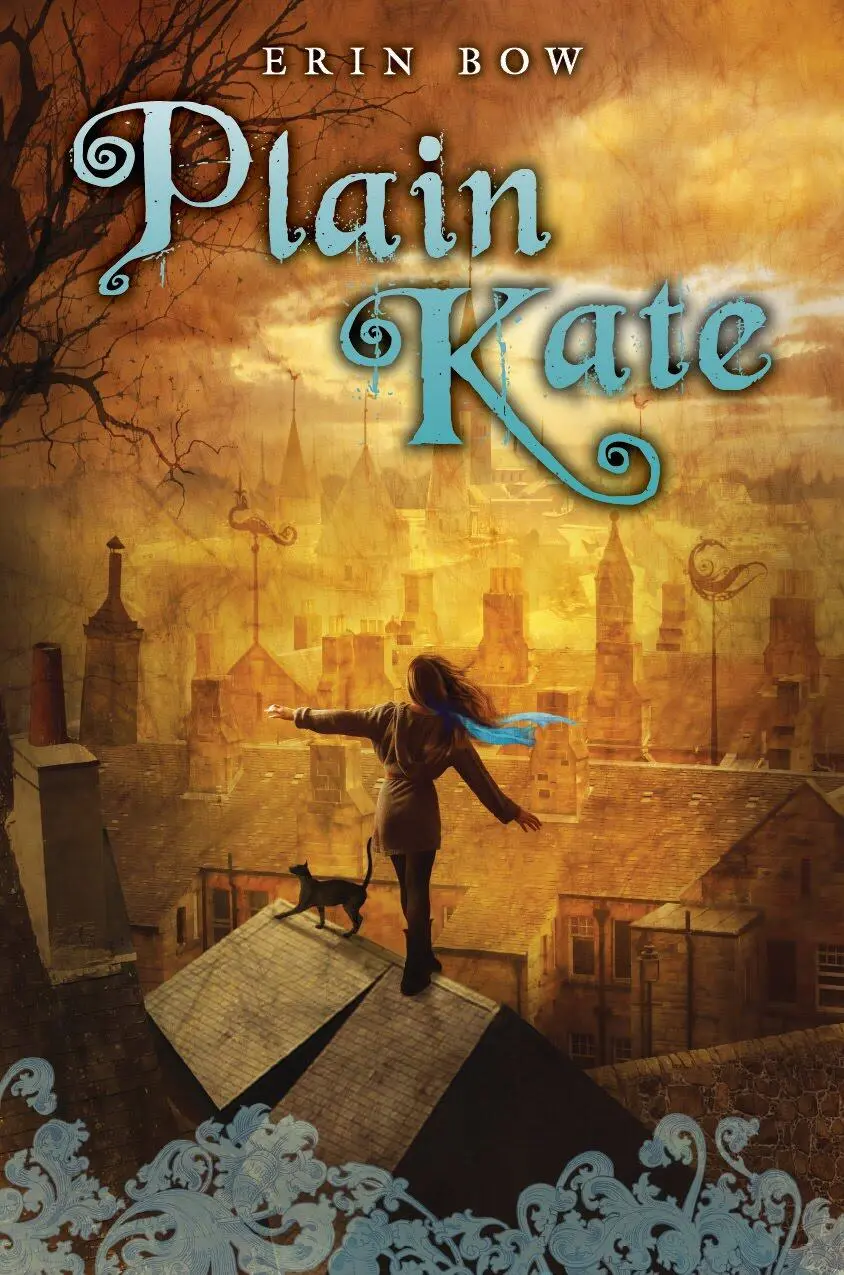
- Название:Plain Kate
- Автор:
- Издательство:Scholastic Inc.
- Жанр:
- Год:2010
- ISBN:9780545166645
- Рейтинг книги:3 / 5. Голосов: 1
-
Избранное:Добавить в избранное
- Отзывы:
-
Ваша оценка:
Plain Kate: краткое содержание, описание и аннотация
Предлагаем к чтению аннотацию, описание, краткое содержание или предисловие (зависит от того, что написал сам автор книги «Plain Kate»). Если вы не нашли необходимую информацию о книге — напишите в комментариях, мы постараемся отыскать её.
Plain Kate — читать онлайн бесплатно полную книгу (весь текст) целиком
Ниже представлен текст книги, разбитый по страницам. Система сохранения места последней прочитанной страницы, позволяет с удобством читать онлайн бесплатно книгу «Plain Kate», без необходимости каждый раз заново искать на чём Вы остановились. Поставьте закладку, и сможете в любой момент перейти на страницу, на которой закончили чтение.
Интервал:
Закладка:
“I think…” she said, and stopped to think. The little cabin was stuffy and rocking; it made her drowsy. She lay watching the herbs and bundles above her slowly sway. “I think I have to,” she said. “He will give me my shadow back at Lov. I can’t live without my shadow.”
“I do not trust him.”
“He can’t lie.”
“So he says.” Taggle’s tail lashed. “Katerina, your shadow will do you no good if the thing kills you.”
“It won’t,” said Linay, and Kate jumped. He had slipped down the ladder without them noticing.
Taggle did not deign to flinch, but his ears flicked back. “It will. I have made many things bleed; I know blood. Katerina, you cannot feed the thing again. It will kill you.”
“Well,” said Linay. “There is a trick to it.”
“Faf!” Taggle spat. “You are full of tricks! It is late for tricks! You weaken her; you muddle her!”
Linay ignored this. “Come ashore. I’ll show you.”
Kate wanted only to sleep. The heat lulled; her head pounded. But after a while she got up and climbed the ladder. She found the punt pulled up at the river’s edge where some long-ago flood had left a tangled heap of dead trees. She had waited too long: Linay had gone off on one of his foraging missions and left them alone.
Sitting in the bleached and bony wood, with the sun streaming through her, Plain Kate sat and tried to carve. The knife that had once been like another hand to her now sat stiffly on top of the new scars. Her fingers had lost their sureness and strength. But still, she turned the burl wood she’d found in the road over and over under her knife, cutting away its weak-rotted places, looking for the shape in its heart. It was rough work, the only kind her hands could do.
The burl slowly took a shape like something with wings. She thought of two hands pressed wrist to wrist, with palms and fingers spread. Bound hands.
Taggle sat primly on a deadfall branch and glared at her until she gave up on carving and placated him by catching a fish. She cooked; they ate. Time passed quietly.
“When you were with the Roamers,” said Linay’s voice behind her, sudden and soft as a ghost, “did she come?”
Plain Kate refused to jump again. She nodded without looking at him. Yes, the rusalka had come. And the Roamers—the people who had been almost her family—had blamed Kate.
“Who?” said Linay.
Plain Kate didn’t see why she ought to answer. Let him wonder. But then he said: “Not Drina…?”
Drina. Her first friend, her—the word startled her as it came into her head—her sister. “No,” she said. “Not Drina. Wen. Stivo.”
“Ah,” he said, voice flat. And he sat down across from her and speared the fish’s head.
“Can they be saved?” Kate asked. “The sleepers—could I have saved them?”
Linay shrugged. “If the rusalka was roused from her half sleep, the sleepers might awaken too. I don’t know and I don’t much care.” He flipped up the gill flap with a thumbnail and picked out the morsel of meat behind it.
“We want to see this trick of yours,” said Taggle.
“Hmmm,” hummed Linay. “Come closer.”
Plain Kate hesitated, and shifted her foot to be sure of the knife in her boot. She did it subtly, but he saw it. “Oh, honestly.” He nudged her toe with his. “I saved your life. I’m hardly about to hurt you. Hold out your hands.” He mimed it, making a bowl of his own long hands and lifting it.
She looked at him narrowly. In the sun, the burn scar pulled across her scalp. She cupped and raised her hands.
“I haven’t always been a stealer of shadows, you know,” he said. “I was a weather worker, once—and welcome anywhere, welcome as a summer rain. And I still know the moods of wind and water.” He leaned over her, fitting his own hands against the underside of hers, his long fingers lapping her wrists. “You can’t expect a ghost to lick up spilled blood like a—”
“—dog,” supplied Taggle. The cat had stood up and was watching them, fur on end.
“She will take blood only from a body. But what is a body? Just a bowl for life. A bowl of breath.” And he blew a long breath into the cup of her hands. It was warm at first, and slowly it grew cold.
Kate eased her hands open. Inside them—taking their shape—was a bowl of ice. It was small as a bird’s nest, woven like that, and shining in the sun. She lifted it into the light. Delicate feathers of frost furred its edges.
“You see,” he said, smiling. “It hasn’t always been ugly.”
Then he stood up, fast, like a man insulted. “It’s a bowl. You fill it with blood and she won’t know the difference between this and a body. Thus I control her bottomless appetites. Notice that you can’t do it without me.” He turned his back on her and swung up the skillet as if it were a sword. “Kick out the fire and come aboard,” he said. “I want some distance yet today.”
But when she lifted herself over the edge of the boat he was in the hold below, and he didn’t come up at once. She thought she heard him weeping.

So they went along. The country grew lower, and the weather cooler. Kate’s hands healed slowly. Linay grew stronger, and Plain Kate learned why he had been weak.
Every evening she let her blood fill the bowl of ice that lined Linay’s hands. They were big hands, narrow but long-fingered. It caught up with her like sickness, the blood-letting. The first day she didn’t feel different. But on the second the sun made her drowsy. On the third she found herself nodding over her carving. By the fifth a sort of heaviness came over her, and made her knife shake. She sheathed it and asked, “How far to Lov?”
Linay shrugged. The old fluidness was back in his joints; he no longer moved as if his jumping-jack strings had stiffened. “Two weeks? Three? It’s not my country.” He set the pole to the river bottom, pushed them ahead, and added: “But we’re coming to it, mira . I can taste it, like ashes. Lov, at last.”
His voice made her scars ache. She ducked her head and took up the wood again.
Days passed. Linay brought back from his wanderings leather leggings and a farm boy’s smock, and she folded the long linen dress away, gladly. The next day he gave her a roll of hand tools: a rasp, a chisel, three kinds of gouges, an awl, and a carving knife. Kate, whose old knife was as much a part of her as her name, put the new knife away, but she used the other tools gratefully.
“No cat would do this,” said Taggle. “Fight.”
“I am fighting,” she answered. But slowly it stopped being true.
She tried to stop herself from feeling the surge of tenderness that came to her when he worked to heal her hands: the liquid song that had once set her father’s smashed fingers, the crooked sunburned part of Linay’s white hair as he bent his fair head. He is dangerous, she told herself. He does not love me. I do not trust him. I am only going to Lov to get back my shadow.
He does not love me. I do not belong here.
thirteen
shadow
Adrift in a green barge on the tea-colored, slow-flowing Narwe, Plain Kate carved and bled.
She sat on the pole man’s seat, knife in hand, drowsy in the sun. The burl wood wings were almost finished, full of long, strange twists of wood grain, less like feathers now than like long hair spread in water. They had an uneasy beauty. But the lump between the wings would not show her its face. She had cut away the rough and rotten wood and found a smooth knot, like an acorn. Was it a sharp chin and a high forehead? An owl’s beak and flaring ears? Its blank curve told her nothing. She sat with her knife above it and did not know what to do. If the thing was a mirror, then her heart was blank.
Читать дальшеИнтервал:
Закладка:
Похожие книги на «Plain Kate»
Представляем Вашему вниманию похожие книги на «Plain Kate» списком для выбора. Мы отобрали схожую по названию и смыслу литературу в надежде предоставить читателям больше вариантов отыскать новые, интересные, ещё непрочитанные произведения.






Обсуждение, отзывы о книге «Plain Kate» и просто собственные мнения читателей. Оставьте ваши комментарии, напишите, что Вы думаете о произведении, его смысле или главных героях. Укажите что конкретно понравилось, а что нет, и почему Вы так считаете.