Erin Bow - Plain Kate
Здесь есть возможность читать онлайн «Erin Bow - Plain Kate» весь текст электронной книги совершенно бесплатно (целиком полную версию без сокращений). В некоторых случаях можно слушать аудио, скачать через торрент в формате fb2 и присутствует краткое содержание. Год выпуска: 2010, ISBN: 2010, Издательство: Scholastic Inc., Жанр: Старинная литература, на английском языке. Описание произведения, (предисловие) а так же отзывы посетителей доступны на портале библиотеки ЛибКат.
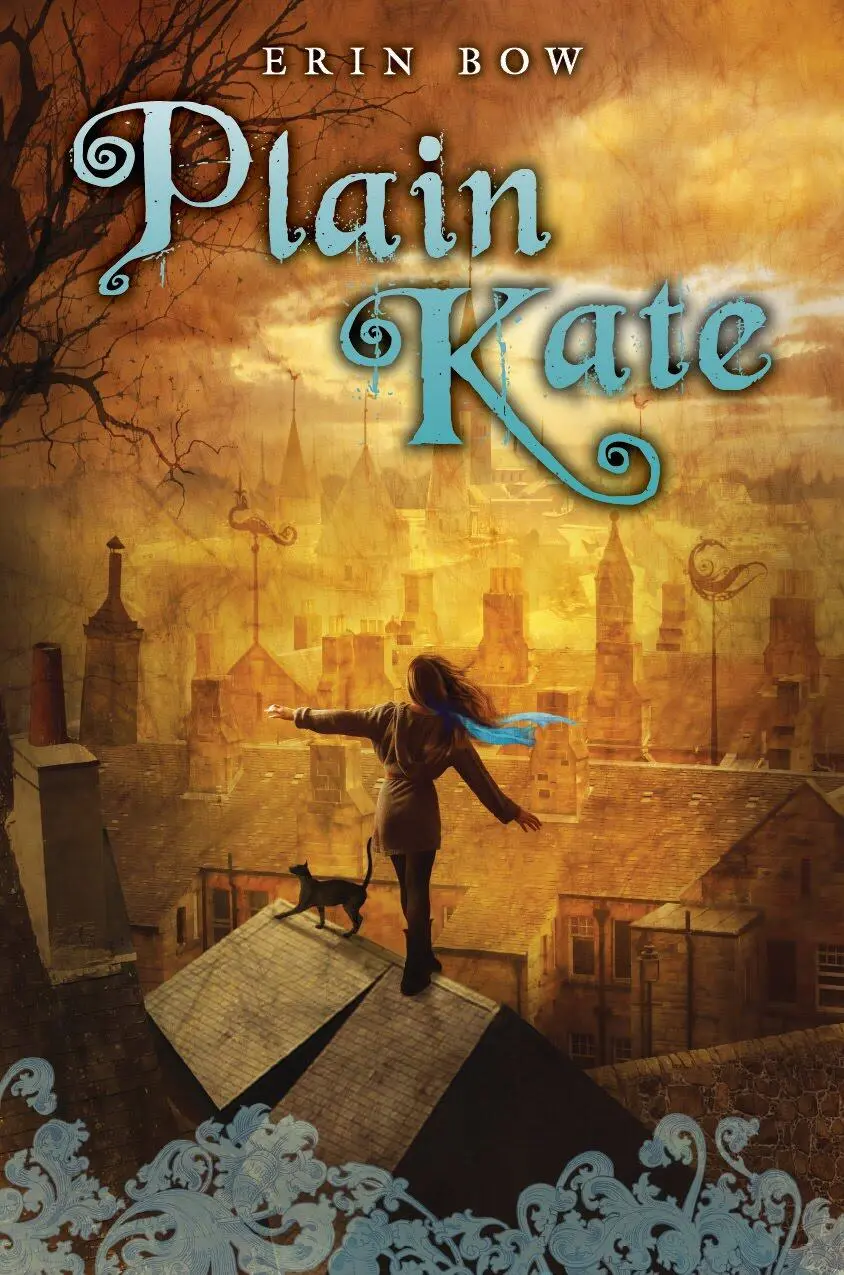
- Название:Plain Kate
- Автор:
- Издательство:Scholastic Inc.
- Жанр:
- Год:2010
- ISBN:9780545166645
- Рейтинг книги:3 / 5. Голосов: 1
-
Избранное:Добавить в избранное
- Отзывы:
-
Ваша оценка:
Plain Kate: краткое содержание, описание и аннотация
Предлагаем к чтению аннотацию, описание, краткое содержание или предисловие (зависит от того, что написал сам автор книги «Plain Kate»). Если вы не нашли необходимую информацию о книге — напишите в комментариях, мы постараемся отыскать её.
Plain Kate — читать онлайн бесплатно полную книгу (весь текст) целиком
Ниже представлен текст книги, разбитый по страницам. Система сохранения места последней прочитанной страницы, позволяет с удобством читать онлайн бесплатно книгу «Plain Kate», без необходимости каждый раз заново искать на чём Вы остановились. Поставьте закладку, и сможете в любой момент перейти на страницу, на которой закончили чтение.
Интервал:
Закладка:
Kate wanted to curl up on the deck and cover her face, but she didn’t. She lifted her hand, filled with blood. Nonsensically, she remembered the last time she had lifted her hand like this, for Taggle: One day when the Roamers strayed far from the river, she had poured water from a skin into her cupped hand and held it out. As Kate thought this, the rusalka dipped her head, and drank.
Kate felt something like a mouth close over the hole in her wrist. It sucked blood, or more than blood. Bones. Her own name.
Time went by.
Kate was dying. It felt like being changed into sleep and water.
The a blur of gray came like a cannonball through the fog and thumped into her chest.
Plain Kate fell backward. Taggle was standing on her chest, crying “Katerina! Kate! Kate!” His claws prickled through her clothes. Fur stood in a ridge on his back. “Taggle…” She choked on his name. Groggy and sick, she pushed herself up on one elbow. The rusalka—
—the rusalka was kneeling beside Plain Kate on the deck. She was made of fog and shadow until Kate caught her eye, and then, all at once, she became human. She was young, mischievously sad, a fox in a story. Kate fell in love with her. And then she was gone.
It was like waking up from a dream. Kate sat up and Taggle fell from her chest and tangled himself around her sprawling legs, circling and high stepping, purring as a cat will do when badly hurt. “The thing!” he said. “The thing came while I was not here to challenge it!”
Plain Kate twisted around. Linay, as if he hadn’t moved, was sitting cross-legged on the cabin roof. He gave a fluid, careless shrug. He picked up his fiddle. Kate got up and went below.

Plain Kate lay in the narrow bunk and listened to the skirl of Linay’s fiddle, ringing wild and strange across the water. Taggle paced the edge of the bunk, up and down. His small feet pressed into her like blunted chisels. “Stop that,” she said when she couldn’t stand it anymore. “Lie down.”
The cat sprang over her and started to walk the hand’s space between her body and the boat wall instead. The third or fourth time he made the turn by her face she batted at him. “Taggle! Lie down!”
He stopped, facing away from her, his restless tail switching over her face. “I could go kill you something,” he offered.
“Just sit.”
He turned—stepping on her spleen—and sat. “I am sorry,” he said. “I don’t like it. It is a new word, sorry . It should not be a thing for cats.”
“I suppose not.”
He lay down and fit his narrow chin into her hand. “But I am sorry. Sorry I was not here to kill the thing for you.”
“It’s not a thing.” Kate was remembering the rusalka’s bright face—fear and flicker of flame in the ghostly eyes. “She must have had a name once.”
“Bah,” said the cat. “She’s dead now. Dead things should stay dead. Otherwise they might scratch you from the inside.”
“Bah,” echoed Kate. The music sighed and rippled. She rubbed her cut wrist, and then crooked her arm around Taggle’s soft warmth. The nights were getting colder.
The cat rolled and shaped his spine to her side. “Sleep,” he said. “I’ll keep watch.”
But Plain Kate lay a long time in the darkness—long after the cat had drifted to sleep—listening to the sad music, and thinking.
Linay was a witch, and a Roamer man alone. His sister was a witch, a woman both burned and drowned. How many could there be? Linay, Kate was sure, was Drina’s uncle, the man who had given a piece of his shadow to summon the dead. The man who had gone mad.
twelve
fog
The next day, Plain Kate looked for it and saw it: the hole in Linay’s shadow.
He was poling the punt. The light threw his long shadow across the deck. In the center of that shadow, over his heart, was a patch that fluttered like a hurt bird. The sun broke through it, once in a while, in coins of light.
Kate watched that roiling patch. Under her, the boat surged, coasted, and slowed; surged, coasted, and slowed. The fog bank was still behind them, the watery sunrise turning the top of it pink and yellow. She was remembering the story of how he had used blood and hair to pull apart his shadow. To give a voice to the ghost of his sister.
“What was her name?” Kate asked. “Your sister. The rusalka. What was her name?”
The boat rocked a little when Linay fumbled the pole, but his eerie-pale face stayed smooth. “She’s dead,” he answered at length. “We do not say the names of the dead.”
“I know. Drina told me.”
That drew a sudden, startled look. “Drina.” He stilled himself again. “Well, well. How a life comes round. I knew as I followed you that you were with the Roamers, but I—”
“You followed me?” It was Kate’s turn for shock.
“To draw your shadow. Did you think its remnants were to be sent to me by the royal messenger? The loss of a shadow, as I told you, is a slow thing. I had to be close, to catch yours as it pulled away.” He shrugged. “There is only one road; there is only one river. It was not hard to follow you.”
Why should she feel betrayed? But she did. His words stirred up the sticky panic of her long loss, her heavy secret, her shadow twisting away from her. She turned from him. His shadow fell past her, and hers was nowhere, gone.
“Why?” she said. “Why did you do this to me?”
She saw his shadow shrug. “I needed a shadow. Yours was the easiest to get.”
Plain Kate looked down at her burnt hands, the light going right through them. She said nothing. Time passed. Then Linay was suddenly, silently, at her shoulder. She shuddered away from him, but he reached out and took her wrists. He lifted them, oblivious to her cold resistance. “These are healing well.”
“Let me go.” She jerked her hands fruitlessly.
“Some salve, first.” He released her and produced, from the billows of his zupan, a stoppered jar. He rubbed some of the chilling, oily stuff into her scars. The mint-sharp smell washed over her. Linay’s head was bent over her hands. “Lenore,” he said softly. “My sister’s name was Lenore. She was a healer. She taught me this. I will see you carve again.”
She could think of nothing to say. Linay stayed bent over her hands, singing softly. Kate remembered what Drina had said: that all magic depended on a gift, freely given, and that healers gave some of their own life for the health of those they healed. Linay rocked as he sang, as if he were praying or exhausted. He sang himself slowly into silence. He let go of her hands but did not lift his head. His voice was low. “What does your cat call you?”
“Katerina.”
“Katerina. I am sorry.” Even if he had not been a witch, bound to the truth by his own power, she would have been sure that he meant it.
But that night as the fog rolled around the punt, he again summoned the rusalka. He again sat and watched as Kate filled her hand—her hand that he had just worked to heal—with her own blood. And he let the rusalka nurse on her blood until Kate found herself sliding into grayness, trying to hold on to the memory that Linay was dangerous, that he did not love her, and that she must not forgive him.

Plain Kate slept deep into the next day. When she woke, the first things she saw were cat eyes. Taggle was sitting on her chest glaring as only cats can. “You let the thing come for you again,” he said. “If you die I am going to be furious with you.”
Her head felt muzzy. “Where were you?”
The cat abruptly decided to groom his shoulder. “He gave me fish,” came the fur-muffled voice. “I went to sleep.”
“He poisoned you?”
“I will not take food from him again,” Taggle intoned. “Please know that this is a great sacrifice. But clearly I must guard you, Katerina.” He looked at her sidelong. “You are thinking of giving it more blood.”
Читать дальшеИнтервал:
Закладка:
Похожие книги на «Plain Kate»
Представляем Вашему вниманию похожие книги на «Plain Kate» списком для выбора. Мы отобрали схожую по названию и смыслу литературу в надежде предоставить читателям больше вариантов отыскать новые, интересные, ещё непрочитанные произведения.






Обсуждение, отзывы о книге «Plain Kate» и просто собственные мнения читателей. Оставьте ваши комментарии, напишите, что Вы думаете о произведении, его смысле или главных героях. Укажите что конкретно понравилось, а что нет, и почему Вы так считаете.