Erin Bow - Plain Kate
Здесь есть возможность читать онлайн «Erin Bow - Plain Kate» весь текст электронной книги совершенно бесплатно (целиком полную версию без сокращений). В некоторых случаях можно слушать аудио, скачать через торрент в формате fb2 и присутствует краткое содержание. Год выпуска: 2010, ISBN: 2010, Издательство: Scholastic Inc., Жанр: Старинная литература, на английском языке. Описание произведения, (предисловие) а так же отзывы посетителей доступны на портале библиотеки ЛибКат.
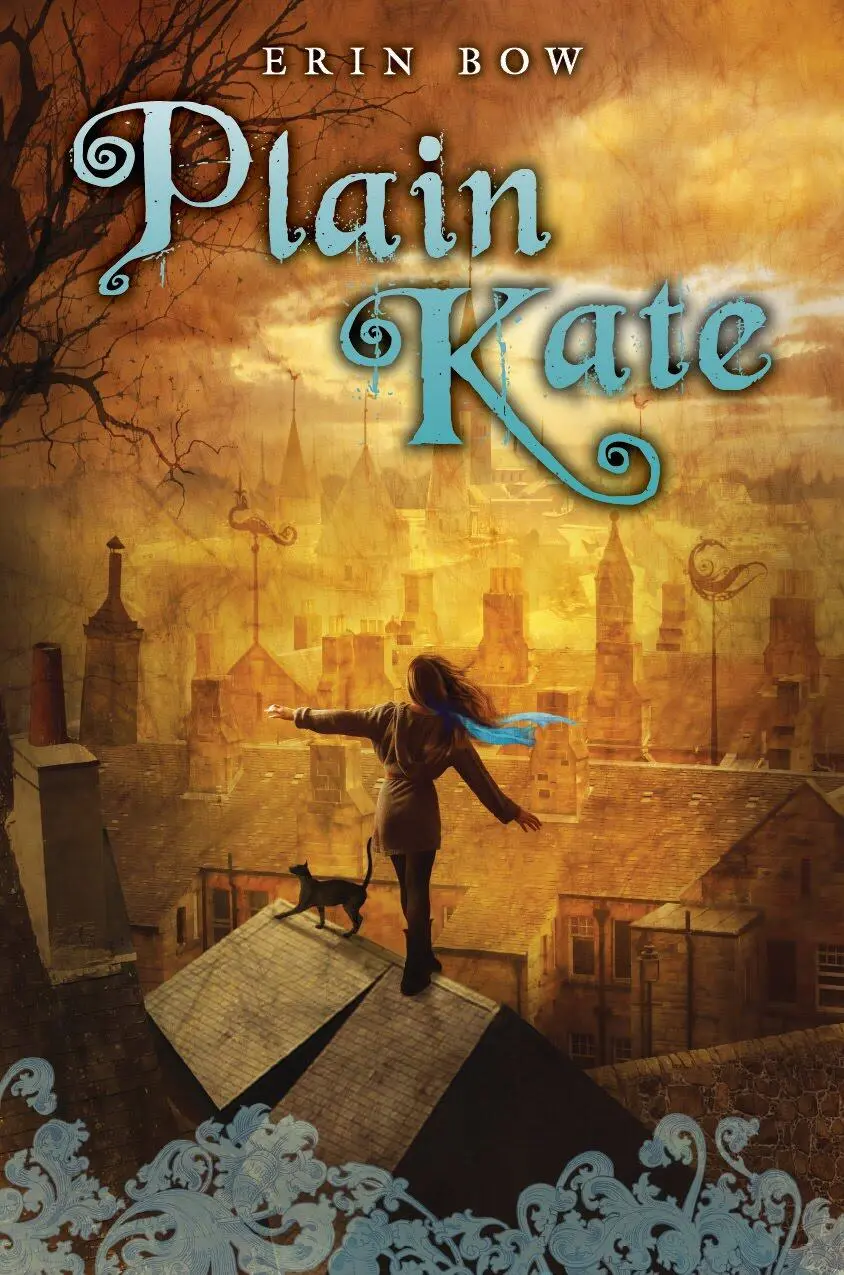
- Название:Plain Kate
- Автор:
- Издательство:Scholastic Inc.
- Жанр:
- Год:2010
- ISBN:9780545166645
- Рейтинг книги:3 / 5. Голосов: 1
-
Избранное:Добавить в избранное
- Отзывы:
-
Ваша оценка:
Plain Kate: краткое содержание, описание и аннотация
Предлагаем к чтению аннотацию, описание, краткое содержание или предисловие (зависит от того, что написал сам автор книги «Plain Kate»). Если вы не нашли необходимую информацию о книге — напишите в комментариях, мы постараемся отыскать её.
Plain Kate — читать онлайн бесплатно полную книгу (весь текст) целиком
Ниже представлен текст книги, разбитый по страницам. Система сохранения места последней прочитанной страницы, позволяет с удобством читать онлайн бесплатно книгу «Plain Kate», без необходимости каждый раз заново искать на чём Вы остановились. Поставьте закладку, и сможете в любой момент перейти на страницу, на которой закончили чтение.
Интервал:
Закладка:
She tried to summon up her father’s voice: Be brave. Trust the wood. Lift your knife.
Kate touched the knife to the smooth curve, took a shallow stroke. The blade hit a knot and shot from her hand, skittering across the deck. Kate stood and fetched the knife. She thought about throwing the carving into the river, and maybe following it in.
Taggle was leaning out from the prow like a figurehead, his whiskers quivering close to the water. Kate glanced: Catfish stirred in the willow roots, slowly working their white mouths. Taggle was staring at them, cross-eyed with desire.
“I’m going to lie down,” she told him.
“Fish, fissssshhh,” he answered.
She eased down the ladder into the warm dim hold—and saw Linay.
He was kneeling beside the bunk. On top of the quilts was the box made from the ruins of her father’s stall. Linay had one hand stretched above it, and blood was dripping from one fingertip, into the box.
“Don’t come closer,” he said.
She came closer.
From a few steps away she could see inside the box. It was empty, but it held darkness as a bowl might hold water. The clotting shadow inside seemed to bubble around the blood, like fish after bread crumbs.
She stopped coming closer.
And Linay closed the lid.
“My shadow,” Kate whispered.
“All things need to eat.” Linay shrugged and lifted his pricked finger to his mouth, sucking away the blood. “Tears are better than blood, but some days one just can’t weep. And the shadow must be fed or it will wither to ribs and eyeholes—useless.”
“Useless,” she said softly, “for what? Why do you need it?”
“To raise the dead and spread the fire.” He answered her as if sunk into his own dreams. Then he roused and looked daggers at her. “You’re sharp, Plain Kate. Be careful, or you’ll find yourself cut. If you love your life, do not open that box.”
And he stalked out.
Plain Kate stood looking at the closed box. She put her hand on the carved hart and let its antlers prick the tight new skin on her palm. It was her father’s carving; it was as familiar to her as her own breath. Did something stir? Behind the thin wood, as if behind the surface of a mirror, did something press its hand to hers?
Her heart gave a little lurch as if at a hero’s hurt in a story. “Yes,” something answered her. “Mine.”
Tears, Linay had said. If she wept, would it come to her? She could almost have wept, wounded by the new hope.

The next day, when Linay went foraging in the abandoned country, Kate climbed back aboard the barge. She went below and sat on the edge of the bunk, looking at the box. Taggle climbed into her lap. “Hello,” he said, then rolled over and peered up at her appealingly. “I am fond of you and present my throat for scratching.”
“Taggle,” said Kate. She knitted her fingers through his fur. “I… ”
There’s this itchy spot, you see,” he said. “Just over the left jawbone. Oooooo, yes, therrrrre…” His voice trailed away into a purr.
As you love your life, Linay had said. But she had to see. If there was any chance of getting her shadow back—“I have to try.”
“Oooo, you’re succeeding.” Taggle’s claws bared and velveted as he kneaded at the air. “You’re talented, I’ve always said so. Ooooooo…”
“We’re not talking about you.”
The cat’s inner eyelids had been sliding closed. He lifted one, lizardlike. “We’re not? Why not?”
“It’s my shadow, Taggle. The thing in that box is my shadow.”
Taggle’s eyes opened. They looked uncattishly wise. “And how long have you known that?”
“Since yesterday,” she said. “You thought—”
“I thought you might have known longer, yes. I thought you might have known and yet done nothing. You have not been yourself. You have given yourself too much to that man.” He tipped his head at her. “A dog, you know—her master may beat her and she will still be glad to see him. Open the door of her cage and she might still faithfully wait.”
“I’m not a dog,” she said hotly.
He arched his whiskers into a cat grin and rubbed his brow bone against her cheek. “I should say not.” He growled with fierce joy. “Is it dangerous, this box?”
If you love your life…
“Yes,” she answered.
“Then I will stand by you,” he said.
So Kate stood up.
The box sat in its shadowy corner. She nudged it with her foot. It scraped over the deck. She’d thought it would either lean into her like an animal or stand heavy like a lead casket. But it was just a box. She picked it up and set it on the bunk. In the bunched blankets it looked bigger than it should have. It had butt joints, the simplest of joints, but even so they weren’t square. Just a badly made little box.
Taggle sniffed at it, squinted, and backed away. “Bitter.” He snorted to clear his sensitive nose.
Kate lifted the lid.
The box was empty, but around them, the air was slowly tightening. The emptiness began to rise in the box, sitting up on its blind haunches and sniffing at the air.
Kate’s heart reached for it, and her heart followed. “Easy—” said Taggle. The shadow nosed and licked at her fingers, put its not-breath on her scarred palms. She pulled away and it whined after her.
And then it was out—her shadow.
It flowed over her—it joined her hand and foot—it rushed cold across her skin—it dove into her nose and ears. Wherever it touched her, she went numb—the kind of numbness that comes after a blow. It was between her fingers, inside her smock, inside her mouth. She spun away but it followed her, whirling around her like a dancer.
“Katerina!” Taggle spun with her, circling fast, swiping at the clinging almost-stuff.
“Tag—” Kate choked. It was in her. She felt heavier and lighter, buzzing, dizzy. But as she reeled into the light from the hatch she saw it: the Kate-shaped thing flying across the floor, across the wall, a shadow, her shadow!
Yes, said the presence, as it pushed against her. Mine. Us.
Kate stopped and stood panting. She lifted a hand and watched the shadow’s hand-thing lift. It slid up the wall. It grew long claws. Kate stood frozen, one hand uplifted. “Is it—”
“Breaking!” Taggle shouted. One of the long fingers flew off. Another. And suddenly the shadow hand came apart into whirling knots. Kate gasped, clutched at her own hand, and crashed to her knees. “Katerina!” Taggle cried.
Kate squeezed her wrist as hard as a tourniquet; her shadow was in a dozen pieces, her hand felt alien as a flock of birds. Across the floorboards, her shadow slumped as she did. She could see its edges tattering and lifting away. “The light,” she gasped. “The light is breaking it!”
They don’t wear them in the land of the dead, Linay’s voice came back to her. The dead had no shadows. If you had no shadow, were you dead? It felt like death—a breaking apart that was well past any pain.
Something streaked down past her ear and thumped onto the deck: Taggle. He’d gone above and she hadn’t even noticed. “I tried—close the hatch. Block the light,” he panted. “Can’t. Latched. Can’t—Kate! Kate!” She had toppled sideways and lay there in pieces. Taggle seized her by the scruff of her neck and tried to drag her like a kitten, out of the light.
“The box,” she managed. “Close the box.”
He was gone, endlessly. And then back. “The shadow-thing won’t go in,” he said. She could hardly hear him; his words and the whole world was breaking into whirling birds. “What do I do?” A sudden point of pain brought her back. Taggle was biting her hand. “Kate! What do I do?”
Читать дальшеИнтервал:
Закладка:
Похожие книги на «Plain Kate»
Представляем Вашему вниманию похожие книги на «Plain Kate» списком для выбора. Мы отобрали схожую по названию и смыслу литературу в надежде предоставить читателям больше вариантов отыскать новые, интересные, ещё непрочитанные произведения.




Обсуждение, отзывы о книге «Plain Kate» и просто собственные мнения читателей. Оставьте ваши комментарии, напишите, что Вы думаете о произведении, его смысле или главных героях. Укажите что конкретно понравилось, а что нет, и почему Вы так считаете.