Erin Bow - Plain Kate
Здесь есть возможность читать онлайн «Erin Bow - Plain Kate» весь текст электронной книги совершенно бесплатно (целиком полную версию без сокращений). В некоторых случаях можно слушать аудио, скачать через торрент в формате fb2 и присутствует краткое содержание. Год выпуска: 2010, ISBN: 2010, Издательство: Scholastic Inc., Жанр: Старинная литература, на английском языке. Описание произведения, (предисловие) а так же отзывы посетителей доступны на портале библиотеки ЛибКат.
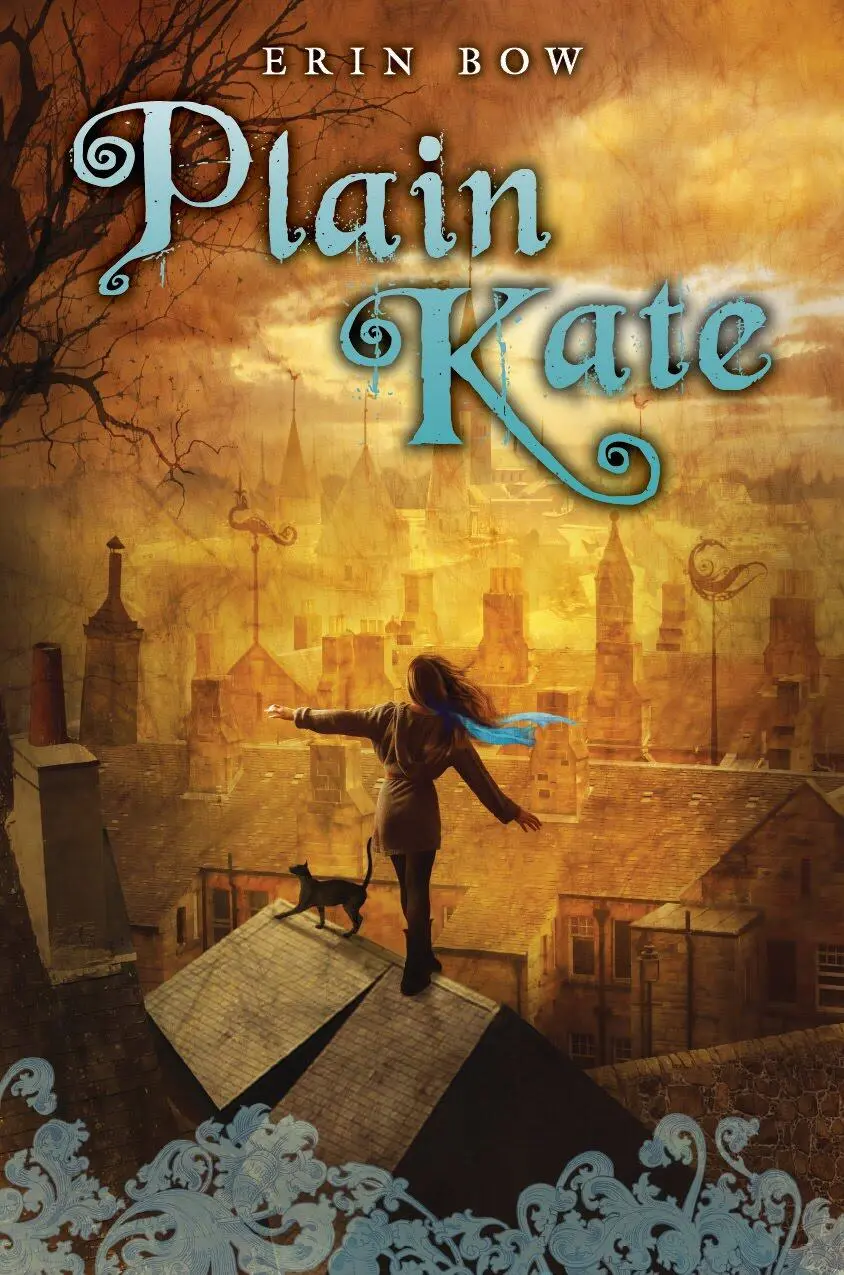
- Название:Plain Kate
- Автор:
- Издательство:Scholastic Inc.
- Жанр:
- Год:2010
- ISBN:9780545166645
- Рейтинг книги:3 / 5. Голосов: 1
-
Избранное:Добавить в избранное
- Отзывы:
-
Ваша оценка:
Plain Kate: краткое содержание, описание и аннотация
Предлагаем к чтению аннотацию, описание, краткое содержание или предисловие (зависит от того, что написал сам автор книги «Plain Kate»). Если вы не нашли необходимую информацию о книге — напишите в комментариях, мы постараемся отыскать её.
Plain Kate — читать онлайн бесплатно полную книгу (весь текст) целиком
Ниже представлен текст книги, разбитый по страницам. Система сохранения места последней прочитанной страницы, позволяет с удобством читать онлайн бесплатно книгу «Plain Kate», без необходимости каждый раз заново искать на чём Вы остановились. Поставьте закладку, и сможете в любой момент перейти на страницу, на которой закончили чтение.
Интервал:
Закладка:
The fog was so thick now that she felt completely alone. Then Taggle came from nowhere, standing regally at her elbow, with his ears pricked and his fine head lifted. They heard Linay jump down onto the deck. He emerged from the fog and stopped in front of them. Wordless, he held out his cupped hands, ready for her blood.
Kate stood up. “I won’t,” she said.
“Oh, won’t you? I believe we had a bargain. Your blood for your shadow.”
“I gave you blood. I never said I’d keep giving it.” In the rye field the birds settled into a silence that struck Kate as ominous. She drew herself up. “I want something else.”
“I want answers,” said Kate. “To three questions.”
“Three questions!” He laughed. “Do you think you’re a fair maid in a tale? Shall I fetch a mirror, Little Stick, to set you straight?”
“Two questions,” she bargained.
Linay stopped laughing. A thicker fog was beginning to pour over the side of the punt. “You would haggle with hell’s boatman,” Linay spat at her, then thinned his voice to a little girl’’: “One coin or two?”
Kate tried a shrug. “Bleed yourself, if you’d rather.”
“I’ll help,” said Taggle.
Linay ignored the cat, and spoke as if to himself. “I am going to need my strength.”
The boar was full of fog now. Plain Kate felt as if they might sink into it and drown.
“ One question,” said Linay.
“One a night.”
“Done. Now bleed.”
So she did, letting the blood trickle into the bowl of ice in Linay’s hands. In the twilight, it looked black. As the bowl filled, the fog rose and thickened and began to eddy around them and rub at them like a stray dog. In another moment the rusalka was there, thin as a rib bone but wrapped halfway around them. She leaned for the blood. There was nothing human in her face, nothing lovely—just a bottomless avidity.
Kate backed away.
Linay, though, stayed where he was, and when the rusalka knelt to drink he crouched beside her, as if he wanted to wrap an arm around her shoulders. He was singing something. Kate couldn’t hear what.
She reached down and picked up Taggle. Together they watched the rusalka and Linay kneeling together like a bride and groom. They waited.
The rusalka drank the blood from the bowl, and when she was gone, Linay folded up. He sat on the deck with his knees drawn up and his head resting on his arms.
“Linay?” said Kate. She couldn’t tell whether or not he was weeping.
He fluttered a pale hand without lifting his head. “Yes, yes. Ask your question.”
“Why—” she asked softly. She found, to her surprise, that she didn’t want to hurt him. “Why are you taking her—Lenore—to Lov?”
“She died there.” His bent head made his voice soft. “In the skara rok . She was tending the sick.” He laughed, barely louder than the river. “By the Black Lady, they would hardly have needed to kill her—she had spent so much of herself in healing magic. But they did. They killed her. They took her for a witch, they tortured her, and they killed her. The people of Lov.”
Kate sat down on the pole man’s seat not beside Linay but near. “So why? Why take her back there?”
“After—” He swallowed. “After I saw what she had become, I decided I had to save her. I studied dark magic. I went to dark places. I spoke with…things…no man should speak with. I gathered power. And I learned. I learned, among other things, that a rusalka’s fate can be undone by avenging her death.”
“But—people have died.” People I knew, she thought. Stivo. Wen. And maybe—don’t let it be Drina. “It’s already done. People have already died.”
Linay shrugged. “But not the people who killed her.”
“Lov,” she said. “The people of Lov.”
“Lov.” He nodded. “So at last we are going.” With that he lifted his head. He was not weeping. His face was set and fierce as a blade. Plain Kate stood up and wished she had room to back away.
“Enough,” he said, looking down and dashing the fragments of ice from his hands. “Go.”
She went.
The carving of Lenore’s face was going to be beautiful. Even in its rough form, it arrested. The nose, narrow. The mouth, rich and sad. The eyes, tilted as a fox’s eyes. The hair, wild as the fog, vanishing seamlessly into those seaweed wings. All the next morning, Plain Kate worked on it, staying in the hold to avoid Linay’s eyes. And though Taggle disliked the hot closed space, he stayed with her, drowsing at her feet.
Working fast and fearlessly, Kate used a chisel to free high cheekbones and quizzical brows from the wood that had enclosed them. Lenore. Kate could see Drina’s lively eyes in the carving’s face. She felt a stab of loss and guilt. Drina. What had happened to Drina?
And this woman who had been her mother, with her lively eyes, with Linay’s full mouth, with some alchemy of mischief and sadness that was all her own, Lenore: Was there anything left of her, inside the rusalka? Did she know what she had become? When she took her own husband, Stivo, into her gray sleeping kingdom, had she known?
At Pan Oksar’s farm, Plain Kate had seen a new thing: The Oksar people, with their foreign ways, had nailed iron to trees for luck. Horseshoes and rough crosses shaped of broken plowshares and pitchfork tines. Some had been there a long time, and the trees, in their swelling growth, had edged their bark over the metal like slow lips, had grown around their injury and taken black iron into their mouths, into their hearts.
Linay had taken his sister’s fate inside that way. And its weight and blackness had sent him slowly mad. No wonder his people had cast him out. He was as lost as Lenore was—more lost, because unlike her, he surely did know. He did know what he was doing.
And he was going to do it anyway. Unless she could stop him.
So, on the second night, Kate waited, slapping at mosquitoes, and Taggle came over and sat, sphinxlike, between her feet. The light grew blue and the fog caught up to them. Soon the little punt was alone in a world of it.
Linay shipped his pole and came forward, springing lightly onto the boat roof, and then down again to the deck in front of Kate. He bowed to her elaborately. “Fair maid of the wood, again the moment has come. Ask your question.”
“How?” she said. “You are going to revenge Lenore’s death. How?”
“Hmmm,” he said. “Your interest is…interesting. Are you planning another little adventure? Have you given any thought to how that might turn out?”
“How?” she insisted.
“Why,” he said with a little smile. “I am going to destroy the city, of course.”
He was still smiling when he held out his hands for blood. All that evening he did not say another word.
“I think we should kill him,” said Taggle.
Plain Kate put her head in her hands. The hold was hot, and the rocking made her queasy. “There must be,” she muttered. “There must be something we can do to stop him.”
“Yes,” said the cat, patiently. “Killing him would stop him.”
“I can’t.” She traced the curve of Lenore’s carved cheek. “I can’t.”
Plain Kate stayed below as long as she could, until after the boat stopped moving, until she could smell the fog rising. When she came up the ladder she didn’t see Linay at first, but when she turned he was inches away, sitting cross-legged on the hold roof, grinning like a wolf. “Well, Little Stick,” he said. “Are you ready to match wits?”
Kate turned to face him. They had anchored in a mill-pond, slate-dark in the twilight and lively with swallows. The millrace chattered and the wheel turned, but the grindstones inside were silent and the chimney was cold. Plain Kate knew what she’d find if she went inside: the miller fled, like the rest of the country, before the wall of fog and the rusalka’s gray sleep. A mill, she thought. This country will starve.
Читать дальшеИнтервал:
Закладка:
Похожие книги на «Plain Kate»
Представляем Вашему вниманию похожие книги на «Plain Kate» списком для выбора. Мы отобрали схожую по названию и смыслу литературу в надежде предоставить читателям больше вариантов отыскать новые, интересные, ещё непрочитанные произведения.



Обсуждение, отзывы о книге «Plain Kate» и просто собственные мнения читателей. Оставьте ваши комментарии, напишите, что Вы думаете о произведении, его смысле или главных героях. Укажите что конкретно понравилось, а что нет, и почему Вы так считаете.