Erin Bow - Plain Kate
Здесь есть возможность читать онлайн «Erin Bow - Plain Kate» весь текст электронной книги совершенно бесплатно (целиком полную версию без сокращений). В некоторых случаях можно слушать аудио, скачать через торрент в формате fb2 и присутствует краткое содержание. Год выпуска: 2010, ISBN: 2010, Издательство: Scholastic Inc., Жанр: Старинная литература, на английском языке. Описание произведения, (предисловие) а так же отзывы посетителей доступны на портале библиотеки ЛибКат.
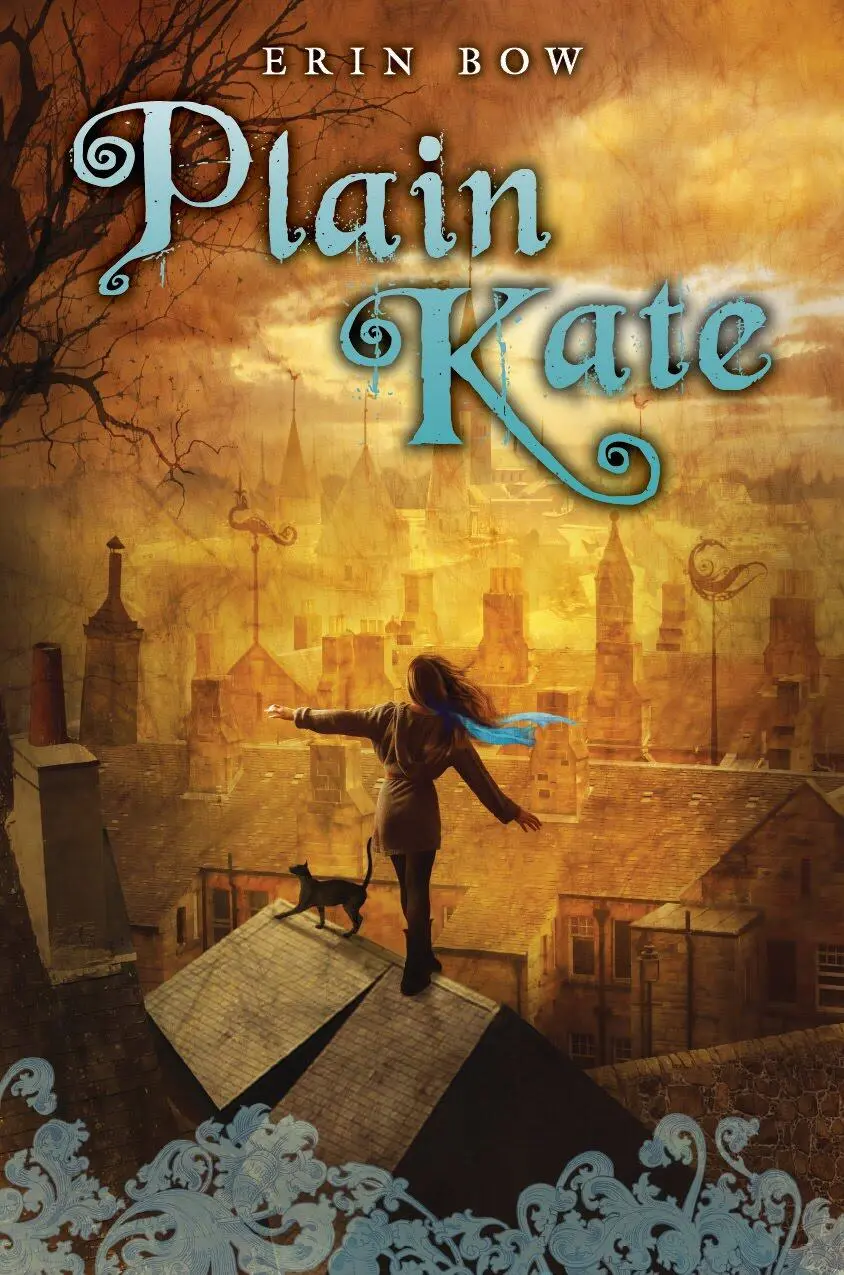
- Название:Plain Kate
- Автор:
- Издательство:Scholastic Inc.
- Жанр:
- Год:2010
- ISBN:9780545166645
- Рейтинг книги:3 / 5. Голосов: 1
-
Избранное:Добавить в избранное
- Отзывы:
-
Ваша оценка:
Plain Kate: краткое содержание, описание и аннотация
Предлагаем к чтению аннотацию, описание, краткое содержание или предисловие (зависит от того, что написал сам автор книги «Plain Kate»). Если вы не нашли необходимую информацию о книге — напишите в комментариях, мы постараемся отыскать её.
Plain Kate — читать онлайн бесплатно полную книгу (весь текст) целиком
Ниже представлен текст книги, разбитый по страницам. Система сохранения места последней прочитанной страницы, позволяет с удобством читать онлайн бесплатно книгу «Plain Kate», без необходимости каждый раз заново искать на чём Вы остановились. Поставьте закладку, и сможете в любой момент перейти на страницу, на которой закончили чтение.
Интервал:
Закладка:
Plain Kate stood up. Between her and the road was a steep slope, almost a bluff, tangled with the bent roots of the willows and clogged with nettles. She tilted her chin up. “Taggle,” she said, “we’re leaving.”

When Kate finally reached the road she was scratched and netttle stung and shaking with exhaustion. It had only been a little climb, but her body was weak. She tried to hear her father’s voice: Be brave. Things will find their shape. Lift your knife.
She turned her back on the way Linay had been going, and followed the road upriver. The road went with the grain of the land, cutting between the river bluffs and the strip of farmland won from the forest: fields of wheat and millet, with the wooded hills beyond. It was a narrow road, quiet. Kate walked and Taggle ambled at her heels.
As she walked, the weather changed. Butter sunshine gave way to a light like watered milk, and then to a thick fog, wet as drizzle. The fog caught and twisted the sound of crows in the wheat, hoarse as a mob of voices.
A little way into the fog they found a tree stump abandoned in the road. It was oak, big as a shed, and still harnessed to a yoke that stood empty. Plain Kate touched one of the hames: ash wood, old but well-made, its inner curve smooth as a lady’s wrist. It was not the sort of thing people in a poor country left to lie in the middle of the road. Plain Kate edged around the stump—and then she saw something that made her stop. In among the biggest roots was a knot of wood, twice as big as her head. It was a burl.
Burls had twisting grains that made them hard to carve, but made them beautiful. Many a carver had made his masterpiece from just such a burl. Kate had dreamed of it—but had never been able to afford the wood. Burl wood was rare and expensive.
Plain Kate looked down at her hands, stiff and patched with scars, white and pink like the belly of an old fish. In an unknown country, with not so much as a kopek in her pocket, there were better things to carry than ten pounds of wood. And there were easier things to carve, when you weren’t sure if your hands would serve you. Indeed, anything she could have chosen would be easier to carve than an oak burl.
But she took it anyway.

Plain Kate walked down the road with the oak burl under one arm. Crumbs and clots of dirt broke into the folds of her white dress. But there was no one to tut over the damage. The foggy road was beginning to grow strange with its emptiness. The fields, which should have been bustling with harvesters, were empty. The farm huts let no smoke from their chimneys. She met a cow that lowed to be milked and butted at her. Mile after mile, there was no one.
She came finally to a wheat field that was half harvested, rough-shorn as Drina’s hair. It was quiet, thick with starlings that were feasting on the fallen wheat.
Plain Kate was a town girl, but she knew that wheat shouldn’t be left to lie in the fields until poppies came up through it. She walked beside the red flowers, feeling her legs begin to tremble with their weakness. Something was wrong. Something was wrong.
She kept walking. There was a brew-house sour smell of wheat rotting. A wave of starlings startled as she passed, and flew up, twisting over her head like a ribbon of smoke. Taggle craned his neck to follow the flight, but he was staying close to her side, almost like a dog. She didn’t mention that, of course.
She trudged on. Her legs felt like old wineskins: her skin stiff and her muscles sloshing. She teetered a little as she walked, though she tried not to. But there was nowhere to stop. She squinted ahead. There was a place where the wheat was still standing, and beyond that, at the edge of the field, a windrow of birch. When she reached that windrow, she promised herself, she would cut a walking staff and stop to carve it. She locked her eyes on the white trees and tried to keep her feet from dragging. When she got to the windrow, she kept thinking. When she got to the windrow—
But she never reached it.
At the raged shore between the cut and uncut wheat, there was a splash of poppies. Something dark lay in them like a log. She would sit down on that, she thought, staggering, and—
She saw that the log was a body. A half-grown lad with wheat-bright hair lay sprawled there with his scythe stuck in the ground beside him. Kate toppled to her knees.
Taggle sniffed the lad’s face. “He’s alive. He had fish to eat…but…Katerina. I smell the thing. The thing has done this to him.”
Kate took the boy’s limp hand, shook the rough-clad shoulder. The lad didn’t stir, didn’t even sigh in his sleep. Like Wen, she thought. Like Stivo and like Wen. She shut her eyes and tried to get up, but fell forward instead. She might have passed out. Time stopped, blankly.
When it moved again, Taggle was butting at her hand. She could feel the lump on his skull where the axe had hit him, a gnarled spot under his soft fur. “There are more of them,” he hissed. His fur was on end. “The thing. More sleepers. The thing has been here.”
“The white shadow.” Plain Kate gagged and spit out the sourness in her mouth. “The thing that killed Wen and Stivo.” She looked at the limp, sleeping lad, then yanked the scythe out of the earth, and, leaning on it, staggered to her feet. She stood panting.
Taggle was looking at the sky, a ridge of fur standing up from his spine. Plain Kate looked up too, her skin beginning to goose-bump with a slow-dawning fear. It was dimming toward evening. A fog twined off the river, snaking over the road. It would be night in an hour or two; the fog would come; the white creature would come with it. It had killed Stivo with one touch. She had no defense. “We have to go back,” she said.
So they went back. Exhausted, Kate went stumbling and limping, hauling her burl, leaning on the scythe, until its smooth handle rubbed through her scars. She arrived at Linay’s boat in purple twilight, both hands bloody, stooping like the angel of death.
Linay raised his eyebrows. “That was a long bath.”
Taggle bit him. Kate collapsed at his feet.
eleven
a ghost in the river
“That cat of yours really is something of a bother.” Linay was perched on the edge of the bunk; Kate saw him blurred then silhouetted as she struggled to get her eyes open. She was awake again and confused again. It took her a moment to put the boy in the poppies and the bear cage and the willow pool and the violin bow and the axe in the darkness all together, and in the right order. They swirled around Linay. They were all his fault, and there he was sitting beside her, dressing a wound on his wrist, whistling. “He’s bitten nearly to the bone, look!” He held up one—scratched—finger.
It was day again, and either dawn or sunset. The light at the hatch was soft and birds were singing.
“Sit up, then, fair maid. You should be able to manage that. Though perhaps you ought not strike out on pilgrimage again.” He reached for her hand and pulled her up. Her own hands were bandaged, softly and well, in clean linen.
Linay flexed his hand closed, then mimed his fingers rippling over the violin’s fret. His bitten finger seemed stiff. “It will make a merry mess of my fingering.” He looked at her, smiling but humorless, implacable as snow. “You’re lucky I do not hurt him.”
Plain Kate went cold. She could hear Taggle on the deck, yowling. And Linay sang softly, giving words to the cat’s song:
Oh bats, oh bats, oh snacks with wings—
Come and hear how Taggle sings!
Oh squirm, oh squeak, my wriggly bats—
You’ll make a gift for lady cats!
“I would be sorry to hurt him, Plain Kate. Truly I would.”
Читать дальшеИнтервал:
Закладка:
Похожие книги на «Plain Kate»
Представляем Вашему вниманию похожие книги на «Plain Kate» списком для выбора. Мы отобрали схожую по названию и смыслу литературу в надежде предоставить читателям больше вариантов отыскать новые, интересные, ещё непрочитанные произведения.




Обсуждение, отзывы о книге «Plain Kate» и просто собственные мнения читателей. Оставьте ваши комментарии, напишите, что Вы думаете о произведении, его смысле или главных героях. Укажите что конкретно понравилось, а что нет, и почему Вы так считаете.