Jack Campbell - Invincible
Здесь есть возможность читать онлайн «Jack Campbell - Invincible» весь текст электронной книги совершенно бесплатно (целиком полную версию без сокращений). В некоторых случаях можно слушать аудио, скачать через торрент в формате fb2 и присутствует краткое содержание. Город: New York, Год выпуска: 2012, ISBN: 2012, Издательство: Ace Books, Жанр: Старинная литература, на английском языке. Описание произведения, (предисловие) а так же отзывы посетителей доступны на портале библиотеки ЛибКат.
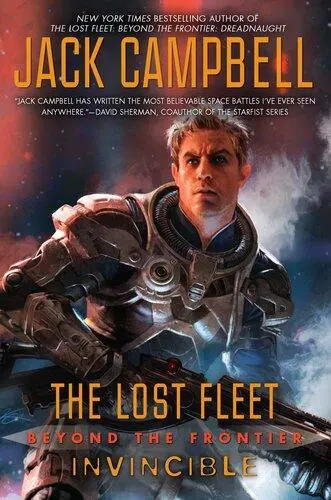
- Название:Invincible
- Автор:
- Издательство:Ace Books
- Жанр:
- Год:2012
- Город:New York
- ISBN:978-1-101-58078-3
- Рейтинг книги:5 / 5. Голосов: 1
-
Избранное:Добавить в избранное
- Отзывы:
-
Ваша оценка:
Invincible: краткое содержание, описание и аннотация
Предлагаем к чтению аннотацию, описание, краткое содержание или предисловие (зависит от того, что написал сам автор книги «Invincible»). Если вы не нашли необходимую информацию о книге — напишите в комментариях, мы постараемся отыскать её.
Invincible — читать онлайн бесплатно полную книгу (весь текст) целиком
Ниже представлен текст книги, разбитый по страницам. Система сохранения места последней прочитанной страницы, позволяет с удобством читать онлайн бесплатно книгу «Invincible», без необходимости каждый раз заново искать на чём Вы остановились. Поставьте закладку, и сможете в любой момент перейти на страницу, на которой закончили чтение.
Интервал:
Закладка:
As they moved across the outer span of the star system, the main spider-wolf formation, still watching the jump point leading to the bear-cow star Pandora, slid past to their right. The beautiful whorls and patterns of the spider-wolf formation changed as the view from the human ships altered, the curves seeming to swirl and melt in upon themselves.
“Four and a half light-hours to the jump point. Forty-five hours’ travel time if you want to keep to point one light speed,” Desjani announced.
“It wouldn’t be worth the cost in fuel cells to speed up, then slow down again for the jump,” Geary said. “Not for the small amount of time we’d gain. And getting the captured superbattleship up to speed or slowing it down again is not fast or easy to do.”
“Is the hypernet gate at the next star?”
“Our emissaries and our experts aren’t sure,” Geary replied. He watched his display, trying to relax the tension inside him as he waited for problems to pop up. But no propulsion units failed, no maneuvering difficulties appeared, and no pieces came off any of the ships. It doesn’t take all that much to make me happy these days. A century ago, when I was in a peacetime fleet with ships made to last at least several decades, I never could have imagined being thrilled to see none of my ships break when we started a simple movement. “If the hypernet gate isn’t at the next star, we’ll be able to use the additional time in transit and jump space for more repair work.”
“You’ve gotten very good at rationalizing things,” Desjani said.
“I don’t have any choice. We need to get to Midway before the enigmas do, but we can only get there so fast.” He had seriously considered leaving the bear-cow superbattleship with a strong escort to follow on behind while he took the rest of the fleet ahead on a dash to Midway. But General Charban had expressed serious doubts that he could get across to the spider-wolves that the human fleet wanted to split and pass through their space in two separate movements. And there was no telling what might await them at any star system they would have to jump through to reach human space after using the spider-wolf hypernet. What if one of those star systems was occupied by the enigmas? What would the enigmas do when they saw a bear-cow warship being towed along by the human fleet? Probably something drastic.
But nothing had gone wrong yet, and as Geary sat there watching everything happen without a hitch, he realized how incredibly worn-out he was after the last several days of unrelenting work. The effects of the rest day he had ordered hadn’t lasted all that long, probably because he hadn’t really had much chance to rest. “I’m going to get some sleep.”
He walked down to his stateroom, feeling the mixture of tension, relief, and happiness among the crew members he passed. Happiness to be on the way home again. Relief to be under way. Tension over what they might find along the way home.
Senior Chief Tarrini smiled as she saluted Geary. “Are there any more questions you need answered, Admiral?”
Geary almost said no, then paused. “Yes, Senior Chief. I’ve heard the sailors using a word I haven’t heard before.”
“Well, now, Admiral, you know sailors—”
“It’s not that kind of word, Senior Chief. At least I don’t think so. Do you know what ‘Bub’ means?”
“‘Bub’?” Tarrini asked.
“Yes, and I can tell by the way you asked me that you do know what it means.”
The senior chief nodded. “It’s short for Big Ugly Bugs, Admiral. Or Butt-Ugly Bugs. It’s what the sailors are starting to call the, uh…”
“The spider-wolves.” Geary let his unhappiness show. “They’re our allies, Senior Chief. They fought alongside us, they took losses fighting alongside us, and they’re helping us get home quickly.”
“Yes, sir, Admiral,” Tarrini agreed. “But you know sailors. To them, those guys are Bubs. Though I think some Marines might have actually coined the term. You know how Marines are.”
Geary looked around, exasperated. “I also know what would happen if I ordered the fleet not to use the term ‘Bub.’”
“Every sailor would be using it as much as possible,” Senior Chief Tarrini said. “And the Marines would be using it even more.”
“Do you have something against Marines, Senior Chief?”
“Hell, no, Admiral. I was married to a Marine for a while, before he moved on to take another objective, as they say. I hardly ever think about that bas—I mean, that individual, sir.”
“I’ll take your word for it.” Geary looked the senior chief in the eye. “Do me a favor. Spread the word that I have heard the term ‘Bub,’ and I don’t like it. It makes me unhappy to know people are using it.”
“Certainly, Admiral.” Senior Chief Tarrini saluted him again. “Everyone will know you’d rather they not use that term. If anything can keep it under control, that will. But it won’t go away. You know sailors.”
“I do, yes, Senior Chief. Thank you.”
For the rest of his walk, Geary found the strength to look unconcerned and ready for anything as he returned salutes, then slumped against his hatch once safely inside his stateroom. He dropped down on his bunk without undressing, finally feeling that he could justify some time asleep.
His comm panel buzzed relentlessly.
Geary finally roused enough to hit the hold control, knowing that if it were a real emergency, he would be getting a different alert from the device. He took enough time to get his uniform in halfway-decent shape before answering.
Captain Smythe’s beaming face seemed oddly incongruous. “Good afternoon, Admiral. I have good news.”
“That would be welcome.” Geary sat down, rubbing his face with both hands.
“Our engineers have extensively analyzed the systems failures that occurred when preparing for the battle here. They have concluded that the spike in failures was caused by the extra stresses on already-weak systems during the power ramp-ups.”
“I thought we already knew that.”
“We did.” Smythe’s smile grew smug. “But, Admiral, here’s what we didn’t know. We blew out the weakest system components. That means we had a spike then, but it also means we will now have a period of relatively low failures. Those components most prone to failure have failed. Those components that didn’t fail will probably last a little longer before going bad.”
Geary ran that through his head once, then one more time to make sure he had understood it. “You’re telling me that the next time we go into battle we shouldn’t have a sudden cascade of failures on numerous ships.”
“As long as that battle isn’t too far in the future. If it is within the next month or so, you’ll be fine.”
“That is good news.”
“You don’t have to sound so surprised, Admiral.”
Realizing that he was smiling, Geary pushed his luck. “Does this mean we’ll have a chance to get a little ahead on the repair and replacement work?”
Smythe shook his head. “No, sir. We’re so far behind the curve on that one that we’re in danger of being rear-ended by ourselves. We will continue to get done what we can, but there will be many more system failures before we can get so many internal systems rebuilt on so many ships.”
“I understand.”
“It would help,” Smythe added, “if we didn’t have to spend quite so much time repairing battle damage.”
“I’ll see what I can do to avoid further battle damage, Captain Smythe.” Geary tried to think. There was something else… “Has Lieutenant Jamenson discovered anything else regarding that topic she was researching?”
“Researching? Oh, that. I’m afraid she’s been as busy as the rest of us lately, Admiral. As a matter of fact, she’s on Orion right now as part of the tiger team overseeing the tow linkages to the BKS.”
Читать дальшеИнтервал:
Закладка:
Похожие книги на «Invincible»
Представляем Вашему вниманию похожие книги на «Invincible» списком для выбора. Мы отобрали схожую по названию и смыслу литературу в надежде предоставить читателям больше вариантов отыскать новые, интересные, ещё непрочитанные произведения.






Обсуждение, отзывы о книге «Invincible» и просто собственные мнения читателей. Оставьте ваши комментарии, напишите, что Вы думаете о произведении, его смысле или главных героях. Укажите что конкретно понравилось, а что нет, и почему Вы так считаете.