Jack Campbell - Invincible
Здесь есть возможность читать онлайн «Jack Campbell - Invincible» весь текст электронной книги совершенно бесплатно (целиком полную версию без сокращений). В некоторых случаях можно слушать аудио, скачать через торрент в формате fb2 и присутствует краткое содержание. Город: New York, Год выпуска: 2012, ISBN: 2012, Издательство: Ace Books, Жанр: Старинная литература, на английском языке. Описание произведения, (предисловие) а так же отзывы посетителей доступны на портале библиотеки ЛибКат.
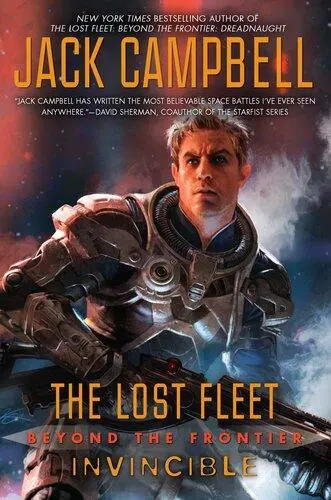
- Название:Invincible
- Автор:
- Издательство:Ace Books
- Жанр:
- Год:2012
- Город:New York
- ISBN:978-1-101-58078-3
- Рейтинг книги:5 / 5. Голосов: 1
-
Избранное:Добавить в избранное
- Отзывы:
-
Ваша оценка:
Invincible: краткое содержание, описание и аннотация
Предлагаем к чтению аннотацию, описание, краткое содержание или предисловие (зависит от того, что написал сам автор книги «Invincible»). Если вы не нашли необходимую информацию о книге — напишите в комментариях, мы постараемся отыскать её.
Invincible — читать онлайн бесплатно полную книгу (весь текст) целиком
Ниже представлен текст книги, разбитый по страницам. Система сохранения места последней прочитанной страницы, позволяет с удобством читать онлайн бесплатно книгу «Invincible», без необходимости каждый раз заново искать на чём Вы остановились. Поставьте закладку, и сможете в любой момент перейти на страницу, на которой закончили чтение.
Интервал:
Закладка:
“Tough bastards,” a Marine said as he skirted a solid wall of unmoving bear-cows, their armor torn, blobs of purplish blood filling the air in the absence of gravity.
“Good thing there weren’t more of them,” one of his companions agreed.
“There are more of them,” their sergeant barked. “Keep your weapons ready, your mouths shut, and your eyes sharp.”
As the Marines moved farther into the ship, they encountered scattered pockets of Kicks, who hurled themselves forward in hopeless, desperate attacks that ended only when the last of them was dead. Geary watched the symbols of the Marine units spread back through the superbattleship, then onward past the points where the crew had counterattacked.
“What the hell?” a lieutenant asked as her unit entered a very large area near the center of the ship, a vast compartment whose ceiling soared six meters high. But the deck of the compartment wasn’t a deck, it was vegetation, row upon row of crops set into growing containers, the tops of multiple stems on each plant heavy with seeds or fruit or maybe something that was both seed and fruit.
“Food and oxygen resupply combined in one,” a sergeant remarked, pulling himself down to examine a long line of growing containers. “My father worked on a farm like this in a sealed city before Huldera Star System was abandoned. And, unless I miss my guess, this is how those bear-cows recycled at least some of their waste products, as fertilizer. Good things these troughs are sealed so stuff couldn’t float away when the gravity went off.”
The sergeant’s squad made noises of revulsion, suddenly taking great care where they put their hands and feet.
More units stumbled across similar compartments, then one platoon sounded an alert that drew Geary’s attention. “Lieutenant, I think we found a control station. It doesn’t look big enough for a full power core.”
“How would you know, Winski?”
“I helped take a Syndic battleship at Welfrida, that’s how. That was a lot smaller ship than this thing, and it had a bigger control station than this one.”
“Tanya,” Geary said, “take a look at this.” He also forwarded the image to Captain Smythe. “What do you think?”
Desjani sounded doubtful. “A secondary control station, maybe. That’s not big enough even for the power core of a ship the size of Dauntless .”
Smythe agreed but added something else. “It may be that what we find will all look like secondary control stations. I’ve been watching as the Marines fill in the deck plan on that superbattleship, and I am ever more convinced that the bear-cows avoided using one or two major power sources, instead choosing to use multiple lesser power sources. Maybe that was for backup. Redundancy. Or maybe in a ship of that size it made sense to distribute the power sources rather than run lines all over from one or two sources located in one area.”
“Why didn’t they blow it up?” Geary asked the question again.
“Maybe it didn’t occur to them. Maybe they beat the predators on their world by refusing to give up, instead fighting to the last breath and the last Kick to kill their opponents.” Smythe blinked, his expression twisting. “When you showed me the images of that control room, I saw some of the passageways on that ship. What they’re like now, filled with so many dead. Why would they keep fighting? Why die in a hopeless struggle?”
“I guess they thought they’d die anyway and wanted to go down swinging.” Geary had disliked the bear-cows. No, he had hated them for forcing the fights in the Pandora Star System and here, but he had to feel grudging respect for them as well, just as Desjani did. It was easy to see why they had overrun their world, wiping out all competition.
But that was just one more reason why they couldn’t be allowed to follow this fleet back to human space.
The Marines spread through the superbattleship, breaking down into smaller and smaller forces, wiping out smaller and smaller gatherings of remaining Kicks, who still refused to surrender and attacked until they were killed. Occasionally, a tiny group of bear-cows stampeded away from the Marines, but the moment the aliens hit a dead end, they turned and charged their pursuers.
The human invaders found vast barracks, subdivided by airtight hatches but otherwise sprawling for long distances. Everywhere, there were compartments set up for eating, as if the bear-cows grazed nearly constantly. The Marines found what could only be hospitals, the operating equipment undersized so that the complexes seemed oddly and disturbingly like children’s playrooms. Armories empty of weapons. More control rooms.
Finally, a squad came across the bridge of the superbattleship, a compartment where command seats were backed up by what seemed like stadium seating, as if dozens of spectators routinely watched events there.
“That is so weird,” Desjani said. “What is that about?”
“Beats the hell out of me,” Geary replied.
General Carabali called in, professionally deadpan as she made her report. “Organized resistance has ceased aboard the superbattleship, Admiral, but I can’t say it’s safe yet. Not until we’ve gone over it much more carefully. My Marines aboard that ship will remain in a combat footing, and any fleet personnel coming aboard will require Marine escorts.”
“Thank you, General,” Geary said. “Damned good job. My congratulations on your success and my condolences on your losses.”
“Thank you, Admiral.”
“Are there any bear-cows still alive?”
“The Kicks fought until they were killed, or if we started to physically overcome them they died. We don’t know if there’s a suicide device on them or in their armor, or if it’s some mental thing. They also slaughtered their unconscious wounded if there seemed a chance of their being captured.”
“Ancestors preserve us.”
Carabali made a face. “If you think about it, Admiral, if you were a cow, and you knew the fate awaiting any of your fellow cows who were captured, then the Kick actions make sense. They were protecting their injured from a fate worse than death. My Marines are searching through the enemy dead for any Kicks who were injured so badly they were rendered unconscious but weren’t subsequently killed by their own comrades to ‘save’ them from us.”
Now Carabali hesitated. “Speaking of the enemy dead… Admiral, after any battle there is the matter of enemy remains to address. Our policy on that varied during the war, as you know, even though our opponents were fellow humans. But since you assumed command, we have dealt with remains with all due dignity and respect. But now… Admiral, there are so many dead crowding that ship. Long stretches of some passageways are impossible to get through, and there’s a tremendous amount of blood floating around so we don’t dare restart ventilation even if we knew the right controls. What should we do with them?”
How could they give decent burials to that many enemy dead, especially when many of the bodies weren’t intact but blown into pieces?
But they had to get them out of the ship, or, within a few days, it would turn into an unlivable hell.
“General, we’ll treat them as best we know how. Working parties will have to collect the enemy dead. Fleet medical will want to retain some specimens; but otherwise, they are to be gathered at one of the cargo docks. A service will be said each time the dock is full, then the bodies will be ejected en masse on a trajectory aimed at the star, and we’ll start filling the dock again.”
“Yes, sir. It would help if we could get sailors to assist in those working parties. It’s not a pleasant job, and there’s a lot to collect.”
Geary shook his head, looking at the fleet status readouts. “General, every sailor I’ve got is working almost around the clock either repairing their own ship or on tiger teams assisting other ships. I have to give priority to getting my ships as combat-ready as possible as soon as possible.” What other resources did he have? The senior officers rescued from the Syndic labor camp on Dunai. The Syndic citizens rescued from the enigma race. There weren’t that many of either, but it was something. “I will ask for volunteers among our two groups of passengers to assist in the cleanup and will see if the auxiliaries have any equipment that can handle the task on its own.”
Читать дальшеИнтервал:
Закладка:
Похожие книги на «Invincible»
Представляем Вашему вниманию похожие книги на «Invincible» списком для выбора. Мы отобрали схожую по названию и смыслу литературу в надежде предоставить читателям больше вариантов отыскать новые, интересные, ещё непрочитанные произведения.








Обсуждение, отзывы о книге «Invincible» и просто собственные мнения читателей. Оставьте ваши комментарии, напишите, что Вы думаете о произведении, его смысле или главных героях. Укажите что конкретно понравилось, а что нет, и почему Вы так считаете.