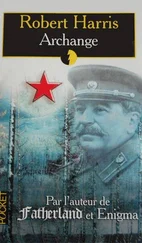
Robert Harris - Archangel
Здесь есть возможность читать онлайн «Robert Harris - Archangel» весь текст электронной книги совершенно бесплатно (целиком полную версию без сокращений). В некоторых случаях можно слушать аудио, скачать через торрент в формате fb2 и присутствует краткое содержание. Год выпуска: 2009, ISBN: 2009, Издательство: Arrow, Жанр: Старинная литература, на английском языке. Описание произведения, (предисловие) а так же отзывы посетителей доступны на портале библиотеки ЛибКат.

- Название:Archangel
- Автор:
- Издательство:Arrow
- Жанр:
- Год:2009
- ISBN:9780099282419
- Рейтинг книги:4 / 5. Голосов: 1
-
Избранное:Добавить в избранное
- Отзывы:
-
Ваша оценка:
Archangel: краткое содержание, описание и аннотация
Предлагаем к чтению аннотацию, описание, краткое содержание или предисловие (зависит от того, что написал сам автор книги «Archangel»). Если вы не нашли необходимую информацию о книге — напишите в комментариях, мы постараемся отыскать её.
Archangel — читать онлайн бесплатно полную книгу (весь текст) целиком
Ниже представлен текст книги, разбитый по страницам. Система сохранения места последней прочитанной страницы, позволяет с удобством читать онлайн бесплатно книгу «Archangel», без необходимости каждый раз заново искать на чём Вы остановились. Поставьте закладку, и сможете в любой момент перейти на страницу, на которой закончили чтение.
Интервал:
Закладка:
O'Brian grunted and, pulled up his hood.
They trudged down the side of the road, past a row of patched and tumbledown houses, each tilted at its own mad angle to the ground. Every summer the land must thaw, thought Kelso, and shift, and the houses with it. And then fresh boards would have to be nailed over the new cracks, so that some of the walls had skins of repairs that must date back to the Tsars. He had a sense of time frozen. It wasn't hard to imagine Anna Safanova, fifty years ago, walking where they walked, with a pair of ice skates slung around her shoulders.
It took them another ten minutes to find the old woman's street - an alley, really, no more, running off the main road, behind a clump of birch trees, and leading to the back of the house. In the yard were some animal coops: chickens, a pig, a couple of goats. And looming over it all, ghostly in the snow, a slab-sided fourteen-storey tower block, with a few yellow lights visible on the lower floors.
O'Brian unlocked his case, took out his video camera and started filming. Kelso watched him, unhappily.
'Shouldn't we check she's in first? Shouldn't you get her permission?'
'You ask her. Go ahead.'
Kelso glanced at the sky. The flakes seemed to be getting bigger - thick and soft as a baby's hand. He could feel a knot of tension in his stomach the size of his fist. He picked his way across the yard, past the hot stink of the goats, and started to climb the half-dozen loose wooden steps that led to the back porch. On the third step he paused. The door was partially open and in the narrow gap he could see an old woman, bent forwards, two hands resting on a stick, watching him.
He said, 'Vavara Safanova?'
She didn't say anything for a moment. Then she muttered, 'Who wants her?'
He took this as an invitation to climb the remaining steps. He wasn't a tall man but when he reached the rickety porch he soared above her. She had osteoporosis, he could see now. The tops of her shoulders were on a level with her ears and it gave her a watchful look.
He tugged down his hood and for the second time that morning he launched into his carefully prepared lie - they were in town to make a film about the communists. they were looking for people with interesting memories; they had been given her name and address by the local Party - and all the time he was appraising her, trying to reconcile this hunched figure with the matriarch who featured briefly in the girl's journal.
Mama is strong, as ever.. . Mama brings me to the station, I kiss her dear cheeks.. .'
She had opened the door a crack wider to get a better look at him, and he could see more of her. Apart from her shawl the clothes she wore were masculine - old clothes: her dead husband's clothes, perhaps - with a man's thick socks and boots. Her face was still handsome. She might have been stunning once - the evidence was there, in the sharpness of her jaw and cheekbones, in the keenness of her one good blue-green eye; the other was milky with a cataract. It didn't take much effort to imagine her as a young communist in the 1 930s, pioneer builder of a new civilisation, a socialist heroine to warm the hearts of Shaw or Wells. He bet she would have worshipped Stalin.
And Mama, yes, it is a modest house! Two storeys only. Your good Bolshevik heart would rejoice at its simplicity...
'- so if it would be possible,' he concluded, 'for us to take up some of your time, we would be very grateful.'
He transferred the satchel uneasily, from hand to hand. He was conscious of the snow settling in a cold clump on his back, of water trickling from his scalp, and of O'Brian at the foot of the steps, filming them.
Oh God, throw us out, he thought suddenly. Tell us to go to hell, and take our lies with us: I would if I were you. You must know why we're here.
But all she did was turn and shuffle back into the room, leaving the door wide open behind her.
KELSO went in first, and then O'Brian, who had to duck to get through the low entrance. It was dark. The solitary window was thickly glazed with snow.
If they wanted tea, she said, setting herself down heavily in a hard-backed wooden chair, then they would have to make it themselves.
'Tea?' said Kelso softly to O'Brian. 'She's offering to let us make her tea. I think yes, don't you?'
'Sure. I'll do it.'
She issued a stream of irritated instructions. Her voice, emanating from her buckled frame, was unexpectedly deep and masculine.
'Well, get the water from the pail, then - no, not that jug:
that one, the black one - use the ladle, that's it - no, no no -she banged her stick on the floor ' - not that much, that much. Now put it on the stove. And you can put some wood on the fire, too, while you're about it.' Another two bangs of the stick. 'Wood? Fire?'
O'Brian appealed helplessly to Kelso for a translation.
'She wants you to put some wood on the fire.'
'Tea in that jar. No, no. Yes. That jar. Yes. There.'
Kelso couldn't get a handle on any of this - on the town, on her, on this place, on the speed with which everything seemed to be happening. It was like a dream. He thought he ought to start taking some notes, so he pulled out his yellow pad and began making a discreet inventory of the room. On the floor: a large square of grey linoleum. On the linoleum:
one table, one chair and a bed covered with a woollen blanket. On the table: a pair of spectacles, a collection of pill-bottles and a copy of the northern edition of Pravda, open at the third page. On the walls: nothing, except in one c&rner, where a flickering red candle on a small sideboard punctuated the gloom, lighting a wood-framed photograph of V. I. Lenin. Hanging next to it were two medals for Socialist Labour and a certificate commemorating her fiftieth anniversary in the Party in 1984; by the time of her sixtieth, presumably, they couldn't run to such extravagance. The bones of communism and of Vavara Safanova had crumbled together.
The two men sat awkwardly on the bed. They drank their tea. It had a peculiar, herbal flavour, not unpleasant -cloudberries in it somewhere: a taste of the forest. She seemed to find nothing surprising in the fact of two foreigners arriving in her yard with a Japanese video camera, claiming to be making a film about the history of the Archangel Communist Party. It was as if she had been expecting them. Kelso guessed she would find no surprise in anything any more. She had the resigned indifference of extreme old age. Buildings and empires rose and fell. It snowed. It stopped snowing. People came and went. One day death would come for her, and she would not find that
surprising either, and she would not care - not so long as He trod in the proper places: 'No, not there. There...'
WELL, yes, she remembered the past, she said, settling back. Nobody in Archangel remembered the past better than she did. She remembered everything She could remember the Reds in 1917 coming out on to the street, and her uncle wheeling her up in the air, and kissing her and telling her the Tsar had gone and Paradise was on the way. She could remember her uncle and her father running away into the forest to hide when the British came to stop the Revolution in 1918 - a great grey battleship moored in the Dvina and runty little English soldiers swarming ashore. She played to the sound of gunfire. And then she remembered early one morning walking down to the harbour and the ship had gone. And that afternoon her uncle came back - but not her father: her father had been taken by the Whites and he never came back.
She remembered all these things.
And the kulaks?
Yes, she remembered the kulaks. She was seventeen. They arrived at the railway station, thousands of them, in their strange national dress. Ukrainians: you never saw so many people - covered in sores and carrying their bundles - they were locked in the churches and the townspeople were forbidden to approach them. Not that they wished to. The kulaks carried contamination, they all knew that.
Читать дальшеИнтервал:
Закладка:
Похожие книги на «Archangel»
Представляем Вашему вниманию похожие книги на «Archangel» списком для выбора. Мы отобрали схожую по названию и смыслу литературу в надежде предоставить читателям больше вариантов отыскать новые, интересные, ещё непрочитанные произведения.










Обсуждение, отзывы о книге «Archangel» и просто собственные мнения читателей. Оставьте ваши комментарии, напишите, что Вы думаете о произведении, его смысле или главных героях. Укажите что конкретно понравилось, а что нет, и почему Вы так считаете.