SS
Здесь есть возможность читать онлайн «SS» весь текст электронной книги совершенно бесплатно (целиком полную версию без сокращений). В некоторых случаях можно слушать аудио, скачать через торрент в формате fb2 и присутствует краткое содержание. Жанр: Справочники, на английском языке. Описание произведения, (предисловие) а так же отзывы посетителей доступны на портале библиотеки ЛибКат.

- Название:SS
- Автор:
- Жанр:
- Год:неизвестен
- ISBN:нет данных
- Рейтинг книги:5 / 5. Голосов: 1
-
Избранное:Добавить в избранное
- Отзывы:
-
Ваша оценка:
SS: краткое содержание, описание и аннотация
Предлагаем к чтению аннотацию, описание, краткое содержание или предисловие (зависит от того, что написал сам автор книги «SS»). Если вы не нашли необходимую информацию о книге — напишите в комментариях, мы постараемся отыскать её.
SS — читать онлайн бесплатно полную книгу (весь текст) целиком
Ниже представлен текст книги, разбитый по страницам. Система сохранения места последней прочитанной страницы, позволяет с удобством читать онлайн бесплатно книгу «SS», без необходимости каждый раз заново искать на чём Вы остановились. Поставьте закладку, и сможете в любой момент перейти на страницу, на которой закончили чтение.
Интервал:
Закладка:
Productivity tools can make efficient use of human resources. Communications and collaboration tools can increase the effectiveness of knowledge sharing and problem solving.
Analytical modelling , simulation and visualization tools are useful to analyse the impact of strategies, tactics and operations. They are useful to construct hypotheses, evaluate options and plan scenarios.
The effectiveness of Service Strategy relies on a loosely coupled but balanced and strong relationship between the social and technical subsystems. It is essential to identify and control these dependencies and influences. Review s in Service design , Service Transition , Service Operation and Continual Service Improvement should include analysis of possible dysfunction or lack of synchronization between the two subsystems.
The design of socio-technical system s is an important consideration in service management . It is important to recognize that services are much more than a series of activities that produce intangible value. They are systems with complex interactions between various factors of production or service assets. The methods and principles of operations research, systems dynamics and statistical process control are very useful within the context of improving the reliability of services.
8.1 Service automation
Automation can have particularly significant impact on the performance of service asset s such as management, organization, people, process, knowledge and information. Application s by themselves are a means of automation but their performance can also be improved where they need to be shared between people and process assets. Advances in artificial intelligence, machine learning and rich-media technologies have increased the capabilities of software-based service agents to handle a variety of tasks and interactions.
Automation is considered to improve the utility and warranty of services. It may offer advantages in many areas of opportunity, including the following:
The capacity of automated resource s can be more easily adjusted in response to variations in demand volumes.
Automated resources can handle capacity with fewer restrictions on time of access; they can therefore be used to serve demand across time zones and during after hours.
Automated systems present a good basis for measuring and improving service processes by holding constant the factor of human resources. Conversely, they can be used to measure the differential impact on service quality and costs due to varying levels of knowledge, skills and experience of human resources.
Many optimization problems such as scheduling, routing and allocation of resources require computing power that is beyond the capacity of human agents.
Automation is a means for capturing the knowledge required for a service process. Codified knowledge is relatively easy to distribute throughout the organization in a consistent and secure manner. It reduces the depreciation of knowledge when employees move within the organization or permanently leave.
When judiciously applied, the automation of service processes helps improve the quality of service, reduce costs and reduce risk s by reducing complexity and uncertainty, and by efficiently resolving trade-offs. (This is the concept of Pareto efficiency , where the solution or bargain is efficient when one side of the trade-off cannot be better off without making the other side worse off.)
The following are some of the areas where service management can benefit from automation:
Design and modelling
Service catalogue
Pattern recognition and analysis
Classification , prioritization and routing
Detection and monitoring
Optimization.
Demand for services can be captured from simple interactions customers have with items in an automated Service Catalogue . There is a need to hide the complexity in the relationships between customer outcomes and the service asset s that produce them, and present only the information the customers need to specify the utility and warranty needed with respect to any particular outcome . However, customers need choice and flexibility in presenting demand.
It is possible to handle routine service request s with some level of automation. Such requests should be identified, classified and routed to automated units or self-service options. This requires the study of business activity patterns that exist with each customer.
The variation in the performance of individuals with time, workload , motivation and nature of the task at hand can be a disadvantage in many situations. The variation in the knowledge, skills and experience of individuals can lead to variation in the performance of processes. Variations in processing times across service transaction s, jobs or cycles can result in degradation of service level s, usually in the form of delays and congestion (Figure 8.2).
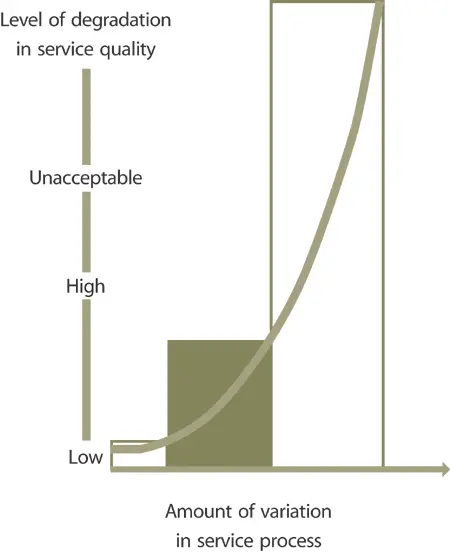
Figure 8.2 Degrading effect of variation in service processes
8.1.1 Preparing for automation
Applying automation indiscriminately can create more problems or exacerbate existing ones. The following guideline s should be applied:
Simplify the service processes before automating them . By itself, simplification of processes can reduce variations in performance because there are fewer tasks and interactions for variations to enter. Simplification should not adversely affect the outcome of the process . Removal of necessary information, tasks, or interactions makes the processes simpler but less useful. There are limits to simplification. Begin the analysis for automation at this limit.
Clarify the flow of activities, allocation of tasks, need for information, and interactions . All service agents and user s should be clear about what they need to do so that the required inputs for a service transaction are available and complete. Automation itself makes the clarification easier through messaging, interactive terminals and websites. So automate, clarify, test , modify and then automate again.
In self-service situations, reduce the surface area of the contact users have with the underlying systems and processes . Needless interactions with the internals of the system can introduce avoidable variation because of mental overload and slower learning curves. Apply the principles of encapsulation and modularity to simplify the interfaces so that users see the attributes needed to present demand and extract utility.
Do not be in a hurry to automate tasks and interactions that are neither simple nor routine in terms of inputs, resource s and outcomes. Recurring patterns are more suited for automation than less consistent and infrequent activities.
8.1.2 Service analytics and instrumentation
Information is necessary but not sufficient for answering questions such as why certain data is the way it is and how it is likely to change in the future. Information is static. It only becomes knowledge when placed in the context of patterns and their implications. Those patterns give a high level of predictability and reliability about how the data will change over time. By understanding patterns of information we can answer ‘How?’ questions such as:
How does this incident affect the service?
Читать дальшеИнтервал:
Закладка:
Обсуждение, отзывы о книге «SS» и просто собственные мнения читателей. Оставьте ваши комментарии, напишите, что Вы думаете о произведении, его смысле или главных героях. Укажите что конкретно понравилось, а что нет, и почему Вы так считаете.