SS
Здесь есть возможность читать онлайн «SS» весь текст электронной книги совершенно бесплатно (целиком полную версию без сокращений). В некоторых случаях можно слушать аудио, скачать через торрент в формате fb2 и присутствует краткое содержание. Жанр: Справочники, на английском языке. Описание произведения, (предисловие) а так же отзывы посетителей доступны на портале библиотеки ЛибКат.

- Название:SS
- Автор:
- Жанр:
- Год:неизвестен
- ISBN:нет данных
- Рейтинг книги:5 / 5. Голосов: 1
-
Избранное:Добавить в избранное
- Отзывы:
-
Ваша оценка:
SS: краткое содержание, описание и аннотация
Предлагаем к чтению аннотацию, описание, краткое содержание или предисловие (зависит от того, что написал сам автор книги «SS»). Если вы не нашли необходимую информацию о книге — напишите в комментариях, мы постараемся отыскать её.
SS — читать онлайн бесплатно полную книгу (весь текст) целиком
Ниже представлен текст книги, разбитый по страницам. Система сохранения места последней прочитанной страницы, позволяет с удобством читать онлайн бесплатно книгу «SS», без необходимости каждый раз заново искать на чём Вы остановились. Поставьте закладку, и сможете в любой момент перейти на страницу, на которой закончили чтение.
Интервал:
Закладка:
An airline decides to improve customer satisfaction by increasing the number of ways for customers to purchase tickets and prepare for travel. It offers an online channel for passengers to check flight status, select seats, check in and print boarding passes before arriving at the airport. It also installs a network of self-service terminals that allow passengers with only carry-on baggage to proceed to the gates without having to wait in line at the counters. The net effect is that of virtually extending the ‘surface area’ of the airport check-in counter to locations convenient to the passenger, such as homes, offices and hotel rooms. The airline staff and other passengers at the airport benefit from reduced congestion. Passengers self-select between airport counters, self-service kiosks and the website channels, based on personal preference. They also respond to incentives offered by the airline to control the arrival of demand at particular locations. Similarly, a retail bank decides to make frequently requested and simple transaction s available on its website and wireless devices such as telephones and personal digital assistants (PDAs).
Both businesses have effectively increased the probability that their services will be easily available for use by their customers. The improvements are not through the MTBF and MTRS factors. The primary factor has accessibility through a wider area of contact between customers and service assets through well-defined interfaces (Figure 7.21). Increasing the ‘surface area’ of contact of the service delivery system directly results in increased service availability from the users’ perspective.
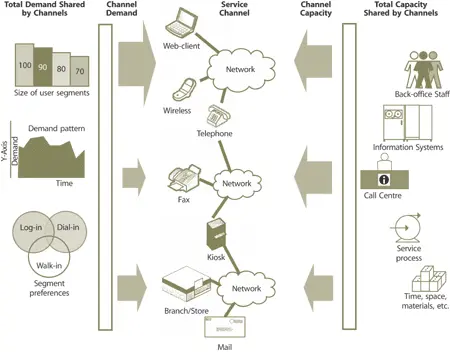
Figure 7.21 Increasing accessibility through multiple service channels
The following approaches increase the accessibility of services (Figure 7.22):
Diversity of channels – provide multiple types of access channels so that demand goes through different channels and is safe from a single cause of failure . This is active diverse redundancy , which also provides utility to customers through preferred choices.
Density of network – add additional service access points, nodes, or terminals of the same type to increase the capacity of the network with density of coverage. This is active homogeneous redundancy, which does not reduce vulnerability to a single cause of failure but reduces the complexity and provides economy of scale.
Loose coupling – design interfaces based on public infrastructure, open source technologies and ubiquitous access points such as mobile phones and browsers so that the marginal cost of adding a user is low. It enables users to access the service from a wider range of locations and situations and also reduces the overall cost of maintaining a service. Advances in information security make this possible.
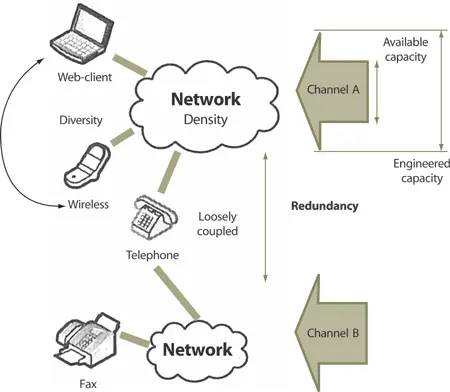
Figure 7.22 Channel capacity used for redundancy
7.5.7 Interactions between factors of availability
By balancing availability factors, the same capacity may achieve higher throughput leading to improvements in the overall operational effectiveness of the service operation . Controlling the flow of demand patterns can reduce the overall cost of service provision. Pricing and discounts can influence demand patterns. Customer s can self-select as business needs justify. Self-service options are generally available at lower charges than staffed options with more expensive resource s. In many countries, maintaining idle capacity of staff costs more than providing the equivalent capacity via self-service channels such as websites, kiosks, interactive-voice response units (IVR) and new forms of service robots.
Multiple channels of service increase the level of redundancy, increase the area of contact and distribute the workload across the system . Customer s value the convenience provided by a choice of multiple channels. When any one channel suffers outages or degradation in performance , it is possible to maintain the quality of service.
Underlying risks and unintended outcomes driven by feedback loops may influence the Capacity Management approach pursued. Socio-technical systems are complex with many interactions and trade-offs to be considered. The additional service channels increase not only the area of contact with customers but also the exposure to operational risks. Maintaining service level s requires additional continuity and security measures. The opening of new service channels may attract new usage patterns that need support. It is important to examine the interactions between the various factors of service availability (Figure 7.23).
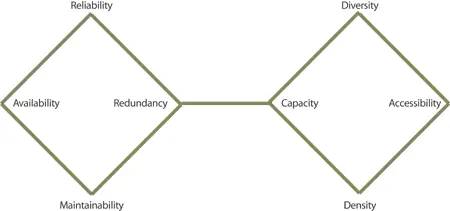
Figure 7.23 Interactions between factors of service availability
Reinforcing and balancing effects are set up according to the feedback principle between factors of availability . The control levers of access, reliability and maintainability , applied in combination, provide the desired level of service availability. Considerations of capacity , cost and risk s constrain each type of advantage.
8 Technology and strategy
Herbert A. Simon of Carnegie Mellon University won the 1978 Nobel Prize in economics for his work on decision-making processes within economic organizations. According to Simon’s concept of bounded rationality there are limits to the decision-making capabilities of human agents in formulating and solving complex problems and in processing information. Even the most dedicated, motivated and talented groups and individuals have limited capacity for dealing with the inherent complexity, uncertainty and conflicts or trade-offs in most socio-technical system s.
Services are socio-technical system s with service asset s as the operating elements. People and processes act as concentrators of other assets in social and technical subsystems respectively (Figure 8.1). The performance of one sub-system affects the performance of the other in positive and negative ways.
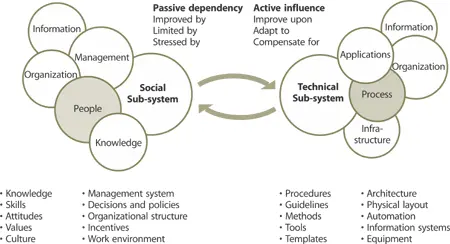
Figure 8.1 Services as socio-technical systems with people and processes as pivots
The interactions between the two subsystems are in the form of dependencies (passive) and influences (active) critical to the performance of service management as a value-creating system. The following are just a few examples of how each of these interactions matter.
Improvements in design and engineering of activities, tasks and interfaces can compensate for limitations of people.
Improvements in knowledge, skills, attitudes and experience can partly compensate for poorly designed or inadequate processes, application s and infrastructure.
Automation of routine processes can reduce variation, allow quick adjustments to process capacity, and relieve stress on service staff during peak demand and off-hours. In some countries, automation can reduce the cost of operations attributable to expensive human resources.
Читать дальшеИнтервал:
Закладка:
Обсуждение, отзывы о книге «SS» и просто собственные мнения читателей. Оставьте ваши комментарии, напишите, что Вы думаете о произведении, его смысле или главных героях. Укажите что конкретно понравилось, а что нет, и почему Вы так считаете.