SS
Здесь есть возможность читать онлайн «SS» весь текст электронной книги совершенно бесплатно (целиком полную версию без сокращений). В некоторых случаях можно слушать аудио, скачать через торрент в формате fb2 и присутствует краткое содержание. Жанр: Справочники, на английском языке. Описание произведения, (предисловие) а так же отзывы посетителей доступны на портале библиотеки ЛибКат.

- Название:SS
- Автор:
- Жанр:
- Год:неизвестен
- ISBN:нет данных
- Рейтинг книги:5 / 5. Голосов: 1
-
Избранное:Добавить в избранное
- Отзывы:
-
Ваша оценка:
SS: краткое содержание, описание и аннотация
Предлагаем к чтению аннотацию, описание, краткое содержание или предисловие (зависит от того, что написал сам автор книги «SS»). Если вы не нашли необходимую информацию о книге — напишите в комментариях, мы постараемся отыскать её.
SS — читать онлайн бесплатно полную книгу (весь текст) целиком
Ниже представлен текст книги, разбитый по страницам. Система сохранения места последней прочитанной страницы, позволяет с удобством читать онлайн бесплатно книгу «SS», без необходимости каждый раз заново искать на чём Вы остановились. Поставьте закладку, и сможете в любой момент перейти на страницу, на которой закончили чтение.
Интервал:
Закладка:
Service interfaces should be self-reliant, requiring little or no intervention from service agents other than the dialogue necessary to carry out the service transaction .
8.2.2 Types of service technology encounters
Advances in communication technologies are having a profound effect on the manner in which service provider s interact with customers. Airport kiosks, for example, have changed the interaction between airlines and their customers. There are four modes in which technology interacts with a service provider ’s customers (Figure 8.5).
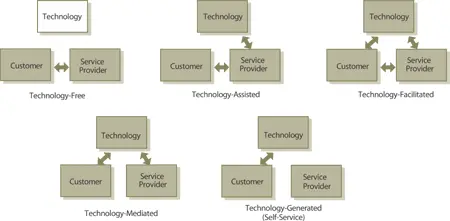
Figure 8.5 Types of service technology encounters35
Mode A: technology-free – technology is not involved in the service encounter. Consulting services, for example, may be Mode A.
Mode B: technology-assisted – a service encounter where only the service provider has access to the technology. For example, an airline representative who uses a terminal to check in passengers is Mode B.
Mode C: technology-facilitated – a service encounter where both the service provider and the customer have access to the same technology. For example, a planner in consultation with a customer can refer to ‘what if’ scenarios on a personal computer to illustrate capacity and availability modelling profiles.
Mode D: technology-mediated – a service encounter where the service provider and the customer are not in physical proximity. Communication may be through a phone. For example, a customer who receives technical support services from a Service desk is Mode D.
Mode E: technology-generated – a service encounter where the service provider is represented entirely by technology, commonly known as self-service. For example, bank ATMs, online banking and distance learning are Mode E.
Encounters should be designed while considering customer assets.
Are customer employees technical or non-technical?
What are the implications of the technology encounter to the customer?
What are the customer expectations and perceptions?
For example, Mode E may be less effective than Mode B or C in cases where the encounter is complex or ambiguous. When the encounter is routine and explicit, as in password resets, Mode E may be preferred. Other modes may have secondary considerations. Mode D, for example, may have language or time-zone implications.
8.2.3 Self-service channels
Automation is useful to supplement the capacity of services. Self-service channels are increasingly popular among user s now accustomed to human–computer interactions, devices and appliances. The ubiquitous channel of service delivery is the internet with browsers acting as service access points that are widely distributed, standardized and highly familiar through constant use. Advances in artificial intelligence and speech recognition have improved the capabilities of software-based service agents in conducting dialogue with customers. The richness of the dialogue and the complexity of the interaction continue to increase.
The capacity of self-service channels has very low marginal cost , is highly scalable, does not suffer from fatigue, offers highly consistent performance , and is offered on a 24/7 basis at a relatively low cost. Additionally, users perceive the following disadvantages with human-to-human interactions with respect to incident s and problems:
The emotional burden that the user is asked to carry in complaining about the service
Variability in the experience, competence and emotional state of human agents
Limited capacity of human resources, which causes uncertainty in wait times
The need to schedule certain interactions with staff
The fees associated with certain human resources.
Self-service channels are effective when appropriate knowledge and service logic is embedded into the self-service terminal. Service Design should ensure that Use Case analysis is performed to ensure usability , efficiency and ease in interactions through the automated interface.
Another example would be the use of the productive capacity of customers through self-service channels. Advances in human-computer interaction and the richness of interaction technologies, such as touch-screens, scanners and signature capture devices, allow for certain service activities to be completed without the presence or intervention of service staff.36 This is a very intelligent way to adjust capacity that is highly sensitive to the presence of demand. Each customer brings one additional unit of productive capacity, instantly added and removed from the system without inventory-carrying costs to the service provider .
It is necessary to evaluate the level of control user s are expected to assume with self-service options. The level of control should be commensurate with the proficiency and experience level of the users.12 In almost every population of users there are differences in levels of experience, skills, aptitudes and work environment s that determine preferences for methods and modes of interaction. The attributes and function s of service interfaces should take these differences into account. There will be trade-offs as different segments of users expect to be served according to their preferences. Some prefer step-by-step guidance while others prefer efficiency and flexibility. Advances in artificial intelligences and machine learning are creating a new level of sophistication for service interfaces, which are context-aware, forgiving of new users, and capable of dialogue embedded with inquiry. The principle of forgiveness requires that the design of a service helps users avoid error s. When the errors do occur, the design should minimize negative consequences.
8.2.4 Technology-mediated service recovery
According to the peak-end rule, whereby the service providers recover well from service incident s, customers may actually retain a more positive perception of service quality than they had before the incident. This behaviour provides justification for investment in superior service support systems, processes and staff. While the strategic intent may be to reduce the occurrence of service incidents, the tactical goal would be to recover well from service incidents that are not avoided or foreseen.
Under certain conditions, the use of automation allows for quicker service recovery through fast resolution of service incidents. User s often expect nothing more than quick resolution of their problems without tedious policies and procedure s. This provides a business case for simplifying, standardizing and automating certain service activities or interactions. However, when poorly designed or implemented, automated or self-service options can be especially aggravating for a user who may have suffered from a service incident. The challenge is to pick the right type of interface for a particular interaction.
Simple and routine incidents should be recovered using automation when all other factors are equal. Software-agents with diagnostic capabilities can interact with users to resolve basic technical problems. Online knowledge base s with search and navigation capabilities are useful examples of such recovery.
The approach is necessary knowledge from service management processes into automated solutions such as online technical support , self-service terminals, IVR units and software application s. User s are then presented with the self-service option as the first line of support to solve the most routine of problems. It also helps to raise the level of technical knowledge of users through well-designed documentation and self-help kits. Over time, this reduces the number of incidents that have to be handled by human resources (see example in Figure 8.4).
Читать дальшеИнтервал:
Закладка:
Обсуждение, отзывы о книге «SS» и просто собственные мнения читателей. Оставьте ваши комментарии, напишите, что Вы думаете о произведении, его смысле или главных героях. Укажите что конкретно понравилось, а что нет, и почему Вы так считаете.