SS
Здесь есть возможность читать онлайн «SS» весь текст электронной книги совершенно бесплатно (целиком полную версию без сокращений). В некоторых случаях можно слушать аудио, скачать через торрент в формате fb2 и присутствует краткое содержание. Жанр: Справочники, на английском языке. Описание произведения, (предисловие) а так же отзывы посетителей доступны на портале библиотеки ЛибКат.

- Название:SS
- Автор:
- Жанр:
- Год:неизвестен
- ISBN:нет данных
- Рейтинг книги:5 / 5. Голосов: 1
-
Избранное:Добавить в избранное
- Отзывы:
-
Ваша оценка:
SS: краткое содержание, описание и аннотация
Предлагаем к чтению аннотацию, описание, краткое содержание или предисловие (зависит от того, что написал сам автор книги «SS»). Если вы не нашли необходимую информацию о книге — напишите в комментариях, мы постараемся отыскать её.
SS — читать онлайн бесплатно полную книгу (весь текст) целиком
Ниже представлен текст книги, разбитый по страницам. Система сохранения места последней прочитанной страницы, позволяет с удобством читать онлайн бесплатно книгу «SS», без необходимости каждый раз заново искать на чём Вы остановились. Поставьте закладку, и сможете в любой момент перейти на страницу, на которой закончили чтение.
Интервал:
Закладка:
Example of leveraging intangibleasset s
The product installation and maintenance system of a major internet and telecom solutions provider generated £0.75 billion in savings (1996–98). The company made an extensive amount of technical knowledge about its solutions freely available online to its customers. Large amounts of workload were diverted away from its technical support staff and engineers, who could focus on tougher problems needing escalation . Most of the customers were themselves technical staff willing to attempt to fix problems on their own to the extent possible. This online knowledge base could be concurrently used by a large number of customers without degradation of quality or inordinate waiting times.
Baruch Lev37
The idea of making it convenient, quick and courteous for user s to report service incident s and receive compensation is an important principle that should shape policies and guideline s. Good service culture requires it to be easy and fair for customers to file a complaint and have problems resolved, without undue burden on their time, effort, or emotion, all of which are forms of indirect cost s and psychological costs of being a customer .38 The need for that becomes particularly important where the customer or users will not receive any financial compensation. At this level of maturity , the service provider has institutionalized the true meaning of providing warranty to the customer. Preventing simple failures from turning into negative feelings will help maintain higher levels of customer satisfaction. Such service providers also demonstrate to their customers certain ethics that contribute to long-term success in the relationship .
8.3 Tools for service strategy
8.3.1 Simulation
IT organizations often exhibit the counterintuitive behaviour resulting from many agents interacting over time. Long-term behaviour can be surprisingly different from short-term behaviour. System Dynamics is a methodology for understanding and managing the complex problems of IT organizations. It offers a means to capture and model the feedback processes, stocks and flows, time delays and other sources of complexity associated with IT organizations. It is a tool for evaluating the consequences of new policies and structures before putting them into action.
Just as an airline uses flight simulators to help pilots learn, System Dynamics offers simulation methods and tools available to help senior managers understand their organizations. These management flight simulators, based on mathematical model s and computer simulation, can deliver useful insights for decision makers faced with enormous complexity and policy resistance.
The application of System Dynamics in the service and process domains has yielded remarkable insight for IT organizations. Some examples follow.
The Capability Trap– By pressuring staff to work harder, an organization unwittingly triggers a scenario where ever-increasing levels of effort are required to maintain the same level of performance .39
The Tool Trap– Although technology tools offer very useful help to an organization, they often require the development of knowledge and experience. When an organization adopts new tools, it triggers lower productivity in the short term. The increase in workload from training, learning and practice activities may unwittingly push a resource -constrained organization over its tipping point.40
The Firefighter Trap– When an organization rewards managers for excellence in firefighting, they may unwittingly create a dynamic harming the long-term performance of the organization. The long-term performance is instead improved by not rewarding excellence in firefighting.40
8.3.2 Analytical models
Analytical model s are very useful where the complexity is manageable, and there is no policy resistance or interacting feedback loops. They are effective when objective s are clear, the options are well defined and the critical uncertainties are measurable. They are easy to develop when there is a fair amount of clarity on a problem or situation, the cause and effect relationships are clear and persistent, and patterns are recognizable patterns (Figures 3.6, 4.8, 4.9, 4.13, 8.2, 9.9). They also need enough historical information for assumptions on certain variables, such as costs, processing times and the load factors of resources.
Good examples of the use of analytical models are Service Desk and call centre staffing, which can be visualized as a system of queues. It is possible to gather data on the rate of arrival of requests (or incident s), how long it takes to process them on average, and how many requests are waiting to be handled. This level of knowledge is sufficient to build simple analytical models. Figure 8.6 shows an example for a single-stage, single-agent queue at a Service Desk, with certain assumptions about the arrival pattern of requests and the processing time.
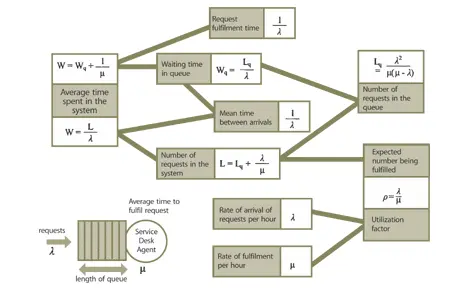
Figure 8.6 Example of simple analytical model for the Service Desk
Service Desk modelling can become quite complex with the addition of numbers of service channels, multi-stage processes, dependencies and delays. However, it is useful to start with basic models and progressively elaborate them to reflect closely the reality of a problem or situation.
The following are commonly used sets of tools useful for decision making in Service Strategy :
Decision trees, payoff matrices, analytic hierarchy process , etc.
Linear programming (Figure 8.7) and integer programming, goal programming, etc.
Queuing and network flow models (Figure 8.8)
Clustering, forecasting, time-series analysis, etc.
Analysis of variance , design of experiments, etc.
These methods can be applied to solve a variety of problems such as:
Allocation of resources between services and contract s
Analysis of demand patterns and segmentation of users
Compression, correlation and filtering (Table 8.2)
Scheduling of jobs, tasks and staff
Location and layout of facilities and infrastructure elements
Capital budgeting , pricing and purchase decisions
Portfolio optimization
Contingency planning and redundancy (coverage problems).
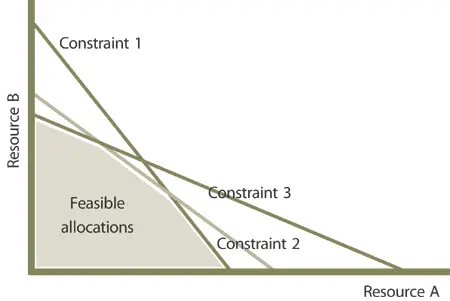
Figure 8.7 Simple LP model
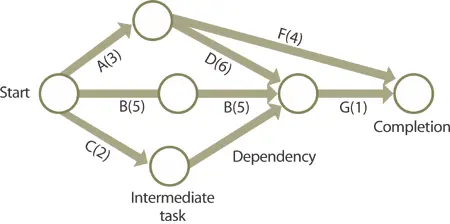
Figure 8.8 Simple network model
There is depth and diversity in analytical model s, some of which have been in use for decades and have been instrumental to the maturity of disciplines such as operations management , project management and financial analysis. Service sectors such as telecommunications, transportation, logistics and financial services have achieved high levels of performance from the application of systems and industrial engineering concepts, methodologies and quality control processes to service function s and processes.41
Читать дальшеИнтервал:
Закладка:
Обсуждение, отзывы о книге «SS» и просто собственные мнения читателей. Оставьте ваши комментарии, напишите, что Вы думаете о произведении, его смысле или главных героях. Укажите что конкретно понравилось, а что нет, и почему Вы так считаете.