SS
Здесь есть возможность читать онлайн «SS» весь текст электронной книги совершенно бесплатно (целиком полную версию без сокращений). В некоторых случаях можно слушать аудио, скачать через торрент в формате fb2 и присутствует краткое содержание. Жанр: Справочники, на английском языке. Описание произведения, (предисловие) а так же отзывы посетителей доступны на портале библиотеки ЛибКат.

- Название:SS
- Автор:
- Жанр:
- Год:неизвестен
- ISBN:нет данных
- Рейтинг книги:5 / 5. Голосов: 1
-
Избранное:Добавить в избранное
- Отзывы:
-
Ваша оценка:
SS: краткое содержание, описание и аннотация
Предлагаем к чтению аннотацию, описание, краткое содержание или предисловие (зависит от того, что написал сам автор книги «SS»). Если вы не нашли необходимую информацию о книге — напишите в комментариях, мы постараемся отыскать её.
SS — читать онлайн бесплатно полную книгу (весь текст) целиком
Ниже представлен текст книги, разбитый по страницам. Система сохранения места последней прочитанной страницы, позволяет с удобством читать онлайн бесплатно книгу «SS», без необходимости каждый раз заново искать на чём Вы остановились. Поставьте закладку, и сможете в любой момент перейти на страницу, на которой закончили чтение.
Интервал:
Закладка:
The prices are indicative of the value customers place on outcomes. Service providers can then coordinate control and deploy their assets to provide services that facilitate the outcomes at a cost less than or equal to the price customers are willing to pay. They have autonomy and control over the design , development and operation of the service as well as improvements necessary over time. They can optimize , reconfigure, standardize and engineer the internals of a service as necessary while maintaining the value delivered to the customer in specified terms. Any uncertainties in demand and delivery can be factored for either in the service level commitments, the prices, or both. This allows for management on both sides to manage by outcomes.
9.3 Preserving value
9.3.1 Deviations in performance
Mature customers care not only about the utility and warranty they receive for the price they are being charged. They also care about the total cost of utilization (TCU). The concept of TCU is based on the principle of transaction costs discussed earlier. Customers perceive not just the direct cost s of actual consumption but also all other related costs incurred indirectly in the process of receiving the committed utility and warranty.
For service provider s, creating value for customers is a highly visible objective. Capturing value for their own stakeholders is also important. In the case of Type I providers, these two sets of objectives may be closely aligned. They can easily diverge or be in conflict, especially with Type III providers.
Value created for customers is easily lost to hidden costs that the customer incurs from utilizing a service. Poor management of services over the lifecycle can result in customers paying much more than the price of the service when the effect of hidden costs sets in. The enduring value for customers turns out to be much lower than the value created. Eliminating hidden costs is a challenge, a critical success factor and a risk . There is a need to reduce the total losses in the system (Figure 9.1).
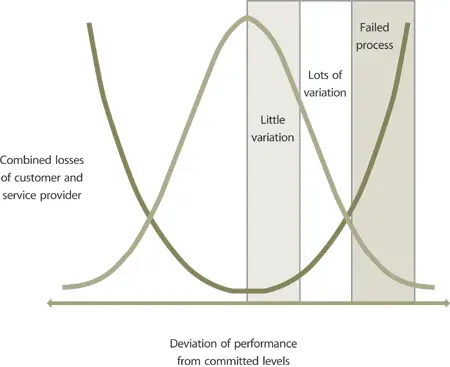
Figure 9.1 Combined losses from deviation of performance (Taguchi Loss Function)
9.3.2 Operational effectiveness and efficiency
Service s ought be a beneficial undertaking from both the customer and service provider perspectives. Value creation for the customer should result in value capture for the service provider. This mutual welfare is important for the economic viability of services. It avoids losses on both sides of the relationship in real terms. Otherwise, sooner or later there will be tension in the relationship and at least one of the parties will be wishing for alternatives.
It is not unusual to start with the idea of efficiency . The notion of value itself is commonly based on efficiency. There are several notions of efficiency. The one used here is the ratio or proportionality of specific output in relation to the necessary inputs in terms of resource s. Measures of efficiency depend on the type of input resource. For example, they could be based on minutes, full-time equivalents (FTE), square feet of space for facilities and equipment, gigabytes of storage, or simply financial equivalents of those units.
Efficiency goes to waste when output or outcome is not fit for purpose or fit for use. This is all too common in the case of services, because value is largely intangible. Therefore efficiency should have the guide rails of some desired effect. Effectiveness is the quality of being able to bring about a desired effect. In the context of services the two primary effects are utility and warranty (Figure 2.2).
Increasing the efficiency of a process can effectively increase remaining capacity to support additional units of demand. Increase in efficiency can result in more units of demand served from the same amount of a resource. Improvements in Service design and Service Operation can drive such efficiency gains. There is feedback and interaction between efficiency and effectiveness (Figure 9.2).
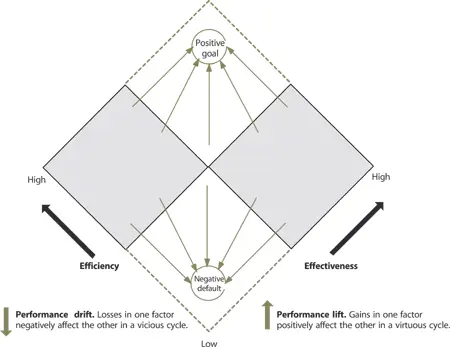
Figure 9.2 Efficiency and effectiveness
An increase in efficiency can lead to an increase in effectiveness , which in turn can result in a further increase in efficiency until some optimization limit is reached. A shortfall in effectiveness when addressed by allocating more resources to recover the situation results in a decrease in efficiency. Efficiency losses in turn can lead to lower effectiveness because of the lower potency of each unit of output. These interactions between efficiency and effectiveness result in drifts or lifts in performance .
9.3.3 Reducing hidden costs
One category of hidden costs is transaction costs. These include costs for the resources that service providers spend to determine customer needs, user preferences, quality criteria that underpin value, and pricing decisions. Cost s are also incurred when changes are made to services, service level agreement s and demand in a trial-and-error manner. Custom-built services and low volumes of demand mean that set-up and tooling costs for the services are all borne by the customer. Standardization, shared services and reuse, coupled with segmentation and differentiated service levels should drive down transaction costs of coordination by reducing such overheads. This way, the needs of user segments are efficiently served while optimizing the use of service provider resources for maximum gain.42 Well-defined service management processes, measurement systems, automation and communication, should drive down the transaction costs related to coordination through hierarchies. Indeed the very purpose of service governance is to drive down transaction costs. Low transaction costs are an inducement for customers to buy services instead of owning and operating non-core assets to produce the same effect on their business outcomes.
9.3.4 Substantiating hidden benefits
Customer s find value in leasing assets such as application s and infrastructure rather than owning them. Part of that value comes in the form of the reduced lock-in that would otherwise exist due to high switching costs. Switching costs are high when the investment in the capital asset s is high, when a major proportion of the assets come from the same vendor, and when the depreciation of the assets is slower. Faced with high switching costs, customers are often discouraged from purchasing assets. One way of reducing lock-in is to rent or lease the assets rather than buying them. Service s provide an attractive alternative to asset purchases. They offer customers the utility of an asset without the related lock-in. That represents value to the customer. Another way to reduce lock-in is to contract out the maintenance and repair operations (MRO) of the assets to a third party provided a similar or better level of service is available. MRO services define a distinct category of services.
However, services by themselves can be a source of lock-in for customers. This is characterized by the disruption of learning curves of user s and other people assets of the customer . It is also characterized by the changes required to processes, applications and infrastructure when switching to a new service provider . Customers value standardization in technologies, processes and industry practices to increase network externalities. Standardization helps increase the possibilities of multiple connections within a value network . When service management processes are standardized across a particular industry, then greater efficiency and flexibility can be realized from consolidation, disaggregation, and flexible configuration of business process es, infrastructure components and human resources. The risk of lock-in is reduced when it is easier to switch service providers within a value network. It also reduces operational risk to the customer’s business from service provider failure s. Internal service provider s can be just as risky for customers as their commercial counterparts.
Читать дальшеИнтервал:
Закладка:
Обсуждение, отзывы о книге «SS» и просто собственные мнения читателей. Оставьте ваши комментарии, напишите, что Вы думаете о произведении, его смысле или главных героях. Укажите что конкретно понравилось, а что нет, и почему Вы так считаете.